
Items related to The Reins of Power: Racial Change and Challenge in...
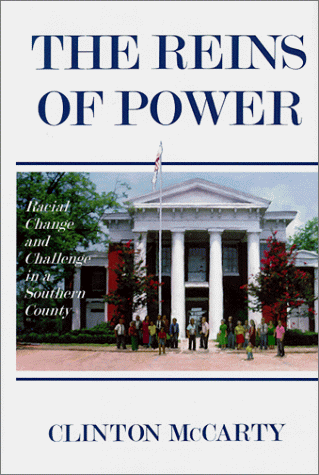
Synopsis
Wilcox County, Alabama, is a fascinating repository of Southern history. with its conflicting images of romanticism and repression. After recounting the county's early history to set the stage for what was to come, Clinton McCarty, a journalist whose own roots are in Wilcox, moves into the 1960s and beyond, detailing the county's extended school desegregation battle and its painful transition from white to black political control. He then takes a closer look at how blacks have done in their stewardship and consider's Wilcox's prospects in the new millennium.
"synopsis" may belong to another edition of this title.
About the Author
Clinton McCarty, a native Alabamian, has worked as a journalist in Montgomery, Washington, New York, Frankfurt, London, and Zurich. He has been a magazine editor, a producer-writer for CBS News, and a Cabinet-level speechwriter. He retired in 1991 from the editorial board of The Orlando Sentinel and now lives in Mobile.
From the Back Cover
"This is a powerful and honest book about 20th century race relations in a Black Belt county of Alabama. Well written and informative, it will have a broad appeal to scholars and general readers in the South and nation." (William Warren Rogers, Distinguished Teaching Professor of History Emeritus, Florida State University, and author of The One-Gallused Rebellion: Agrarianism in Alabama, 1865-1896)
"From white supremacy, slavery, and racial apartheid to black political triumph and racial division, Clinton McCarty traces the history of Wilcox County, Alabama, with skill and sensitivity. His insights into the personalities of the participants make this an important book on the evolution of race relations in the Deep South." (Harvey Jackson, Chairman, History Department, Jacksonville State University and author of Rivers of History, Life on the Coosa, Tallapoosa, and Alabama)
"What we have here is a remarkable look at the impact the civil rights revolution has had in predominantly black Wilcox County, most especially the shift of political power from white to black. Clinton McCarty leaves one encouraged at how far blacks and whites have come...but discouraged in that the book confirms the truism that power tends to corrupt no matter the color of one's skin." (Bob Ingram, political columnist, television news analyst, and author of That's the Way I Saw It)
"Few recent works of local history have so frankly and unflinchingly held up a mirror to a county and demanded that the population take an honest look at themselves. The result is a wonderful local history and a timely warning about what the future of many Alabama counties will be like unless courageous leaders on both ends of the racial divide insist on a better way." (Wayne Flynt, Distinguished University Professor, Auburn University, and author of Poor but Proud: Alabama's Poor Whites)
Excerpt. © Reprinted by permission. All rights reserved.
Whatever the racial transformations of the last few decades, an antebellum aura survives to a remarkable degree in rural and isolated Wilcox County, in southwestern Alabama, and in its seat of government, Camden. On State Road 41, near the meandering Alabama River, the next town to the north is Selma, burned into the national consciousness by civil rights confrontations of the mid-1960s. The next to the south is Monroeville, boyhood haunt of Truman Capote and locale of Harper Lee's To Kill a Mockingbird. Between Selma and Monroeville lies a seventy-five-mile time warp, with Camden at its core. It is also a Gone With the Wind sequel in which the third-stage plantation country South is still painfully evolving. The isolation and limited physical change have combined to make Wilcox as much a laboratory as an anachronism. Since the late 1940s, the county has been the subject of sociological studies and other books, television news and feature segments broadcast nationally and abroad, and articles published in the old Look, The National Geographic, The Reader's Digest, The Los Angeles Times, and The New York Times, among other publications. A British television documentary producer, asked why he had chosen Wilcox to contrast African-American life in the South and in Chicago, replied that the county had rather chosen itself. Word of its rare characteristics spreads. Even movie director Spike Lee, whose great-grandfather established an educational institute for the African-American children of eastern Wilcox in 1893, felt drawn to the county for the centennial observance of the now defunct institute's founding. Yet no one has painted a complete portrait of Wilcox in an effort to lend more substance to its magnetism. Nor has anyone, to my knowledge, chosen a Deep South county of predominantly African-American population and closely examined its transition from white to black power. I have attempted to fill both these voids, selecting Wilcox as a metaphor not only because it is the ideal choice but also because it is of special interest to me. Both my parents were from there. My mother's grandfather moved to the area's Indian-infested wilderness several years before Alabama became a state. My father's much younger grandfather, a refugee from Ireland's potato famine, arrived in the late 1840s. I spent most of each summer with relatives in the county until I was fifteen years old. The sleepy, segregated Wilcox of the 1930s (and the second-stage South) is indelible in my memory. Yet, excepting a few hours for my paternal grandfather's funeral in 1944 and my father's in 1945, the county had been out of my life for nearly half a century when I made my first return visit in 1988. I had not even driven down for a look in the racially explosive year of 1965, when I spent a week in Selma as a member of a CBS News production team from New York. The 1988 visit was occasioned mostly by genealogical curiosity long after the last of my Wilcox kinsmen had died or emigrated. The visit revived a dormant affection and unleashed irresistible questions. I learned that blacks, who still outnumbered whites two to one (the ratio had once been four to one), had taken over most county offices between 1978 and 1984, gaining control of the County Commission and Board of Education in 1982. As a slight minority within the city limits, they had no voice on the City Council when I first went back, but they were challenging the citywide voting system in the federal courts. The consequent black advance had transformed the old order to an extent that would astonish the county's departed generations. It could even foster disbelief among the living who had not been on the scene from this modern revolution's inception. I would be startled later on, in this deepest recess of the Deep South, to hear white supplicants at a County Commission meeting say "sir" to the black chairman, and to hear the chairman berate a white in front of a biracial crowd. That first visit whetted my appetite for the details of the extended and no doubt tumultuous transition. I also wondered what problems had arisen from the historic change, how well both whites and blacks had adjusted to the new realities, how blacks were doing as governmental managers, and what leaders of both races thought of the county's long-range prospects. I resolved to seek the answers to these questions when I had the time.
This book is the result. A review of Wilcox history from the earliest days through the 1950s should lead to a more thorough understanding of what transpired thereafter. Summaries of state and national events at several points are intended to lend perspective to the county's evolution. Chapters on the extended confrontations over school desegregation, voter registration, employment opportunities, public services, and political power trace those dramatic and often traumatic changes of the 1960s, 1970s, and calmer 1980s. A final chapter finds qualified hope for strengthened interracial accommodation, after electoral crises in the mid-1990s, and speculates on an uncertain economic future.
"About this title" may belong to another edition of this title.
Search results for The Reins of Power: Racial Change and Challenge in...

Stock Image
THE REINS OF POWER; RACIAL CHANGE AND CHALLENGE IN A SOUTHERN COUNTY. [Wilcox County, Alabama.]
Published by
Tallahassee, FL: Sentry Press, 1999., 1999
ISBN 10: 1889574066
ISBN 13: 9781889574066
Used
Hardcover
First Edition
Signed
Seller: David Hallinan, Bookseller, Columbus, MS, U.S.A.
Seller rating 4 out of 5 stars

None (illustrator). Presumed first edition (no direct statement provided) INSCRIBED AND SIGNED BY THE AUTHOR WITH AUTHOR'S TYPED LETTER SIGNED ALSO LAID-IN. xvi, 374 pages. Hardcover: H 23.5cm x L 15.75cm. Dust jacket lightly rubbed with some bumping at edges; front flap is price-clipped. Navy blue cloth with vibrant gilt stamping to spine. Author's four-line ink inscription to a college fraternity brother familiarly signed "Clint" upon half-title page. Author's folded TLS laid-in at front endpapers; letter is single one-sided sheet stapled to two photocopies of their college yearbook fraternity pages. Interior pages are otherwise bright and clean. Binding is firm. A fine copy in a very good+ dust jacket. With Introduction, Epilogue, Acknowledgments, Bibliography, Source Notes, and Index. ISBN 1889574066. Seller Inventory # Z626X-7416
Stock Image
The Reins of Power: Racial Change and Challenge in a Southern County
Seller: ThriftBooks-Atlanta, AUSTELL, GA, U.S.A.
Seller rating 5 out of 5 stars

Hardcover. Condition: Good. No Jacket. None (illustrator). Former library book; Pages can have notes/highlighting. Spine may show signs of wear. ~ ThriftBooks: Read More, Spend Less. Seller Inventory # G1889574066I3N10
Stock Image
The Reins of Power: Racial Change and Challenge in a Southern County
Seller: ThriftBooks-Dallas, Dallas, TX, U.S.A.
Seller rating 5 out of 5 stars
Hardcover. Condition: Good. No Jacket. None (illustrator). Pages can have notes/highlighting. Spine may show signs of wear. ~ ThriftBooks: Read More, Spend Less. Seller Inventory # G1889574066I3N00
Stock Image
The Reins of Power: Racial Change and Challenge in a Southern County
Seller: ThriftBooks-Atlanta, AUSTELL, GA, U.S.A.
Seller rating 5 out of 5 stars
Hardcover. Condition: Very Good. No Jacket. None (illustrator). May have limited writing in cover pages. Pages are unmarked. ~ ThriftBooks: Read More, Spend Less. Seller Inventory # G1889574066I4N00
Stock Image
The Reins of Power: Racial Change and Challenge in a Southern County
Seller: The Book Spot, North Branch, MN, U.S.A.
Seller rating 4 out of 5 stars
Hardcover. Condition: New. None (illustrator). Seller Inventory # Abebooks467013