Tale of the Western Plains (Lost Classics Book Company) - Softcover
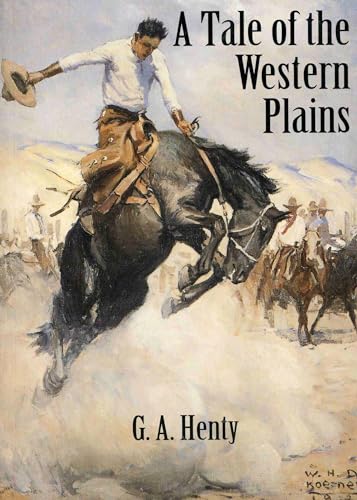
Henty, G. A.

  • 3.77 out of 5 stars
    145 ratings by Goodreads
 
9781890623005: Tale of the Western Plains (Lost Classics Book Company)

Synopsis

Henty has crafted a rousing adventure story drawing on real cowboy stories. "In treating cowboy life," he tells us," indeed, it may well be said that truth is stranger than fiction." The result: an exciting story that transports children back to the early days of the Wild West.

"synopsis" may belong to another edition of this title.

About the Author

Writing in World Magazine, George Grant reminisced about the childhood pleasure of reading George Alfred Henty's books.

"Whenever I ran across [a Henty book] in our local library I quickly checked it out, rushed home, and read itusually without putting it down."

George Alfred Henty wrote his first boys' adventure, Out of the Pampas, in 1868. Its popularity spurred him to write some eighty more children's books. Drawing on his own experiences fighting in the Crimean War and as a foreign correspondent in Europe and Africa, Henty fashioned stories for children that combined realism and what he called a "manly tone." His novels encompass an array of times and places from the early days of Egypt to the mines of the California Gold Rush.

George Alfred Henty was born in Trumpington, England, on December 8, 1832. He studied at Cambridge, but left without his degree to volunteer for service in the Crimean War. After several failed attempts at careers, he decided in 1865 to become a writer, beginning as a correspondent for The Standard. He also wrote adult novels, but turned to children's stories after contributing with success to Union Jack magazine. In his World article George Grant calls Mr. Henty "a Victorian literary phenomenon whose 144 books and myriad short stories have long enthralled adults and children alike. His fiercely accurate narratives range across the whole spectrum of human achievement, highlighting the greatest characters and the most decisive moments in history."

Mr. Henty died on November 16, 1902, leaving a literary legacy that Lost Classics Book Company is proud to help revive.

From the Back Cover

G. A Henty is a Victorian literary phenomenon whose 144 books and myriad short stories have long enthralled adults and children alike.George Grant

G. A Hentys specialty was combining history and fiction for children. In A Tale of the Western Plains the nineteenth century author crafts an exciting adventure story drawing on real life cowboy stories. In treating cowboy life, Henty tells us, indeed, it may well be said that truth is stranger than fiction. The result: a cant-put-it-down story that transports children back to the early days of the Wild West--

"Five hundred dollars reward. The above sum will be paid by James Campbell, attorney, San Fransisco, to any one who will give him information as to the whereabouts of William Tunstall, who was last heard of four years ago in California."

"A simple ad in a Sacramento paper. A simple ad that changes Bill Tunstalls life and the life of his young nephew, Hugh."

From California during the Gold Rush to the English countryside and its landed gentry and back to Americas vast land of cowboys and Indians, Hentys riproaring story follows Hugh Tunstalls exploits from England to the American West. Hughs exploits in America start in Texas where the lawlessness of the West rears its ugly head. Working on a cattle ranch . . . fighting Indians . . . chasing kidnappers all play a part in Hughs escapades in the West.

Valuable Bonus for Homeschoolers. Includes a Build-Your-Vocabulary Glossary of some 430 words and definitions. Each word is cross-referenced with its page number so children can easily go back and see how it is used in the story.

Excerpt. © Reprinted by permission. All rights reserved.

Several cowboys rode off as they entered, and in a quarter of an hour a mob of horses was seen approaching, the men riding behind cracking their whips and yelling at the top of their voices. The gates were opened, and a couple of minutes later the horses rushed in. There were some forty or fifty of them, and of these about two-thirds were branded. In the first place, the others were speedily roped both by the head and hind legs. Four cowboys hung on to the ropes while another approached with a heated brand and applied it to the animals hind quarters, the horses kicking and struggling wildly. As soon as the operation, which lasted but a second or two, was completed the ropes were loosed, and the frightened animals rejoined their companions, who were huddled in a corner of the enclosure.

Now, each man of No. 1 and No. 2 outfit take one of the horses, the manager said.

Hugh and Bill had the night before been told that they were to form part of No. 2 outfit. Like the others they had their ropes in their hands, and had brought their saddles inside the enclosure. Hugh picked out a horse that struck him as being a good one, and threw his lasso round its neck. One of the cowboys belonging to the other outfit, who was standing by, said, That is a pretty bad horse, mate. I would take a quieter one if I were you.

I have got to learn to sit them, Hugh replied; so I may as well begin with a bad one as a good one.

All right, the other said, taking hold of the rope, and helping Hugh haul upon it. The animal resisted violently, but the pressure of the rope half-choked him, and he was forced to leave the group and come up to them. I will hold him, Hughs assistant said. Get your saddle and bridle.

There was some difficulty in putting these on, for the animal kicked, plunged, and reared furiously, and it was only when another cowboy threw a rope and, catching one of its hind legs, pulled it out stiffly behind, that Hugh succeeded in saddling it. Now, up you go! the man said. Gathering up the reins Hugh sprang into the saddle, and the two men, as soon as they saw him seated, slipped off the ropes. For a moment the horse stood perfectly still. Keep his head up, one of the men shouted; but before Hugh could draw in the reins the horse dropped its head to its knees. Then it seemed to Hugh that it doubled itself up, and before he knew what had happened he felt himself flying through the air, and came down to the ground with a crash. There was a shout of laughter from the cowboys, but two or three of them helped Hugh, who for a moment was almost stunned, to his feet.

That is bucking, I suppose, he said as soon as he could get breath.

Thats bucking, sure enough, one of those who had helped him said.

Well, I will try again in a minute, Hugh said.

Take it quietly, the man said good naturedly. You fell pretty heavy, and you are shaken up a bit. Youd better hitch him on to the fence, and look about you for a few minutes before you try again.

Hugh thought the advice good, and after fastening up the horse stood watching the man they called the broncho-breaker, who was fighting one of the most vicious of the last years horses. Had he not seen it, Hugh would not have believed it possible that a horse could go through such performances. He had ridden many vicious brutes at home, and had thought that he knew something of horses, but this was a new experience for him. In the rearing, kicking, and plunging there was nothing novel, and as the horses were much smaller than the English hunters to which he had been accustomed he felt that if this had been all, he should have no difficulty in keeping his seat, but the bucking was new to him. To perform it, it was necessary that the horse should be able to get its head down. The moment this was done it sprang straight into the air, at the same moment rounding its back, and this with such a sharp, sudden jerk that it fairly threw the rider into the air.

On coming down, the animal kept its legs stiff, so that the jerk to the rider was scarcely less than that of the upward spring, and before he had time to settle himself in the slightest, the horse repeated the performance, varying it occasionally by springing sideways, backwards, or forwards. The breaker, or as they were generally called the broncho-buster, kept his figure perfectly upright, with a tremendous grip upon the saddle with his thighs, but depending, as Hugh could see, rather upon balance than upon his hold. The exertion was evidently great. The mans hat had been jerked off, the perspiration stood upon his bronzed forehead. From time to time he dug his spurs into the animals flanks, and excited it to continue its desperate efforts, until at last the horse was utterly exhausted and stood with its head drooping unable to make another effort. There was a shout of applause from the cowboys looking on.

Bully for you, Jake! He is a brute, that is, and no mistake.

I will give him a turn every day for a week, Jake said. He is worth taking trouble with. I will take him for a gallop tomorrow.

Do they buck when they are galloping? Hugh asked the cowboy next to him.

The latter nodded. Not when they are going at their best pace. They havent time to do it then, but when they are going at hand gallop they will do it. They wait until you are off your guard, and then up they go in the air and come down perhaps three yards sideways, and its fifty to one against your being on their back when they do come down.

I see how it is done now, though I dont see how I can do it, Hugh said. But I will try again.

The horse was led out, and Hugh again mounted. This time he was prepared for what was to come, but in spite of the grip with his legs the blow lifted him far above the saddle. It seemed to him that the next buck came before he had fairly descended, for it struck him with the force and suddenness of an electric shock. Again and again he was thrown up, until he felt his balance going, and the next jump threw him fairly over the horses head, but as he was prepared for the fall it was much less heavy than the first time.

Well done! Well done! several of the cowboys said as he rose to his feet. You will do, you will, and make a good rider before long. That will do for today; I would not try any more.

I am going to try it until I can sit him, Hugh said. I have got to do it, and I may as well go on now before I get stiff.

The broncho-breaker came up to him as, after waiting a minute or two to get his breath, he again prepared to mount.

Dont keep your back so stiff, young fellow. Just let your back go as if there was no bones in it. I have known a mans spine broke before now by a bucker. Sit easy and lissom. Keep your head, that is the principal thing. It aint easy when you are being pitched up and down like a ball, but it all turns upon that. Let your legs close on him tight each time you come down, if only for a moment, that saves you from being thrown clean away from him.

Hugh sprang on to the horse, and the struggle again began. It ended like the last, but Hugh had kept his seat somewhat longer than before. Again and again he tried, each time with more success. The fifth time he felt that the horses action was less sudden and violent, and that it was becoming fatigued with its tremendous exertions. Now, you brute, he muttered, it is my turn; and he dug his spurs into the horse. A spring more violent than any he had yet felt followed the application, and for a minute or two he was almost bewildered by the force and rapidity of the animals springs; but he was now confident that he was gaining the mastery, and the moment he found that its efforts were decreasing, he again applied the spurs. The response was less vigorous than before, and in five minutes the animal stood exhausted and subdued. A cheer broke from the cowboys who were standing round looking on at the struggle.

Well done, young fellow! You are the toughest tenderfoot I have ever seen, one of them said, shaking him by the hand. I dont believe there are ten men in the camp who would have sat that horse as you have, and you say that it is the very first time you have been on a bucker.

I have beaten him, Hugh said, but he has pretty well beaten me. You must help me off my saddle, for I feel as if my back was broken, and that I could not lift my leg over the saddle if my life depended on it.

Two cowboys lifted him from his seat. That is a hard tussle, mate, the broncho-breaker said, coming up to him, and you have stuck to it well. You are clear grit, you are. The best thing you can do is to walk about for the next hour; just keep yourself moving, then go and wrap yourself up in two or three blankets and lie down in your bunk for a bit, have a thorough good sweat, and then strip and rub yourself down. Get your mate to rub your back well, and then dress and move about. The great thing is not to get stiff; but you will feel it for a day or two.

Hugh followed the advice, but he found it hard work to do so. He was bruised all over with his falls; he scarce seemed able to put one leg before another, and at every movement a sharp pain shot through the loins, and he felt as if his spine had been dislocated. Still, for an hour he walked about, and at the end of that time felt that his movements were more easy; then he went to the hut, wrapped himself in Bills blankets and his own, and presently dozed off to sleep. A couple of hours later he woke and saw Bill standing beside him.

Now, Hugh, you had better turn out and let me give you a rub. Just take off that shirt. I have got a lump of hogs grease here.

Hugh got out of the bunk with some difficulty and took off his shirt. Now, you lean your hands on that bunk and arch your back; thats it. Now here goes.

For a good half hour Bill worked at his back, kneading it with his knuckles down both sides of the spine and across the loins. Now, you will do, he said at last. Put on a dry shirt and come out.

Hugh strolled down to the stockyard. He felt wonderfully better after the rubbing, and was able to walk with far greater ease than before. The scene in the yard was unchanged. Fresh groups of horses had been driven in as fast as the others had been saddled and mounted, and by nightfall each of the cowboys had been provided with three horses. Hugh was greatly amused at the scene, for the spills were numerous, and the shouting and laughter incessant. The next day the work of breaking in the bronchos commenced. One after another they were roped and dragged out of the drove. The bridle was slipped on, and they were then blindfolded while the saddle was put on and fastened. Then Jake mounted. The cloth was drawn off the animals head, and the struggle commenced. The horses tried every means to unseat their rider, but in vain. Some submitted after comparatively short struggles. Others fought long and desperately. As soon as the first victory was won bars were let down, and the horse was taken for a long gallop across the country, returning home subdued and trembling. Then the process was repeated with a fresh animal.

How long does he take to break them? Hugh asked a cowboy.

Three days generally; sometimes he will ride them four or five times, but three is generally enough. Then they are handed over to us to finish.

It must take a lot out of them, Hugh said. It would be better to do it more gradually. You see they are scared nearly to death before they are begun with.

He cannot afford the time, the man said. He gets two dollars a horse for breaking them. He will be here for a fortnight, and in that time he will do pretty well a hundred. Then he will go off somewhere else.

It must be tremendous work for him, Hugh said.

It is that, you bet. A broncho-buster seldom lasts above two years. They get shaken all to pieces and clean broke up by the end of that time.

As fast as the horses were broken in they were handed over to the cowboys, and Hugh, who had been unable to do any work for two days, then began to break in the lot that were to be his particular property. But he was fond of horses, and could not bring himself to use such violent measures as those which he saw adopted by his companions. The first lesson they taught them was to stand still the moment a rope fell over their necks. The animal was led up to the stump of a tree and then loosed; it at once went off at full speed, but as it did so its owner threw the noose of his rope over its head, and then gave the other end a turn round the stump. The shock was tremendous, the horses being frequently jerked right over on to their backs.

Two or three experiences of this sort was sufficient, and the animal thenceforth learned to stand, not only when a rope was thrown round its neck, but even when the reins were dropped upon it, so that when its master dismounted it remained perfectly quiet until he again mounted and took the reins in his hand, even if he was absent a considerable time. As the teams were to start in a few days on the round-up, Hugh felt that it would be useless for him to attempt to break the horses in by English methods, and he was therefore obliged to adopt those in use by his companions. He mollified them, however, to some extent by getting another rope and tying it to his own. He then took only half a turn round the stump, and let the rope run out, at first fast, but checking it gradually until its pressure upon the neck brought the animal half suffocated to a stop.

It took him longer to accomplish his object, but he found that by the end of a week the seven horses had all learned their lessons; each having been ridden for an hour every day. He had had several severe battles with the animal he had first mounted, which was by far the most vicious of them; but the struggle each day had become less severe, as the horse recognized the futility of endeavoring to unseat its master. Hugh had many falls during the schooling, but he was upon the whole well-satisfied with the result.

Several of the cowboys had advised him to use the methods they adopted for securing them in their seats upon specially vicious horses. One of these methods was the fastening of a loop of leather to the high pommel. Holding this in the hand, it was well-nigh impossible to be bucked from the saddle, but there was the disadvantage that if the strap broke, nothing could save a rider from a fall far more violent and heavy than that which came from being pitched from the saddle in the ordinary way. Another method was to fasten a strap passed under the horses belly tightly below each knee; but this, although it held the riders in their saddles, had the serious disadvantage, that in the event of the horse rearing and falling back, or of its falling headlong from putting its foot in a hole, the rider could not free himself, and was almost certain to be crushed under the horse. Others, again, fastened themselves by bringing their feet together, and crossing their spurs, under the horses belly, a safer measure than the last, but objectionable inasmuch as the spurs when the animal bucked struck him in the belly, and so increased the violence of his action.

Of course, the best riders refrained from using any of these methods, trusting only to their leg grip and to balance; and Hugh determined to ride in this way, even if it did cost him a few more falls. He was on excellent terms with the rest of the cowboys. The tenderfoot, as a newcomer is called, is always the subject of endless pranks and annoyances if he evinces the least timidity or nervousness; but if, on the other hand, he shows that he has pluck, determination to succeed, and good temper, he is treated with kindness and cordiality. Hughs exhibition, therefore, of courage and horsemanship on the occasion of his first attempt at once won their liking and admiration, and all were ready to lend him a hand when necessary, and to give him hints and advice, and he was free from any of the annoyances to which new hands are often exposed. There were several other tenderfeet among the party. Two or three of these got on fairly and soon ceased to be butts; but the rest, before a week was up, found the work altogether too trying, and one after another went off in search of some less dangerous occupation.

"About this title" may belong to another edition of this title.

Other Popular Editions of the Same Title