
Items related to Leonardo’s Incessant Last Supper (Zone Books)
Synopsis
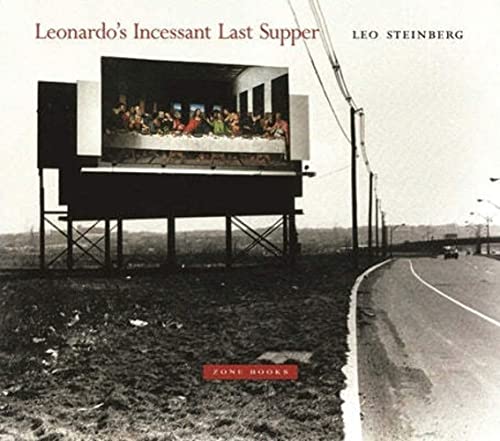
A picture universally recognized, endlessly scrutinized and described, incessantly copied, adapted, lampooned: does Leonardo’s near-ruined Last Supper still offer anything new to be seen or to be said? This book is a resounding Yes to both questions. With direct perception ― and with attention paid to the work of earlier scholars and to the criticism embodied in the production of copyists over the past five hundred years ― Steinberg demonstrates that Leonardo’s mural has been consistently oversimplified.
This most thought-out picture in Western art, painted in the 1490s on the north wall of the refectory of Santa Maria delle Grazie, Milan, is a marvel of compressed meanings. Its subject is not one arrested moment, but successiveness and duration. It is not only Christ’s announcement of the forthcoming betrayal, but in equal measure the institution of the Eucharist. More than the spur of the moment animates the disciples, and more than perspective determines their housing.
Though Leonardo’s geometry obeys all the rules, it responds as well to Christ’s action at center, as if in emanation from the prime mover. The picture is simultaneously narrative and sacramental. As its protagonist is two-natured ― as the twofold event of this night is both human submission and divine dispensation ― so the entire picture is shown to have been conceived as double: a sublime pun.
Meanwhile, the unending disagreement as to what exactly is represented, what the depicted actions express, how and where this assembly is seated ― all these still raging disputes are traced to a single mistaken assumption: that Leonardo intended throughout to be “unambiguous and clear,” and that any one meaning necessarily rules out every other.
As Steinberg reveals an abundance of significant interrelations previously overlooked, Leonardo’s masterpiece retains the freshness of its initial conception and the power to fascinate.
"synopsis" may belong to another edition of this title.
About the Author
Art historian Leo Steinberg is Benjamin Franklin Professor Emeritus at the University of Pennsylvania. His books include Other Criteria: Confrontations with Twentieth-Century Art, Michelangelo's Last Paintings, The Sexuality of Christ in Renaissance Art and in Modern Oblivion, and Encounters with Rauschenberg.
Reviews
Original to the point of provocation, veteran art historian Steinberg (The Sexuality of Christ in Renaissance Art), a professor emeritus at the University of Pennsylvania, has long been a legendary figure in his field. This fascinating new study is as much about the idea of Leonardo's famous Last Supper in Milan as the actual, ruined painting itself. Most critics have seen Leonardo as wishing to freeze a single moment in time, but Steinberg asserts convincingly that the table scene portrays "successiveness and duration." He makes lively contemporary parallels, from a magazine cartoon of The Last Supper, with Jesus telling a waiter, "Separate checks," much to the astonishment of the disciples, to the ballet Agon by George Balanchine and Igor Stravinsky, which, like The Last Supper, also contains infinite groupings that add up to 12 protagonists. In chapters like "Seven Functions of the Hands of Christ," Steinberg adds multiple layers of complexity to the work, shown repeatedly in 201 b&w illustrations and a four-color gatefold insert. There are intriguing aphorisms sure to lead anyone who cares about art to much pondering, like calling The Last Supper "probably the only great painting that earns praise for being symmetrical." Among numerous lengthy appendixes is a particularly useful one on later copies of Leonardo's masterwork. After reading this delightfully stimulating excursus, art lovers everywhere will still regret the painting's ravagement by time, but an intellectual achievement of this order is a real consolation. (Sept. 1)Forecast: The more The Last Supper deteriorates, the more interest it seems to generate. Most casual and serious readers of art history will find the combination of Steinberg and Leonardo hard to resist, and academic collections will not want to be without it. This will be a big book in the field this season, and the painting's fame should lead to some generalist reviews.
Copyright 2001 Cahners Business Information, Inc.
Like many masterpieces, "The Last Supper" has been so long enshrined that the specificities of its greatness can be hard to perceive. This exhaustive consideration (updated and expanded from a well-known 1973 essay) locates the work's genius in its capacity to express simultaneously the secular and the mystical, collapsing the psychological drama of Christ's betrayal and the inauguration of the Eucharist into a single moment. Recapitulating the painting's reception through history, Steinberg's close reading of its individual elements, formal aspects, and setting is an exemplary piece of criticism, illuminating da Vinci's intentions and his achievement in much the same way that recent restorations have helped us see "the most thought-out picture in the history of art" afresh.
Copyright © 2005 The New Yorker
Another Da Vinci icon familiar to most of the world is, of course, La Gioconda, or The Mona Lisa. Sassoon (history, Univ. of London) has written an accessible work, more historical than analytical, that is essentially a biography of the painting itself. Nearly every fact one could ever hope to know about The Mona Lisa is traced, and the travails of the painting provide more than enough action and drama for any reader. Sassoon's knowledge of the minutiae of history and his respect for the image drive the narrative, which ranges from the painting's intriguing beginnings through the abuse of the image by the modern advertising industry. The Mona Lisa has traveled the world and smiled her way into the minds of many generations, and the author rightly points out her effect on the popularization of serious art in general. Thoroughly researched and highly readable, this is recommended for all libraries.
- Douglas McClemont, New York
Copyright 2001 Reed Business Information, Inc.
"About this title" may belong to another edition of this title.
Search results for Leonardo’s Incessant Last Supper (Zone Books)

Stock Image
Leonardo's Incessant Last Supper
Seller: World of Books (was SecondSale), Montgomery, IL, U.S.A.
Seller rating 5 out of 5 stars

Hardback. Condition: Good. A fresh look at the multiplicity of meanings in Leonardo's Last Supper.A picture universally recognized, endlessly scrutinized and described, incessantly copied, adapted, lampooned: does Leonardo's near-ruined Last Supper still offer anything new to be seen or to be said? This book is a resounding Yes to both questions. With direct perception---and with attention paid to the work of earlier scholars and to the criticism embodied in the production of copyists over the past five hundred years--Leo Steinberg demonstrates that Leonardo's mural has been consistently oversimplified. This most thought-out picture in Western art, painted in the 1490s on the north wall of the refectory of Santa Maria delle Grazie, Milan, is a marvel of compressed meanings. Its subject is not one arrested moment, but successiveness and duration. It is not only Christ's announcement of the forthcoming betrayal, but in equal measure the institution of the Eucharist. More than the spur of the moment animates the disciples, and more than perspective determines their housing. Though Leonardo's geometry obeys all rules, it responds as well to Christ's action at center, as if in emanation from the prime mover. The picture is simultaneously narrative and sacramental. As its protagonist is two-natured, as the twofold event of this night is both human submission and divine dispensation---so the entire picture is shown to have been conceived in duplexity: a sublime pun. Meanwhile, the unending disagreement as to what exactly is represented, what the depicted actions express, how and where this assembly is seated---all these still-raging disputes are traced to a single mistaken assumption: that Leonardo intended throughout to be unambiguous and clear, and that any one meaning necessarily rules out every other. As Steinberg reveals an abundance of significant interrelations previously overlooked, Leonardo's masterpiece regains the freshness of its initial conception and the power to fascinate. Seller Inventory # 00106597054
Stock Image
Leonardo's Incessant Last Supper
Seller: World of Books Inc, Montgomery, IL, U.S.A.
Seller rating 4 out of 5 stars

Hardback. Condition: Good. A fresh look at the multiplicity of meanings in Leonardo's Last Supper.A picture universally recognized, endlessly scrutinized and described, incessantly copied, adapted, lampooned: does Leonardo's near-ruined Last Supper still offer anything new to be seen or to be said? This book is a resounding Yes to both questions. With direct perception---and with attention paid to the work of earlier scholars and to the criticism embodied in the production of copyists over the past five hundred years--Leo Steinberg demonstrates that Leonardo's mural has been consistently oversimplified. This most thought-out picture in Western art, painted in the 1490s on the north wall of the refectory of Santa Maria delle Grazie, Milan, is a marvel of compressed meanings. Its subject is not one arrested moment, but successiveness and duration. It is not only Christ's announcement of the forthcoming betrayal, but in equal measure the institution of the Eucharist. More than the spur of the moment animates the disciples, and more than perspective determines their housing. Though Leonardo's geometry obeys all rules, it responds as well to Christ's action at center, as if in emanation from the prime mover. The picture is simultaneously narrative and sacramental. As its protagonist is two-natured, as the twofold event of this night is both human submission and divine dispensation---so the entire picture is shown to have been conceived in duplexity: a sublime pun. Meanwhile, the unending disagreement as to what exactly is represented, what the depicted actions express, how and where this assembly is seated---all these still-raging disputes are traced to a single mistaken assumption: that Leonardo intended throughout to be unambiguous and clear, and that any one meaning necessarily rules out every other. As Steinberg reveals an abundance of significant interrelations previously overlooked, Leonardo's masterpiece regains the freshness of its initial conception and the power to fascinate. Seller Inventory # CIN1890951188G
Seller Image
Leonardoâs Incessant Last Supper (Zone Books)
Seller: Dream Books Co., Denver, CO, U.S.A.
Seller rating 5 out of 5 stars
Condition: acceptable. This copy has clearly been enjoyedâ"expect noticeable shelf wear and some minor creases to the cover. Binding is strong, and all pages are legible. May contain previous library markings or stamps. Seller Inventory # DBV.1890951188.A
Seller Image
Leonardoâs Incessant Last Supper (Zone Books)
Seller: -OnTimeBooks-, Phoenix, AZ, U.S.A.
Seller rating 5 out of 5 stars
Condition: good. A copy that has been read, remains in good condition. All pages are intact, and the cover is intact. The spine and cover show signs of wear. Pages can include notes and highlighting and show signs of wear, and the copy can include "From the library of" labels or previous owner inscriptions. 100% GUARANTEE! Shipped with delivery confirmation, if you're not satisfied with purchase please return item! Ships via media mail. Seller Inventory # OTV.1890951188.G
Stock Image
Leonardo's Incessant Last Supper
Seller: ThriftBooks-Dallas, Dallas, TX, U.S.A.
Seller rating 5 out of 5 stars
Hardcover. Condition: Fair. No Jacket. Missing dust jacket; Readable copy. Pages may have considerable notes/highlighting. ~ ThriftBooks: Read More, Spend Less. Seller Inventory # G1890951188I5N01
Stock Image
Leonardo's Incessant Last Supper
Seller: ThriftBooks-Dallas, Dallas, TX, U.S.A.
Seller rating 5 out of 5 stars
Hardcover. Condition: Fair. No Jacket. Readable copy. Pages may have considerable notes/highlighting. ~ ThriftBooks: Read More, Spend Less. Seller Inventory # G1890951188I5N00
Stock Image
Leonardo's Incessant Last Supper
Seller: ThriftBooks-Dallas, Dallas, TX, U.S.A.
Seller rating 5 out of 5 stars
Hardcover. Condition: Good. No Jacket. Missing dust jacket; Pages can have notes/highlighting. Spine may show signs of wear. ~ ThriftBooks: Read More, Spend Less. Seller Inventory # G1890951188I3N01
Stock Image
Leonardo's Incessant Last Supper
Seller: Better World Books, Mishawaka, IN, U.S.A.
Seller rating 5 out of 5 stars
Condition: Good. Former library copy. Pages intact with minimal writing/highlighting. The binding may be loose and creased. Dust jackets/supplements are not included. Includes library markings. Stock photo provided. Product includes identifying sticker. Better World Books: Buy Books. Do Good. Seller Inventory # 3961363-6
Stock Image
Leonardoâs Incessant Last Supper (Zone Books)
Seller: BooksRun, Philadelphia, PA, U.S.A.
Seller rating 5 out of 5 stars
Hardcover. Condition: Very Good. With dust jacket. It's a well-cared-for item that has seen limited use. The item may show minor signs of wear. All the text is legible, with all pages included. It may have slight markings and/or highlighting. Seller Inventory # 1890951188-11-1-29
Stock Image
Leonardoâs Incessant Last Supper (Zone Books)
Seller: BooksRun, Philadelphia, PA, U.S.A.
Seller rating 5 out of 5 stars
Hardcover. Condition: Fair. With dust jacket. The item might be beaten up but readable. May contain markings or highlighting, as well as stains, bent corners, or any other major defect, but the text is not obscured in any way. Seller Inventory # 1890951188-7-1-29