
Items related to When the War Was Over: Cambodia and the Khmer Rouge...
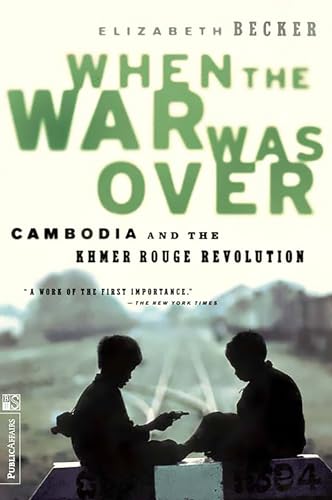
Synopsis
The "definitive" (Los Angeles Times), award-winning history of Cambodia and Pol Pot's rise to power, tracing the country's modern origins to the human rights abuses that reshaped it forever
Award-winning journalist Elizabeth Becker started covering Cambodia in 1973 for The Washington Post, when the country was perceived as little more than a footnote to the Vietnam War. Then, with the rise of the Khmer Rouge in 1975 came the closing of the border and a systematic reorganization of Cambodian society. Everyone was sent from the towns and cities to the countryside, where they were forced to labor endlessly in the fields. The intelligentsia were brutally exterminated, and torture, terror, and death became routine. Ultimately, almost two million people—nearly a quarter of the population—were killed in what was one of this century's worst crimes against humanity.
When the War Was Over is Elizabeth Becker's masterful account of the Cambodian nightmare. Encompassing the era of French colonialism and the revival of Cambodian nationalism; 1950s Paris, where Khmer Rouge leader Pol Pot received his political education; the killing fields of Cambodia; government chambers in Washington, Paris, Moscow, Beijing, Hanoi, and Phnom Penh; and the death of Pol Pot in 1998; this is a book of epic vision and staggering power. Merging original historical research with the many voices of those who lived through the times and exclusive interviews with every Cambodian leader of the past quarter century, When the War Was Over illuminates the darkness of Cambodia with the intensity of a bolt of lightning.
"synopsis" may belong to another edition of this title.
About the Author
Elizabeth Becker is an award-winning journalist and author who began her career as a war correspondent for the Washington Post in Cambodia. The French movie Meeting with Pol Pot is based on her life. She is the author of four books, including You Don't Belong Here and Overbooked. She lives in Washington, D.C.
Excerpt. © Reprinted by permission. All rights reserved.
From Chapter 11: I cleared the table and was asleep by 11:00 p.m. My bags were packed and waiting near the door of my room on the first floor. When I awoke a few hours later my thoughts were confused. Why were dogs knocking over the garbage cans outside my apartment? But I was not in Washington. I was in Phnom Penh and it was the middle of the night. The crashing noise couldn't be garbage cans. I hadn't seen one in the city, had I? I jumped out of bed and heard another sound that made my stomach drop. The sound was familiar but it wasn't a garbage can; it was gunfire, and near enough for me to smell cordite as I pulled on my jeans and went out the dining room.
I heard a moan. I opened the door from my bedroom and stepped out just as a young man barged in form the back door. We met in the dining room and stared at each other. He looked strange to me: his clothes seemed different, he was wearing a hat shaped like a baseball cap, he was Khmer, and, my God, he had two belts of ammunition strapped across his chest, an automatic rifle slung over one shoulder, and a pistol in his hand, and he was pointing the pistol at me. I thought he looked more frightened that I felt, and I felt as if my body would burst from fear.
I yelled, "No, don't shoot." I ran into my bedroom, shutting the door but forgetting to lock it. I kept running, into the adjoining bathroom, and jumped into the bathtub. I lay stomach-down inside the tub. I wasn't thinking, I was moving by instinct, and some part of me remembered advice during the war years when I was told that the tub was a porcelain fortress and the best protection any house offered from stray bullets.
The young man didn't follow me.
The tub was under the stairwell, and I could hear the young assailant tear up the stairs, his arms and ammunition jingling. The lights were out, and it was black. I heard the shots. I couldn't count them. Maybe half a dozen, maybe more. Then the sound of feet running down the stairs and then silence. For one and a half hours.
I stopped thinking of Cambodia; I would go mad. I thought of other places, other people; for some sixty minutes I escaped in my mind. I could not imagine what was happening.
There was an enormous thudding sound. Then the crash. Glass, broken and splintered, heavy footsteps in the front living room. Clomping up the stairs, a heavy object carried down, then up the stairs. Then footsteps in my bedroom. The steps came close to the bathroom door. I watched the knob turn-it was Mit La, someone I knew, one of our aides who spoke no foreign language. I was still on my knees. He looked at me quickly, a gaze to see if I had been hurt, and he turned away. I asked in my pigeon Khmer about the American man and the English man, about Dudman and Caldwell. "Fine, fine," he said. I grabbed his arm and asked him to stay. He turned on the lights and told me not to move. And then he left. I was alone with the whir of the air conditioner and no idea what was happening.
I could have gone to the bedroom, but I stayed crouched in the bathroom. Were the people rising up? Would I be considered one of the enemy? Had the Vietnamese attacked? Finally I remembered what I had been fearing all along, that I was trapped in the country during the invasion. No, that didn't make sense. Unless they thought we were... no, we were Caucasians, we couldn't be mistaken for Khmer Rouge officials. I had to stop thinking again. And wait again. After forty-five minutes I heard a familiar voice. Prasith, with his mandarin manners, was knocking at my bedroom door, calling me. I came out trembling, asking about the others.
Dudman was fine. Caldwell was dead. Shot dead.
Nothing else in the city, only Malcolm Caldwell had been murdered, no uprising, no coup d'etat, no Vietnamese invasion.
They brought Dick Dudman downstairs so I could see him and then asked the two of us to go upstairs and witness the assassination. There was Malcolm, lying on the floor in his pajamas, blood on his chest, his long auburn hair wild around his face. His eyes were closed. And at the threshold of his room was another body, a young man clothed in black who looked like the boy who had pointed his pistol at me. What was he doing there, dead, sprawled across the floor?
And where had Prasith and the guards been all this while? No answers. Please, gather your things and leave immediately, Prasith said. A young girl was waiting in my room, and we threw some papers I had left out into a suitcase.
"About this title" may belong to another edition of this title.
Search results for When the War Was Over: Cambodia and the Khmer Rouge...

Seller Image
When the War Was Over: Cambodia and the Khmer Rouge Revolution, Revised Edition
Seller: -OnTimeBooks-, Phoenix, AZ, U.S.A.
Seller rating 5 out of 5 stars

Condition: good. A copy that has been read, remains in good condition. All pages are intact, and the cover is intact. The spine and cover show signs of wear. Pages can include notes and highlighting and show signs of wear, and the copy can include "From the library of" labels or previous owner inscriptions. 100% GUARANTEE! Shipped with delivery confirmation, if you're not satisfied with purchase please return item! Ships via media mail. Seller Inventory # OTV.1891620002.G
Seller Image
When the War Was Over: Cambodia and the Khmer Rouge Revolution, Revised Edition
Seller: Greenworld Books, Arlington, TX, U.S.A.
Seller rating 5 out of 5 stars
Condition: good. Fast Free Shipping â" Good condition. It may show normal signs of use, such as light writing, highlighting, or library markings, but all pages are intact and the book is fully readable. A solid, complete copy that's ready to enjoy. Seller Inventory # GWV.1891620002.G
Stock Image
When The War Was Over: Cambodia And The Khmer Rouge Revolution, Revised Edition
Seller: HPB-Emerald, Dallas, TX, U.S.A.
Seller rating 5 out of 5 stars
Paperback. Condition: Very Good. Connecting readers with great books since 1972! Used books may not include companion materials, and may have some shelf wear or limited writing. We ship orders daily and Customer Service is our top priority! Seller Inventory # S_469555069
Stock Image
When The War Was Over: Cambodia And The Khmer Rouge Revolution, Revised Edition
Seller: HPB-Ruby, Dallas, TX, U.S.A.
Seller rating 5 out of 5 stars
Paperback. Condition: Very Good. Connecting readers with great books since 1972! Used books may not include companion materials, and may have some shelf wear or limited writing. We ship orders daily and Customer Service is our top priority! Seller Inventory # S_472643736
Stock Image
When The War Was Over (Revised Edition): Cambodia And The Khmer Rouge Revolution, Revised Edition
Seller: World of Books (was SecondSale), Montgomery, IL, U.S.A.
Seller rating 5 out of 5 stars
Paperback. Condition: Good. award-winning journalist Elizabeth Becker started covering Cambodia in 1973 for The Washington Post , when the country was perceived as little more than a footnote to the Vietnam War. Then, with the rise of the Khmer Rouge in 1975 came the closing of the border and a systematic reorganization of Cambodian society. Everyone was sent from the towns and cities to the countryside, where they were forced to labour endlessly in the fields. The intelligentsia were brutally exterminated, and torture, terror, and death became routine. Ultimately, almost two million people,nearly a quarter of the population,were killed in what was one of this century's worst crimes against humanity. When the War Was Over is Elizabeth Becker's masterful account of the Cambodian nightmare. Encompassing the era of French colonialism and the revival of Cambodian nationalism 1950s Paris, where Khmer Rouge leader Pol Pot received his political education the killing fields of Cambodia government chambers in Washington, Paris, Moscow, Beijing, Hanoi, and Phnom Penh and the death of Pol Pot in 1998 this is a book of epic vision and staggering power. Merging original historical research with the many voices of those who lived through the times and exclusive interviews with every Cambodian leader of the past quarter century, When the War Was Over illuminates the darkness of Cambodia with the intensity of a bolt of lightning. Seller Inventory # 00109427159
Stock Image
When The War Was Over (Revised Edition): Cambodia And The Khmer Rouge Revolution, Revised Edition
Seller: World of Books (was SecondSale), Montgomery, IL, U.S.A.
Seller rating 5 out of 5 stars
Paperback. Condition: Very Good. award-winning journalist Elizabeth Becker started covering Cambodia in 1973 for The Washington Post , when the country was perceived as little more than a footnote to the Vietnam War. Then, with the rise of the Khmer Rouge in 1975 came the closing of the border and a systematic reorganization of Cambodian society. Everyone was sent from the towns and cities to the countryside, where they were forced to labour endlessly in the fields. The intelligentsia were brutally exterminated, and torture, terror, and death became routine. Ultimately, almost two million people,nearly a quarter of the population,were killed in what was one of this century's worst crimes against humanity. When the War Was Over is Elizabeth Becker's masterful account of the Cambodian nightmare. Encompassing the era of French colonialism and the revival of Cambodian nationalism 1950s Paris, where Khmer Rouge leader Pol Pot received his political education the killing fields of Cambodia government chambers in Washington, Paris, Moscow, Beijing, Hanoi, and Phnom Penh and the death of Pol Pot in 1998 this is a book of epic vision and staggering power. Merging original historical research with the many voices of those who lived through the times and exclusive interviews with every Cambodian leader of the past quarter century, When the War Was Over illuminates the darkness of Cambodia with the intensity of a bolt of lightning. Seller Inventory # 00109108247
Stock Image
When The War Was Over: Cambodia And The Khmer Rouge Revolution, Revised Edition
Seller: Half Price Books Inc., Dallas, TX, U.S.A.
Seller rating 5 out of 5 stars
Paperback. Condition: Very Good. Connecting readers with great books since 1972! Used books may not include companion materials, and may have some shelf wear or limited writing. We ship orders daily and Customer Service is our top priority! Seller Inventory # S_483496198
Stock Image
When the War Was Over: Cambodia and the Khmer Rouge Revolution, Revised Edition
Seller: Bookoutlet1, Easley, SC, U.S.A.
Seller rating 5 out of 5 stars
Condition: Very Good. Great shape! Has a publisher remainder mark. paperback Used - Very Good 1998. Seller Inventory # IM-10174136
Seller Image
When the War Was Over: Cambodia and the Khmer Rouge Revolution, Revised Edition
Seller: Zoom Books East, Glendale Heights, IL, U.S.A.
Seller rating 5 out of 5 stars
Condition: very_good. Book is in very good condition and may include minimal underlining highlighting. The book can also include "From the library of" labels. May not contain miscellaneous items toys, dvds, etc. . We offer 100% money back guarantee and 24 7 customer service. Seller Inventory # ZEV.1891620002.VG
Seller Image
When the War Was Over: Cambodia and the Khmer Rouge Revolution, Revised Edition
Seller: Zoom Books East, Glendale Heights, IL, U.S.A.
Seller rating 5 out of 5 stars
Condition: good. Book is in good condition and may include underlining highlighting and minimal wear. The book can also include "From the library of" labels. May not contain miscellaneous items toys, dvds, etc. . We offer 100% money back guarantee and 24 7 customer service. Seller Inventory # ZEV.1891620002.G