
Items related to Nonviolent Communication: A Language of Life: Life-Changing...
Nonviolent Communication: A Language of Life: Life-Changing Tools for Healthy Relationships (Nonviolent Communication Guides) - Softcover
Book 13 of 17: Nonviolent Communication Guides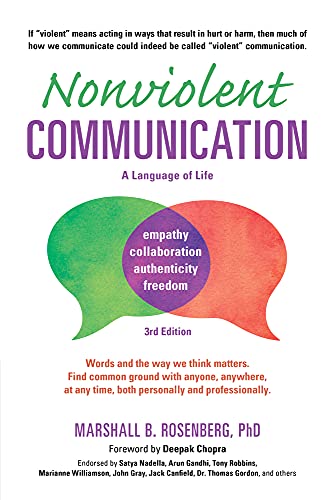
Synopsis
8,000,000 COPIES SOLD WORLDWIDE • TRANSLATED INTO MORE THAN 40 LANGUAGES
Most of us were never taught what to say when a conversation gets hard.
A disagreement with your partner that keeps circling back. A tense meeting at work. A teenager who has stopped telling you anything. In moments like these, most of us fall back on the same patterns ― defending, blaming, going quiet ― and the relationship pays the price.
In this classic guide, Marshall B. Rosenberg, Ph.D., shows there is another way. Nonviolent Communication is a practical approach to effective communication that helps you express yourself honestly, listen with empathy, strengthen your relationships, and approach conflict with understanding.
What is Nonviolent Communication?
Many of our most familiar communication habits ― judging, blaming, criticizing, going on the defensive, reacting in anger, deciding who is ""right"" or ""wrong"" ― create hurt and distance. Nonviolent Communication offers a different approach, built on awareness, honest expression, empathy, and understanding.
Nonviolent Communication is the integration of four things:
• Consciousness: a set of principles that support living a life of compassion, collaboration, courage, and authenticity
• Language: understanding how words contribute to connection or distance
• Communication: knowing how to ask for what we want, how to practice active listening, how to hear others even in disagreement, and how to move toward solutions that work for all
• Means of influence: sharing "power with others" rather than using "power over others"
Nonviolent Communication serves our desire to do three things:
• Increase our ability to live with choice, meaning, and connection
• Connect empathically with self and others to have more satisfying relationships
• Sharing of resources so everyone is able to benefit
This is a practical framework, not a theory. Rather than handing you scripts, it helps you recognize what is happening beneath the words and respond with greater understanding.
What you will learn:
• How to handle difficult conversations without escalating into argument or shutting down
• Conflict resolution skills you can use at home, at work, and in your community
• How to listen so people feel heard ― and how to hear the need behind someone's anger or criticism
• How to say what matters to you clearly and honestly, without blame, judgment, or demand
• How to respond to hostility and defensiveness with empathy, for others and for yourself
• How to build healthier relationships with partners, children, parents, colleagues, and friends
At work as well as at home:
Whether you are leading a team at work or working through a disagreement with a family member, the ability to hear what matters to someone else and say clearly what matters to you changes the conversation. These are professional communication skills as much as personal ones, and they apply across workplace discussions, team relationships, and the conversations most people would rather avoid.
Who this book is for:
This is for you if you want stronger interpersonal skills and healthier relationships. Couples and families working through recurring conflict. Managers, teachers, healthcare workers, mediators, and anyone whose work depends on being understood. Whether you want better communication, stronger relationships, or practical tools for conflict resolution, this book offers a framework you can apply at home, at work, and in everyday life.
Marshall Rosenberg developed the Nonviolent Communication process over four decades of work in more than sixty countries, from schools and prisons to workplaces and regions torn by war. This is the book that started it all, and it remains standard reading for organizations, counselors, and communities around the world.
Nonviolent Communication: A Language of Life offers practical tools for expressing yourself honestly, listening with empathy, and creating greater understanding in the conversations that matter most.
"synopsis" may belong to another edition of this title.
About the Author
Marshall B. Rosenberg, PhD (1934–2015) founded and was for many years the Director of Educational Services for the Center for Nonviolent Communication, an international peacemaking organization. During his life he authored fifteen books, including the bestselling Nonviolent Communication: A Language of Life (PuddleDancer Press), which has sold more than one million copies worldwide and has been translated into more than 30 languages, with more translations in the works.
Dr. Rosenberg has received a number of awards for his Nonviolent Communication work including:
2014: Champion of Forgiveness Award from the Worldwide Forgiveness Alliance
2006: Bridge of Peace Nonviolence Award from the Global Village Foundation
2005: Light of God Expressing in Society Award from the Association of Unity Churches
2004: Religious Science International Golden Works Award
2004: International Peace Prayer Day Man of Peace Award by the Healthy, Happy Holy (3HO) Organization
2002: Princess Anne of England and Chief of Police Restorative Justice Appreciation Award
2000: International Listening Association Listener of the Year Award
Dr. Rosenberg first used the NVC process in federally funded school integration projects to provide mediation and communication skills training during the 1960s. The Center for Nonviolent Communication, which he founded in 1984, now has hundreds of certified NVC trainers and supporters teaching NVC in more than sixty countries around the globe. A sought-after presenter, peacemaker and visionary leader, Dr. Rosenberg led NVC workshops and international intensive trainings for tens of thousands of people in over 60 countries across the world and provided training and initiated peace programs in many war-torn areas including Nigeria, Sierra Leone, and the Middle East.
He worked tirelessly with educators, managers, health care providers, lawyers, military officers, prisoners, police and prison officials, government officials, and individual families. With guitar and puppets in hand and a spiritual energy that filled a room, Marshall showed us how to create a more peaceful and satisfying world.
Excerpt. © Reprinted by permission. All rights reserved.
Nonviolent Communication
A Language of Life
By Marshall B. Rosenberg, Lucy LeuPuddleDancer Press
Copyright © 2015 PuddleDancer Press
All rights reserved.
ISBN: 978-1-892005-28-1All rights reserved.
Contents
Foreword by Deepak Chopra, MD,
Acknowledgments,
1 Giving From the Heart,
2 Communication That Blocks Compassion,
3 Observing Without Evaluating,
4 Identifying and Expressing Feelings,
5 Taking Responsibility for Our Feelings,
6 Requesting That Which Would Enrich Life,
7 Receiving Empathically,
8 The Power of Empathy,
9 Connecting Compassionately With Ourselves,
10 Expressing Anger Fully,
11 Conflict Resolution and Mediation,
12 The Protective Use of Force,
13 Liberating Ourselves and Counseling Others,
14 Expressing Appreciation in Nonviolent Communication,
Epilogue,
Bibliography,
Index,
The Four-Part Nonviolent Communication Process,
Some Basic Feelings and Needs We All Have,
About Nonviolent Communication,
About PuddleDancer Press,
About the Center for Nonviolent Communication,
Trade Books From PuddleDancer Press,
Trade Booklets From PuddleDancer Press,
About the Author,
CHAPTER 1
Giving From the Heart
The Heart of Nonviolent Communication
What I want in my life is compassion, a flow between myself and others based on a mutual giving from the heart.
— Marshall B. Rosenberg, PhD
Introduction
Believing that it is our nature to enjoy giving and receiving in a compassionate manner, I have been preoccupied most of my life with two questions: What happens to disconnect us from our compassionate nature, leading us to behave violently and exploitatively? And conversely, what allows some people to stay connected to their compassionate nature under even the most trying circumstances?
My preoccupation with these questions began in childhood, around the summer of 1943, when our family moved to Detroit, Michigan. The second week after we arrived, a race war erupted over an incident at a public park. More than forty people were killed in the next few days. Our neighborhood was situated in the center of the violence, and we spent three days locked in the house.
When the race riot ended and school began, I discovered that a name could be as dangerous as any skin color. When the teacher called my name during attendance, two boys glared at me and hissed, "Are you a kike?" I had never heard the word before and didn't know some people used it in a derogatory way to refer to Jews. After school, the same two boys were waiting for me: they threw me to the ground and kicked and beat me.
Since that summer in 1943, I have been examining the two questions I mentioned. What empowers us, for example, to stay connected to our compassionate nature even under the worst circumstances? I am thinking of people like Etty Hillesum, who remained compassionate even while subjected to the grotesque conditions of a German concentration camp. As she wrote in her journal at the time,
I am not easily frightened. Not because I am brave but because I know that I am dealing with human beings, and that I must try as hard as I can to understand everything that anyone ever does. And that was the real import of this morning: not that a disgruntled young Gestapo officer yelled at me, but that I felt no indignation, rather a real compassion, and would have liked to ask, 'Did you have a very unhappy childhood, has your girlfriend let you down?' Yes, he looked harassed and driven, sullen and weak. I should have liked to
"About this title" may belong to another edition of this title.
Search results for Nonviolent Communication: A Language of Life: Life-Changing...

Seller Image
Nonviolent Communication: A Language of Life: Life-Changing Tools for Healthy Relationships (Nonviolent Communication Guides)
Seller: Dream Books Co., Denver, CO, U.S.A.
Seller rating 5 out of 5 stars

Condition: acceptable. This copy has clearly been enjoyedâ"expect noticeable shelf wear and some minor creases to the cover. Binding is strong, and all pages are legible. May contain previous library markings or stamps. Seller Inventory # 4EKGLF0088R1_ns
Stock Image
Nonviolent Communication: A Language of Life: Life-Changing Tools for Healthy Relationships (Nonviolent Communication Guides)
Seller: HPB-Red, Dallas, TX, U.S.A.
Seller rating 5 out of 5 stars
Paperback. Condition: Acceptable. Connecting readers with great books since 1972. Used textbooks may not include companion materials such as access codes, etc. May have condition issues including wear and notes/highlighting. We ship orders daily and Customer Service is our top priority! Seller Inventory # S_461746757
Stock Image
Nonviolent Communication: A Language of Life: Life-Changing Tools for Healthy Relationships (Nonviolent Communication Guides)
Seller: HPB-Red, Dallas, TX, U.S.A.
Seller rating 5 out of 5 stars
Paperback. Condition: Good. Connecting readers with great books since 1972! Used textbooks may not include companion materials such as access codes, etc. May have some wear or writing/highlighting. We ship orders daily and Customer Service is our top priority! Seller Inventory # S_462189061
Seller Image
Nonviolent Communication: A Language of Life: Life-Changing Tools for Healthy Relationships (Nonviolent Communication Guides)
Seller: Goodwill Books, Hillsboro, OR, U.S.A.
Seller rating 5 out of 5 stars
Condition: good. Signs of wear and consistent use. Seller Inventory # GICWV.189200528X.G
Seller Image
Nonviolent Communication: A Language of Life: Life-Changing Tools for Healthy Relationships (Nonviolent Communication Guides)
Seller: Goodwill Books, Hillsboro, OR, U.S.A.
Seller rating 5 out of 5 stars
Condition: acceptable. Fairly worn, but readable and intact. If applicable: Dust jacket, disc or access code may not be included. Seller Inventory # 3IIK3O005JU1_ns
Stock Image
Nonviolent Communication: A Language of Life, 3rd Edition: Life-Changing Tools for Healthy Relationships (Nonviolent Communication Guides)
Seller: Half Price Books Inc., Dallas, TX, U.S.A.
Seller rating 5 out of 5 stars
Paperback. Condition: Very Good. Connecting readers with great books since 1972! Used books may not include companion materials, and may have some shelf wear or limited writing. We ship orders daily and Customer Service is our top priority! Seller Inventory # S_481459193
Stock Image
Nonviolent Communication: A Language of Life: Life-Changing Tools for Healthy Relationships (Nonviolent Communication Guides)
Seller: St Vincent de Paul of Lane County, Eugene, OR, U.S.A.
Seller rating 5 out of 5 stars
Condition: Good. paperback 100% of proceeds go to charity! Good condition with all pages in tact. Item shows signs of use and may have cosmetic defects. Seller Inventory # T-02-5232
Stock Image
Nonviolent Communication: A Language of Life: Life-Changing Tools for Healthy Relationships
Seller: ThriftBooks-Reno, Reno, NV, U.S.A.
Seller rating 5 out of 5 stars
Paperback. Condition: Very Good. No Jacket. May have limited writing in cover pages. Pages are unmarked. ~ ThriftBooks: Read More, Spend Less. Seller Inventory # G189200528XI4N00
Stock Image
Nonviolent Communication: A Language of Life: Life-Changing Tools for Healthy Relationships
Seller: ThriftBooks-Atlanta, AUSTELL, GA, U.S.A.
Seller rating 5 out of 5 stars
Paperback. Condition: Fair. No Jacket. Readable copy. Pages may have considerable notes/highlighting. ~ ThriftBooks: Read More, Spend Less. Seller Inventory # G189200528XI5N00
Stock Image
Nonviolent Communication: A Language of Life: Life-Changing Tools for Healthy Relationships
Seller: ThriftBooks-Dallas, Dallas, TX, U.S.A.
Seller rating 5 out of 5 stars
Paperback. Condition: Good. No Jacket. Former library book; Pages can have notes/highlighting. Spine may show signs of wear. ~ ThriftBooks: Read More, Spend Less. Seller Inventory # G189200528XI3N10