
Items related to Copernicus' Secret: How the Scientific Revolution...
Synopsis
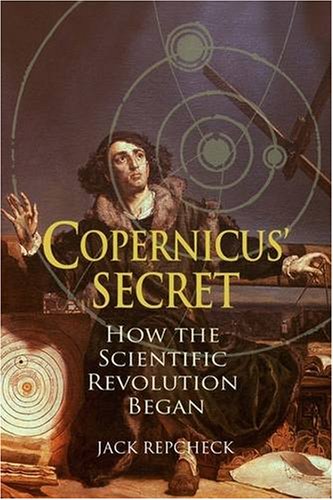
Nicolaus Copernicus gave the world perhaps the most important scientific insight of modern era: the theory that the earth and the other planets revolve around the sun. He was also the first to proclaim that the earth rotates on its axis once every 24 hours. He was a true radical of this time. Despite being a genius of the early Renaissance, he was also a flawed and conflicted person. A cleric who lived during the tumultuous years of the early Reformation, he may have been sympathetic to the teachings of the Lutherans. Although he had taken a vow of celibacy, he kept at least one mistress. He hid his astronomical work, revealing it to only a few intimates, and the manuscript that contained his revolutionary theory that he refined for over 20 years, remained 'hidden among my things'. His work was discovered and brought to light by a young mathematics professor who heard his ideas and journeyed hundreds of miles and risked personal danger to meet with Copernicus. Copernicus' Secret recreates the life and world of the scientific genius whose work revolutionised astronomy and altered our understanding of our place in the world, forever. Revealing a surprising, little known story behind the dawn of the scientific age, his story is compelling and remarkable. Jack Repcheck is an editor at WW Norton & Co, where he publishes the work of leading scientists and economists. His previous book was the critically acclaimed The Man Who Found Time: James Hutton and the Discovery of the Earth's Antiquity.
"synopsis" may belong to another edition of this title.
About the Author
Jack Repcheck is an editor at W. W. Norton & Co., where he publishes the work of leading scientists and economists. His previous book was the critically acclaimed The Man Who Found Time: James Hutton and the Discovery of the Earth's Antiquity. He lives with his family in Bucks County, Pennsylvania.
Excerpt. © Reprinted by permission. All rights reserved.
Preface
A flawed and complex man -- distant, obsequious, womanizing, but possessing a profoundly original and daring intellect -- started the scientific revolution. His name was Nicolaus Copernicus. He achieved this breakthrough when he published his seminal book On the Revolutions of the Heavenly Spheres in 1543, the year that he died, aged seventy. The work provided the technical details for Copernicus's "heliocentric," or sun-centered, theory, the model of the universe that hypothesized that the earth and other planets revolved around the sun, and that the earth itself rotated once a day on its axis.
Prior to the publication of Copernicus's book, the Judeo-Christian world believed that a perfectly still earth rested in the center of God's universe, and that all heavenly bodies -- the sun, the other planets, the moon, and even the distant stars -- revolved around it. This conviction was based on the teachings of Aristotle and the writings of Claudius Ptolemy. The Church had long embraced the paradigm because it conformed to scripture and placed humans at the center of God's firmament. Copernicus's revolutionary work not only presented an entirely different cosmology, but once accepted, it required a titanic shift in mind-set and belief. No longer the center of God's creation, the earth became just one of the other planets. By extension, the primary position of God's highest creation, humankind, was also diminished.
There were many scholars before Copernicus who cast doubt on the earth-centered ("geocentric") model of the universe, in particular Aristarchas, a contemporary of Aristotle's. Yet, no one until Copernicus attempted to develop a comprehensive and complete system to supplant Ptolemy's. This was the key -- Copernicus provided all of the data and mathematics that any other serious student of the heavens would need to conduct inquiries using his heliocentric model of the universe.
Though Copernicus's theory had several serious flaws (in particular, his staunchly held belief that all orbits must be perfectly circular), it was fundamentally correct and exhibited the essential characteristics of modern science -- it was based on unchanging principles, rigorous observation, and mathematical proof. His contribution was immense. It formed the foundation of future work by Tycho Brahe, Johannes Kepler, Galileo Galilei, Isaac Newton, and finally Albert Einstein. On the Revolutions, then, started the scientific journey that has led inexorably to our modern world.
Copernicus's history-altering book came very close to never being published. After pouring his soul into the manuscript for at least two decades and essentially completing it, the astronomer made no move to finish it or submit it to a publisher, despite strenuous urgings from friends and colleagues in high places. He was not afraid of being declared a heretic, as many assume; rather, he was worried that parts of the theory distilled in the manuscript were simply wrong, or if not wrong, incomplete. Thus, he resolved to keep it a secret.
Then, in the last years of his life, Copernicus became embroiled in two serious and distracting clashes that nearly resulted in the manuscript following Copernicus to his grave, consigned to a trunk among his belongings. One dispute was all too human and typical -- it involved a woman who was his mistress. The other was more serious and a product of the times -- Copernicus, a cleric in the hierarchy of the Catholic Church, was tainted with the brush of the heretical Lutheran Reformation.
That the manuscript was not buried with its author was the result of a genuinely remarkable turn of events. At the precise moment that Copernicus was most troubled, a young Lutheran mathematics professor from the University of Wittenberg, having made an arduous journey over hundreds of miles of muddy roads, arrived unannounced on his doorstep. Georg Joachim Rheticus, defying a law that banned Lutherans from Copernicus's region, was determined to find the famous but shadowy astronomer and discover whether or not the rumored revolutionary theory of the heavens was true. He was euphoric when he discovered that it was. Rheticus then stayed with Copernicus for most of the next two years to help him complete the manuscript and publish it.
With turmoil swirling around them in the cathedral town of Frombork in northern Poland, the two gifted scientists found peace in each other's company. They worked together to put the final touches on the book that would introduce the heliocentric theory, beginning the era of scientific discovery that eventually led to modern science. But, as with everything involving Copernicus, nothing was simple, and even the straightforward act of publication became a complicated adventure.
This book explores the life of Copernicus, particularly the eventful last twelve years of his life -- a dozen years that changed the course of western history.
I have written this book for the lay reader who knows nothing of the events I describe, except perhaps for having heard of Copernicus and his theory that the earth revolves around the sun. The science I describe is at the simplest possible level. Those readers interested in digging deeper into the science will be directed to additional readings in the Notes and Select Sources and Suggested Additional Readings sections. The goal of this book is to provide a rich, accurate, and especially human account of the events that started the scientific revolution.
Copyright © 2007 by Jack Repcheck
"About this title" may belong to another edition of this title.
Other Popular Editions of the Same Title

Search results for Copernicus' Secret: How the Scientific Revolution...

Stock Image
Copernicus' Secret: How the Scientific Revolution Began
Seller: ThriftBooks-Atlanta, AUSTELL, GA, U.S.A.
Seller rating 5 out of 5 stars

Hardcover. Condition: Very Good. No Jacket. May have limited writing in cover pages. Pages are unmarked. ~ ThriftBooks: Read More, Spend Less. Seller Inventory # G1906217920I4N00
Stock Image
Copernicus' Secret : How the Scientific Revolution Began
Seller: Better World Books Ltd, Dunfermline, United Kingdom
Seller rating 5 out of 5 stars
Condition: Good. Former library copy. Pages intact with minimal writing/highlighting. The binding may be loose and creased. Dust jackets/supplements are not included. Includes library markings. Stock photo provided. Product includes identifying sticker. Better World Books: Buy Books. Do Good. Seller Inventory # 48892125-20
Buy Used
US$ 12.30
US$ 6.68 shipping
Ships from United Kingdom to U.S.A.
Ships from United Kingdom to U.S.A.
Quantity: 1 available
Stock Image
Copernicus' Secret: How the Scientific Revolution Began
Seller: The Bookseller, Edmonton, AB, Canada
Seller rating 5 out of 5 stars
Hardcover. Condition: Very Good+. Dust Jacket Condition: Very Good+. Minor shelf wear to book and dust jacket. Otherwise a square, tight, unmarked book. Index. xvi, 239 pp. Seller Inventory # 065649
Buy Used
US$ 19.81
US$ 18.99 shipping
Ships from Canada to U.S.A.
Ships from Canada to U.S.A.
Quantity: 1 available
Stock Image
Copernicus' Secret. How the Scientific Revolution Began.
Seller: Antiquariaat Schot, Hendrik-Ido-Ambacht, Netherlands
Seller rating 5 out of 5 stars
Original publisher's green paper-covered boards, gilt title spine, pictorial dustjacket, large 8vo: xvi, 240pp., illustrations, notes & references, bibliography, acknowledgeents, index. Very fine copy - as new., Seller Inventory # 164743
Buy Used
US$ 12.22
US$ 28.67 shipping
Ships from Netherlands to U.S.A.
Ships from Netherlands to U.S.A.
Quantity: 1 available
Stock Image
Copernicus' Secret: How the Scientific Revolution Began
Seller: Edmonton Book Store, Edmonton, AB, Canada
Seller rating 4 out of 5 stars

Condition: very good. Dust Jacket Condition: very good. 8vo pp.239. book. Seller Inventory # 362601
Buy Used
US$ 17.00
US$ 57.00 shipping
Ships from Canada to U.S.A.
Ships from Canada to U.S.A.
Quantity: 1 available
Stock Image
Copernicus' Secret Repcheck, Jack
Seller: Aragon Books Canada, OTTAWA, ON, Canada
Seller rating 3 out of 5 stars

Condition: New. Seller Inventory # DCBAZ--0055
Buy New
US$ 52.00
US$ 23.00 shipping
Ships from Canada to U.S.A.
Ships from Canada to U.S.A.
Quantity: 1 available
Stock Image
Copernicus' Secret Repcheck, Jack
Seller: Aragon Books Canada, OTTAWA, ON, Canada
Seller rating 3 out of 5 stars
Condition: New. Seller Inventory # DCBAA--0183
Buy New
US$ 52.00
US$ 23.00 shipping
Ships from Canada to U.S.A.
Ships from Canada to U.S.A.
Quantity: 1 available
Stock Image
Copernicus' Secret
Seller: The Book Spot, Sioux Falls, MN, U.S.A.
Seller rating 5 out of 5 stars
Hardcover. Condition: New. Seller Inventory # Abebooks470494