
Items related to Pinkerton's Sister
Synopsis
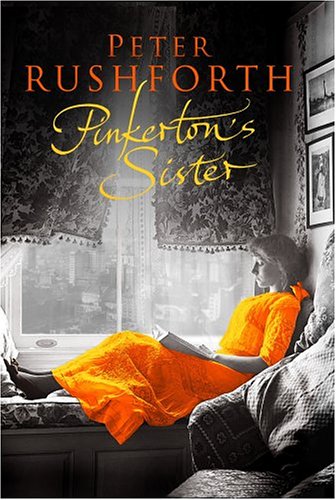
In a novel that celebrates the power of fiction and its ultimate redeeming quality, Alice Pinkerton transports those who belittle her into her own secretly written books where they are forced to reveal their true natures, in a novel set against the backdrop of turn-of-the-century New York.
"synopsis" may belong to another edition of this title.
About the Author
PETER RUSHFORTH is the author of Kindergarten. A former schoolteacher, he lives in North Yorkshire, England.
Reviews
Elvis Costello once remarked, more or less, that you get 19 years to make your first album and 12 months to make your second. The same holds true for publishing, where successful first-time novelists are expected to crank out sophomore efforts within a year. (If Book No. 2 tanks, you generally can take the rest of your life writing No. 3.) Pinkerton's Sister, the second novel by the English writer Peter Rushforth, arrives a cool 25 years after his acclaimed debut, Kindergarten. That first book was a slender volume -- less than 200 pages -- a controlled, harrowing take on "Hansel and Gretel," filtered through an account of Holocaust survivors and late-20th-century terrorism.
At first glance, Pinkerton's Sister, which clocks in at 729 pages, 235,000 words and 2.4 pounds, seems to have little in common with its trim older sibling. But like Kindergarten -- whose protagonist is an illustrator of children's books, and which is filled with references to children's literature and fairy tales -- the new work is a book filled with other books.
Rushforth's novel, the first of a projected quartet, has a clever conceit -- the Pinkerton of the title is Benjamin Franklin Pinkerton, called Ben, who grows up to be "Madame Butterfly's" callow young Lt. B.F. Pinkerton. Ben is recalled as a child for most of Rushforth's novel, which takes place in 1903, during the course of a single day in the life of Pinkerton's 34-year-old sister Alice, who is contemplating a return visit to the Webster Nervine Asylum in Poughkeepsie, upriver from the childhood home in New York City in which she still lives.
Alice is "the madwoman in the attic" -- though she wryly notes, "It should rightly have been called the nursery . . . but she had started to call it the schoolroom when she was a girl, after reading . . . about lonely governesses and grand houses . . . . it was the image that remained: the picture of a young woman going out into the world to make her way alone, sitting in a chair made for someone the size of a child, surrounded by the possessions of others, writing letters home." Like Jane Eyre's, Alice's "home was memory and imagination, her search for someone to love, and these she carried about within her." But Alice has never set out into the world to make her way alone. Her life has been circumscribed by her house and the surrounding (fictional) neighborhood of Longfellow Park. Mostly, however, Alice's life has been defined by reading, and books are what shape the baggy, often brilliant but overlong and overwritten Pinkerton's Sister -- I counted 17 literary references in the first eight pages alone, ranging from Jane Eyre to The Princess and the Goblin.
Alice is one of three daughters named for the sisters in Longfellow's "The Children's Hour," but her own childhood was anything but idyllic. She is the victim of abuses that may or may not have been precisely sexual in nature but were certainly fetishistic, and the unhappy witness to her father's sexual exploitation of the household's servant, Annie, whom she adores. Not surprisingly, Alice is haunted by notions of revenge, obsessive, brooding, impelled by violent impulses that she (mostly) doesn't act upon. Enamored of things both Grimm and grim, she is a bibliophile in the same way that the narrator of Edgar Allan Poe's "The Cask of Amontillado" is an oenophile. She imagines violent acts involving cutlery, hammers nails into her dolls' heads until they splinter, and pictures herself as "the guest denied access to all homes, a woman beyond the pale of decent society, and everyone shrank from her defiling presence."
Fortunately, she is not completely denied access to the outside world. One of the book's best set pieces involves Alice's experience as a model for a statue illustrating "The Children's Hour," wherein she is slowly, eerily encased in plaster -- a masterful evocation of the entombment of an intelligent woman's mind and body. There are also hilarious accounts of the loopily philistine culture-vulture manquée Mrs. Albert Comstock, and the awful alienist Dr. Wolcott Ascharm Webster, who subjects Alice to every form of medical torment at his disposal, from hydrotherapy to hypnotism to crude treatments involving the interpretation of clouds and dreams.
Yet even these are digressions in a maddeningly digressive narrative.
The fictional consciousness that streams through Pinkerton's Sister is compelling but often tedious and not very likable -- less the madwoman in the attic than the smarty-pants in the classroom. Amiability, of course, is not the best measure of a memorable fictional character: More than anyone else, the young Alice is reminiscent of another prickly, precocious know-it-all girl -- Louie, the protagonist of Christina Stead's masterpiece The Man Who Loved Children.
Still, the narrative heart of Pinkerton's Sister is what befalls Alice and Annie at the hands of Alice's father and the frightening figure known only as "Papa's 'friend.' " This story, with its sinister echoes of the gothic tales that Alice loves, and a nightmarish, beautifully written denouement set during a blizzard, should have been freed from some of the wads of paper that surround it. Pinkerton's Sister is a very fine novel, at once sprawling and intimate, and blessed with long gorgeous passages worthy of Henry James; but one senses always the greater book imprisoned inside it, like poor mad Alice trapped within her plaster shroud.
Reviewed by Elizabeth Hand
Copyright 2005, The Washington Post Co. All Rights Reserved.
Rushforth's pyrotechnic second novel (appearing 25 years after the publication of his acclaimed debut, Kindergarten) seeks to capture, in one day, the play of forces—literary, musical, medical and sexual—that made Edwardian New York society. At the center is Alice Pinkerton, nearly 35-year-old "spinster," the "madwoman in the attic" of Longfellow Park. Actually, she is not confined to an attic: she writes, goes to church and takes care of her mother. But these details are almost hidden in the deluge of Alice's inner life flowing over these pages, with a richness comparable to Leopold Bloom's in Ulysses. Alice, it appears, suffers from hypertrophy of childhood memories and a consequent emotional vacancy of adult experience. Does it stem from her discovery, at 20, of the body of her father, who committed suicide in his study? Perhaps the real key to Alice's condition goes back to twinned mysteries: the disappearance of her beloved childhood maid, and the source of her hatred for her father. Alice's fantasies and musings are stuffed with references to Shakespeare, 19th-century novels and poetry (particularly Stevenson's The Children's Hour, which exerts a surprisingly sinister influence in her life), opera and popular music; these are both buffers against reality and a means of mythologizing her neighbors. The flaw is that Rushforth has created no character in the book to counterbalance Alice; you sometimes feel that, in this mansion of a novel, you are locked in a small crowded closet.
Copyright © Reed Business Information, a division of Reed Elsevier Inc. All rights reserved.
Rushforth's second novel, which took him twenty-five years to write, is set in Edwardian New York and takes place on a single day, largely in the avid mind of its heroine, Alice Pinkerton, a bibliophilic spinster with a stammer and a penchant for dressing in white. Something of a cross between Harriet the Spy and Jane Eyre, she passes her days devising ways to expose "the humorless of Longfellow Park," as epitomized by her nemesis, the dowager Mrs. Albert Comstock. She is regarded, unsurprisingly, as the neighborhood eccentric and undergoes various period cures, like hypnotism. Rushforth weaves Alice's often fantastical musings together with bits of the classics, popular novels, doggerel, and even advertisements for dentures and corsets. Although the author's reliance on allusion occasionally shades into the merely curatorial, his novel constitutes an epic inquiry into literature's role as an engine of interior life.
Copyright © 2005 The New Yorker
Rushford's debut novel, Kindergarten, made quite a stir when it was published in 1979, but readers had to wait until now for a follow-up. His new work is a large, sprawling stream-of-conscious novel set primarily in the head of Alice Pinkerton at the dawn of the twentieth century. Alice isn't yet ready for the new age; she's a vestige of Victorian times, a "madwoman" living on the third floor (not in the attic, she insists) of her family's home. "No one was as close to her as words on a page," Alice muses, and indeed, she relates more to characters from the novels of George Eliot, Charlotte Bronte, and Charles Reade than to the people who surround her, especially the thoroughly modern socialite Mrs. Albert Comstock, who represents everything Alice hates. Alice's doctor, who seeks to cure her of her "malady," proclaims, "Imagination is an impediment to progress." For Alice, there's no more chilling sentiment. Though Victoriana and stream-of-conscious style is an odd mix, literary readers will want to take note of this ambitious, fascinating novel. Kristine Huntley
Copyright © American Library Association. All rights reserved
"About this title" may belong to another edition of this title.
Search results for Pinkerton's Sister

Stock Image
Pinkerton's Sister
Seller: Evergreen Goodwill, Seattle, WA, U.S.A.
Seller rating 5 out of 5 stars

paperback. Condition: Good. Seller Inventory # mon0000535517
Stock Image
Pinkerton's Sister
Published by
MacMurray & Beck, U.S.A., 2005
ISBN 10: 1931561990
ISBN 13: 9781931561990
Used
Hardcover
Seller: Bramble Ridge Books, Frankewing, TN, U.S.A.
Seller rating 5 out of 5 stars
Hardcover. Condition: Very Good. Dust Jacket Condition: Very Good. Second Printing. Seller Inventory # 003711
Stock Image
Pinkerton's Sister
Published by
Macmurray & Beck Communication, 2005
ISBN 10: 1931561990
ISBN 13: 9781931561990
Used
Hardcover
First Edition
Seller: Rock Solid Books, Jenison, MI, U.S.A.
Seller rating 5 out of 5 stars
Hardcover. Condition: As New. Dust Jacket Condition: As New. 1st Edition. 1stprinting. Eexcellent copy. 100% guarantee. Expert packaging. Seller Inventory # 000588
Stock Image
Pinkerton's Sister
Published by
MacAdam/Cage Publishing, 2005
ISBN 10: 1931561990
ISBN 13: 9781931561990
Used
Hardcover
Seller: Library House Internet Sales, Grand Rapids, OH, U.S.A.
Seller rating 5 out of 5 stars
Hardcover. Condition: Very Good. Dust Jacket Condition: Very Good. New York at the turn of the century; a city bursting with new life. Out near Hudson Heights, Longfellow Park - an area of wealth and position - is being torn apart to make way for the newly rich and ambitious who threaten to engulf the long-standing residents. The new century brings with it a new order. But they still have their traditions, these older families, still have their respectability, their position, their culture. The grander ones even have statues made in their image. Yet, like so many well-orchestrated worlds, their houses contain secrets, rooms, people that they would prefer the rest of the world not to dwell upon. In the Pinkerton household a nineteenth-century embarrassment remains. Alice Pinkerton. Alice Pinkerton is almost thirty-five, not mad exactly, but disturbed, foolish, not right in the head. She had a friend once, a black servant girl (regarded in itself as a harbinger of abnormality) but she disappeared one day, never to return. Alice is tolerated (more or less), free to wander about, free to accompany her family to tea parties and cultured soirees, free to be condescended to, to have looks exchanged over her, free to be treated like a simpleton. But the truth is, Alice's mind is razor sharp, honed by a restless imagination, years of reading, and a profound contempt for her surroundings. Like her namesake in Through the Looking-Glass, Alice Pinkerton too has a mirror through which to enter a different world, only for her the mirror is her books. Left alone to read, to think, she has devoured the world that brings her mind alive: Shakespeare, Oscar Wilde, Robert Louis Stevenson, Wilkie Collins, Edgar Allan Poe are her inspiration; Jane Eyre (and Bertha Rochester), Maggie Tulliver, Lady Macbeth her companions, sustaining and nourishing her lonely life. As she moves through the witless world of Longfellow Park, observing its prejudices, its shallow culture and its vanity, its hatred of truth, she transports those who belittle her into these books and into her own - secretly-written - books, where they can no longer hide behind their tea parties and their song recitals, but are forced to act out their true characters, and reveal their true natures. Solid binding. Please note the image in this listing is a stock photo and may not match the covers of the actual item. Book. Seller Inventory # 123679334
Stock Image
Pinkerton's Sister
Seller: Your Online Bookstore, Houston, TX, U.S.A.
Seller rating 5 out of 5 stars
Paperback. Condition: New. Seller Inventory # 1931561990-11-25208316
Stock Image
Pinkerton's Sister
Seller: vladimir belskiy, Alexandria, VA, U.S.A.
Seller rating 2 out of 5 stars

Condition: New. Seller Inventory # HT-V1HU-A88V
Stock Image
Pinkerton's Sister
Published by
MacMurray & Beck, 2005
ISBN 10: 1931561990
ISBN 13: 9781931561990
Used
Soft Cover
First Edition
Seller: Burke's Book Store, Memphis, TN, U.S.A.
Seller rating 5 out of 5 stars
Soft Cover. Condition: Very Good. 1st Edition. Tight, clean. Seller Inventory # 279254
Stock Image
Pinkerton's Sister
Published by
Macadam/Cage, San Francisco, 2005
ISBN 10: 1931561990
ISBN 13: 9781931561990
Used
Hardcover
Seller: Willis Monie-Books, ABAA, Cooperstown, NY, U.S.A.
Seller rating 5 out of 5 stars
Hardcover. Condition: Very Good. Dust Jacket Condition: Very Good. First Printing. Seller Inventory # 122919
Seller Image
Pinkerton's Sister
Seller: zenosbooks, San Francisco, CA, U.S.A.
Seller rating 4 out of 5 stars

hardcover. Condition: Very Good in Wrappers. No Jacket. San Francisco. 2005. March 2005. MacAdam/Cage. Advance Reader's Copy. Very Good in Wrappers. 1931561990. 731 pages. hardcover. keywords: Europe England Literature World Literature. DESCRIPTION - Alice Pinkerton is almost thirty-five, not mad exactly, but disturbed, foolish, not right in the head. She had a friend once, a black servant girl (regarded in itself as a harbinger of abnormality) but she disappeared one day, never to return. Alice is tolerated (more or less), free to wander about, free to accompany her family to tea parties and cultured soirees, free to be condescended to, to have looks exchanged over her, free to be treated like a simpleton. But the truth is, Alice's mind is razor sharp, honed by a restless imagination, years of reading, and a profound contempt for her surroundings. Like her namesake in Through the Looking-Glass, Alice Pinkerton too has a mirror through which to enter a different world, only for her the mirror is her books. Left alone to read, to think, she has devoured the world that brings her mind alive: Shakespeare, Oscar Wilde, Robert Louis Stevenson, Wilkie Collins, Edgar Allan Poe are her inspiration; Jane Eyre (and Bertha Rochester), Maggie Tulliver, Lady Macbeth her companions, sustaining and nourishing her lonely life.' As she moves through the witless world of Longfellow Park, observing its prejudices, its shallow culture and its vanity, it is society that prompts her observations, viewing all through the prism of the art that has sustained and nourished her lonely life. inventory #35674. Seller Inventory # z35674
Stock Image
Pinkerton's Sister
Seller: Burm Booksellers, Beckley, WV, U.S.A.
Seller rating 5 out of 5 stars
Soft cover. Condition: Near Fine. Dust Jacket Condition: Near Fine. Hardcover. Ex Library with stickers/stamps etc. DJ in mylar pasted to boards. Nominal edge wear. May have other minor incidental cosmetic defects expected with age. Else, tight and square. HXFIC. Seller Inventory # 013743-HXFIC