
Items related to Awesome African Wildlife
Synopsis
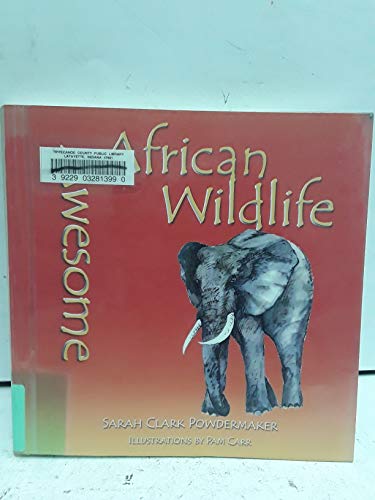
From the savannas, woodlands and deserts of East and southern Africa, the author of this informative and readable book has captured over 50 species of wildlife in a summary verse and short article. A gifted southern African artist has painted a watercolor illustration for each.
Most major groups of African wildlife are represented in this marvelous menagerie and loosely organized under seven whimsical sub-titles. In describing each animal’s characteristics, the author focuses on its adaptations for survival, such as the bushbaby’s eyes and the aardwolf’s digestive system. She recounts fascinating behaviors, many based on her own observations, and draws on African folktales for explanations of other behaviors, such as oxpeckers’ preference for giraffes. She also refers to the roles of some of the wildlife symbolized in Egyptian mythology.
Awesome African Wildlife is intended for a general readership, including older children. It contains a color satellite map of Africa, a reading list and a table of metric and US measurements. Scientific names are given for further reference. A unique feature is a copy of an 1864 photograph from the London Zoo of a quagga, the zebralike animal that is now extinct.
"synopsis" may belong to another edition of this title.
About the Author
Sarah Clark Powdermaker, a former college English teacher and a textbook author, lived for 18 years in East and southern Africa, researching and observing wildlife in the abundant parks and reserves. She and her husband now live in Maine.
Born and raised in southern Africa, Pam Carr is a wildlife artist and a certified park guide in Zambia.
From the Inside Flap
Awesome African Wildlife by Sarah Clark Powdermaker Illustrations by Pam Carr From elephants to elephant shrews, ant lions to lions, African wildlife is awesome. This book is a sampling of more than 50 mammals, birds, reptiles and insects, each one described in a short article and verse and shown in a color illustration. Well known and little known, commonly seen and rarely seen, they illustrate the incredible biodiversity that can still be found in East and southern Africa. Most of the wildlife represented here are mammals, and most of them are plant-eating herbivores such as the familiar zebra and giraffe and the not-so-familiar giant forest hog. A mammal that doesn t look like a mammal, the pangolin, is one of the insect-eating insectivores, along with the aardwolf, a member of the hyena family that eats mainly termites. The meat-eating carnivores are highlighted by the vulnerable cheetah, the endangered wild dog, and two of Africa s seven small cats (the serval and the swamp cat). Topping the group of predators that also scavenge for their meat is the spotted hyena, which eats the whole carcass. The eaters-of-almost-anything-from-flesh-to-flowers, the omnivores, are represented by the savanna baboon. Among the seven birds in the sampling are the Marabou stork and the aerobatic Bateleur eagle. Amphibians are represented by the flipper-footed African clawed frog, and reptiles include the deadly puff adder and Nile crocodile. Insects weigh in with the dangerous but habitat-protective tsetse fly and the habitat-enriching dung beetle. A living quagga, a now-extinct subspecies of zebra, is shown in an 1864 photograph, and the accompanying article describes current attempts to rebreed it. Another article explains the development and relationships of earth s earliest animal life forms down to their modern descendants. Some of the animals are presented from an overview (the bat-eared fox), others with a narrow focus on one or two features (the horns of the rhinoceros and the survival strategies of the leopard.) Several of the articles describe interactions between the subject animal and other creatures (the honey badger and the honeyguide bird), and others bring in a subject s relative that has similar family traits (the hadeda ibis with the sacred ibis, the lesser bushbaby with the greater bushbaby). A talented African artist and wildlife guide has provided the illustrations. African folktales are woven into the accounts for rich, additional perspectives. The book also contains
a color satellite map of the continent
a table of metric measurements and US equivalents
a reference list for further reading. The awesome wildlife of Africa is steadily being diminished by shrinking or degraded habitats and by human indifference, even greed. Some species have already gone, and others are critically close to vanishing. The people of Africa are the inheritors of this great natural treasure. The world s people, who are also beneficiaries, must encourage them to be as proud of it as they are of their culture, and help them preserve it while preservation is still possible.
Excerpt. © Reprinted by permission. All rights reserved.
Amazing Sights and Sounds and One Unseen & Silent
Here a while, then away, Wild Dogs of Africa,
Wide roaming nomads in calico colors,
Pack centered, food sharing, all caring for pups,
And behaving like puppies, they bond with each other.
At first scientific glance, the broad, dark muzzle and big ears of the African wild dog suggested it was some kind of hyena, and it was given the name Hyaena picta, "painted hyena". But after another look, its pack behavior indicated it was more wolf than hyena, so the name was changed to and remains Lycaon pictus, "painted wolflike animal". Its markings have never been an issue: black at the muzzle, white at the tail and mottled in between with daubs and splashes of black, white and yellow or ocher it looks painted.
Despite appearances, wild dogs are not remotely related to hyenas except that both are carnivores, and DNA tests have shown that they are not descended from wolves. (There is a close relative of the European wolf in Africa the critically endangered Ethiopian wolf [Canis simensis].) Fifteen million years ago wild dogs and wolves had a common ancestor, but the dogs evolved as a separate branch of the canid family tree two to three million years ago. They are one of a kind, an exclusive genus found only in Africa and now found less and less.
Once numerous over much of the continent, wild dogs today are considered vulnerable by the World Conservation Union (IUCN), and many groups are endangered. Populations of a few hundred adults survive only in Botswana, Tanzania and South Africa in packs with an average of ten adults. Small groups live in other countries but in scattered, isolated pockets without safe linking corridors to promote the formation of new packs. (Unusual among social mammals, females emigrate to find mates in other areas while males generally stay in their natal pack.)
Along with the drastic shrinkage of wild land that the dogs need to roam and find mates in, their declining numbers are due to their susceptibility to domestic dogs diseases and to gunshots. Myths still linger that they attack people (perhaps because of their erroneous connection to European wolves), that they are major killers of livestock, and that they are cruel and wanton predators of wild animals.
The facts are that wild dogs do not attack humans. Like jackals and wolves, they destroy some livestock, but they prefer their natural food of medium-size antelopes, and they often target an unfit member of the herd. When a large pack is hunting, splinter groups may bring down prey, but typically they take only one animal in a cooperative effort that allows them to be on the lookout for trouble while they bolt as much meat as they can as fast as they can.
The dogs kill by disemboweling their prey, which looks cruel and is bloody but can be quicker than killing by suffocation, as cheetahs and leopards do. With the same attack strategy used by spotted hyenas, they bite at their running quarry to cripple it and then tear into it from underneath its body where the hide is thinnest and the vital organs are easiest to reach. The prey, numbed first by adrenaline and then by shock, can be dead in seconds. The dogs need to kill quickly to avoid injury from horns and hooves, but their survival depends on downing the meal before hyenas steal it and before lions try to kill them, their serious competitors for food.
Wild dogs don t fight over food; they rarely fight over anything among themselves. Aggression in the pack is defused by submissiveness in the form of ritual begging, and they use the same puppylike behavior when they greet each other and rally for a hunt. The pups (usually from the alpha female, occasionally from a second female) begin begging adults for meat even before they re weaned, and all the adults regurgitate for them. Wild dogs also regurgitate for an adult that needs food and can t join the hunt the nursing mother, a baby-sitter that stays at the den, or a wounded dog. Even a very old and decrepit dog is given food by the others. Another exceptional feature of wild dog behavior is that juveniles are always allowed to eat first at the kill, no matter how famished their elders are.
"About this title" may belong to another edition of this title.
Search results for Awesome African Wildlife

Stock Image
Awesome African Wildlife
Seller: BooksRun, Philadelphia, PA, U.S.A.
Seller rating 5 out of 5 stars

Paperback. Condition: Very Good. Carr, Pam (illustrator). It's a well-cared-for item that has seen limited use. The item may show minor signs of wear. All the text is legible, with all pages included. It may have slight markings and/or highlighting. Seller Inventory # 1931807124-11-1
Stock Image
Awesome African Wildlife
Seller: BooksRun, Philadelphia, PA, U.S.A.
Seller rating 5 out of 5 stars
Paperback. Condition: Very Good. Carr, Pam (illustrator). It's a well-cared-for item that has seen limited use. The item may show minor signs of wear. All the text is legible, with all pages included. It may have slight markings and/or highlighting. Seller Inventory # 1931807124-8-1
Stock Image
Awesome African Wildlife
Seller: Fort Hill International LLC, HILLSBORO, OH, U.S.A.
Seller rating 5 out of 5 stars
paperback. Condition: Good. Carr, Pam (illustrator). Ex-library usual stamps and markings Good condition but not perfect, Cover has minor nicks and tears, spine shows some creases from use. Ask Questions and request photos if your buying for the cover and not the content. STOCK PHOTOS MAY VARY FROM THE ACTUAL ITEM. ACTUAL PHOTOS AVAIL. UPON REQUEST. Seller Inventory # 4ZF000000UWJ