
Items related to Flight into Spring (Living History Library)
Synopsis
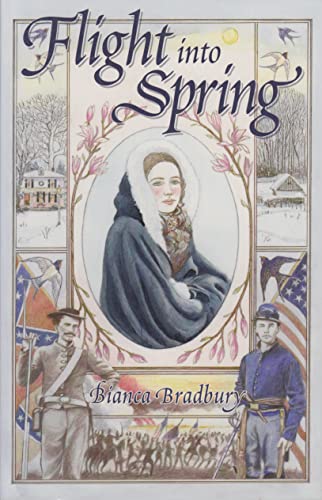
Opposites: Sally Day Hammond is vivacious, tiny, coddled and Southern; Charles Horne is silent, tall, unbending and Northern. The American Civil War has just ended. And a marriage is to be made between these two? When Charles brings Sally Day back to live with his strict New England family, little wonder that tensions rise to the breaking point. But Sally Day has mettle; in the desperate honesty of this young couple’s conflict, both young hearts may yet stretch and truly meld. In a setting of historical depth, skilled novelist Bianca Bradbury brings all the resources of a heart-searching realism to the predicaments of young married love.
New England, 1860s
RL5.1
Of read-aloud interest ages 12-up
"synopsis" may belong to another edition of this title.
About the Author
Born in New Milford, Connecticut in 1908, Bianca Bradbury lived in the state of Connecticut throughout her life. As a young wife, her writing took the form of verse, articles and short stories, which found their way into such magazines as Family Circle and McCall’s. After the birth of her two sons, she began writing for children, first picture books, and then longer books. Later, when the boys had grown up and left home, Mrs. Bradbury’s fiction focused mostly on contemporary issues for young adults. Besides a love for animals, which is most evident in her books for younger readers, her novels reveal her deep interest in honestly dealing with the realities of life. She was never afraid of tackling controversial subjects, desiring to do so with integrity and hope. Flight into Spring, while aimed at older readers as many of Bianca Bradbury’s later books were, is different from these because of its historical setting. It beautifully succeeds in showing the author’s view that to persevere through the day-to-day difficulties of life and relationship is both necessary and possible and was as true in times past as it is today. Bianca Bradbury’s sons recall the life-long discipline she exhibited in her writing craft and her happy zest for life—both important attributes in writers for the young. She authored 46 books over a span of 40 years. Mrs. Bradbury died in 1982.
Excerpt. © Reprinted by permission. All rights reserved.
"This is the longest war that ever was," Sally Day Hammond said gloomily.
Her mother flashed her a warning look. The family had agreed not to discuss the war while Sally Day's cousin Tillman was visiting. "It's the longest winter that ever was, that's true," she said.
Her daughter had caught the warning and said with a smile, "Anyway it doesn't seem so cold tonight, Mama. We've got a lovely supper inside us."
They were all crowded around the kitchen stove, forming three circles. The two hounds were closest because they didn't mind getting scorched. Eleven-year-old Willie, Sally Day's sister, and nine-year-old Eugene huddled close to the dogs. Grownups formed the outer circle. Tillman Wyatt had the best chair because he was a soldier, home for a little while from the war. Mrs. Hammond was sewing in the soft yellow glow of the lamp. Her husband watched them all carefully and Sally Day knew he was afraid the children would ask their cousin about battles and fighting.
As for Sally Day, she was trying not to glance at Tillman, for when she did it was another soldier she saw. That one was just as tall, but dark instead of blond. He wore the blue Union uniform instead of the nut brown of the Confederacy. Wherever Charles Horne was, this winter night of 1865, he carried Sally Day's heart with him.
War was in the very air the Hammond family breathed, for they lived in Chesapeake City, Maryland. The state was split right down the middle in its loyalties, and had been ever since the War Between the States began in 1861. Sally Day's own father was loyal to the Union and President Abraham Lincoln. Tillman Wyatt's branch of the family was just as loyal to the South. By rights Sally Day ought to hate this tall, handsome cousin. What if he and Charles Horne met in battle? They would be duty bound to try to kill each other.
Yet how could she hate Tillman? They had been friends since they were babies.
He stared into the stove's red glow. He still looked sick and exhausted, despite the good supper Mrs. Hammond had set before him. His blue eyes were haunted; some terrible memories were mirrored in them. How old did he look tonight, with deep lines spoiling his smooth, young face? At least thirty, Sally Day realized. Yet she knew for a fact he was only three years older than she, and Sally Day had turned sixteen not long before.
"Where did you get all that good food, Papa?" she asked, just to make conversation.
Her father seemed relieved that the long silence was broken. "I put over a real good deal today," he said. "A farmer from the back country came to the store to swap a side of bacon for a new spade. He didn't have any cash, of course. Nobody has any cash these days. I couldn't keep the store going if people didn't come in to barter.
"His wife was wearing a plain calico bonnet, and she kept eyeing that green velvet one that's on the top shelf. I kind of guessed she had never owned a real fancy bonnet in her whole life. 'It's right pretty, isn't it, ma'am?' I said to her.
" 'It surely is,' she agreed. 'Would you take a pound of butter for it?'
" 'I'd take two pounds of butter and three dozen eggs,' I told her.
"Her husband figured that was too much, but I wasn't too anxious to let it go. I'd been thinking somebody in my own family would look right nice in that velvet bonnet. Still and all, I remembered that Tillman was staying for supper, and the rest of us were sick and tired of plain hoe cake. I let her have it for the butter and eggs."
"It was surely a wonderful supper," his wife agreed. "We'll have another tomorrow if Tillman can see his way clear to stay. Tillman, there's an old rooster pecking around the back porch, and I'll have your uncle kill it if you'll stay. What would you say to a boiled chicken dinner?"
It seemed as though Tillman had to come back a long, long distance before he answered. Then with his usual courtesy he said, "I thank you kindly, Aunt Sarah, and it's a fine offer, but I'll be on my way at dawn."
There was bitterness in his voice as he added, "My own town and my own state aren't very cordial to soldiers who don't wear blue and talk with a Yankee twang. I'd best not stay."
"You won't see your own mother, Tillman?"
"No, I don't dare go into Chesapeake City. I'd take it kindly if you'd let her know I'm alive and well."
"That we'll be happy to do," his aunt said gently.
"Aunt Sarah, would you allow Sally Day to walk with me now, just to the canal and along the towpath? The moon's bright as day. I won't keep her out long."
Sally Day was startled by her cousin's request to walk out with him, and her face must have showed it. "It's a cold night," her father said, guessing she didn't want to go.
"It's not too cold if I borrow Mama's cape with the hood," Sally Day said, and stood up. She had seen the pleading in Tillman's eyes.
"Tillman, you had best wear my coat," Mr. Hammond said, and took it down from the hook and put it around the young man's shoulders.
They were walking through the back garden when Tillman stopped short. "What did Uncle George have in mind?" he asked. "Did he want me to cover my uniform? Are you ashamed to be seen with me?"
"No," Sally Day told him, "Papa only wants you to be warm."
"Do the Yankees keep a guard on the canal?"
"We haven't seen any guards for a long time. Weeks, anyway. They war's—"
"The war's what?" Tillman demanded. "Finish what you started to say."
Maybe Sally Day was small, but she was spirited enough to stand up to any man. "The war's nearly over, that's what I was going to say."
"And we're beaten? Do you honestly believe that the South is beaten?"
"Yes, that's just what I do believe."
"It's not true," he said harshly. "That's only Yankee talk."
"Tillman, if you asked me to come outside so you could lecture me on politics, then we'll go back right now!"
He towered over her. The anger went out of him, and he touched her face with his finger. "You're all silvery from the moonlight," he said, "You're so tiny, Sally Day. And I'd forgotten that you look like a little madonna. How could I forget that when I've thought of you every single day I've been away?"
"Now, Tillman," she said with an uncertain laugh, "don't you sweet-talk me."
They started along the wooden duckwalk which Mr. Hammond had built to cross a marshy spot between the back garden and the canal. Their footsteps echoed and Sally Day shivered, hoping they wouldn't see the dark form of a Union sentry pacing along the canal. They reached the bank and to her relief she saw that the towpath was empty.
Tillman took her hand and they walked in silence. Finally he said, "Sally Day, I heard a queer rumor way down in Virginia. That's one reason I asked for a few days' furlough and came home. A friend in my company got a letter from home, and in it there was a mention you were promised to a soldier."
Sally Day's heart began to beat faster. Was she promised? Yes, she supposed she was.
Her cousin went on, "To a Yankee soldier."
"I met one I like, that is true," she said steadily, lifting her chin.
"You couldn't! That's not true."
"Yes, it is."
"Who is he?"
"His name is Charles Horne, and he's with the 18th Connecticut Volunteers."
"How did you meet him?"
"His regiment was sent to Maryland to guard the canal, and the town gave a supper for the men in one of the churches. Mama and I helped serve, and that's where I met him."
"Chesapeake City gave a supper for a bunch of Yankees?" Tillman demanded, disbelieving.
"Yes. Why not? Most of us here believe in the Union cause."
"You people don't know what they're like," Tillman burst out. "They're animals!"
Sally Day was so taken aback she stared at him, speechless. The moonlight deepened the shadows on his face and turned it into a fanatical, ugly mask. Was this the gentle, merry cousin she had known in better days, in the good days before the war?
Something in her own face recalled him from his black thoughts and he took her hand and cradled it gently in his own. "Don't look so frightened, cousin," he said more reasonably. "The last thing in the world I wanted to do tonight was to frighten you. But you've got to be warned. It's absolutely out of the question for you to like one of them. I know what I’m talking about; I fought them at Gettysburg, I fought them at Fredericksburg, I was at Antietam. I know what they're like. Sally Day, they're foreigners, they're savages!"
She pulled her hand away. "I think I ought to tell you that Charles has been in southern prison camps. Two years ago he was captured and taken to Libby Prison, and later on he was sent to Belle Isle. He was exchanged and sent home to Connecticut to get his health back. He stopped to visit us. He didn't talk to me about it but he told my father how horrible those prisons were. He watched his own brother die of starvation at Belle Isle."
Sally Day shivered in her mother's warm cloak. The night was so still they heard a fish jump in the black water below. She was about to ask her cousin to take her back to the house.
Then he spoke. "I was wrong," he said dully. "War changes everybody. It brings out the best in men, but it also brings out the worst. Don't ask me to say anything good about Yankee soldiers because I can't. They've killed too many of my friends right before my eyes. But I'll grant you that when this terrible war is over and we begin to think about it, we may decide that one army wasn't any worse than the other."
His voice dropped. He said huskily, "I'm sorry I started this. I only wanted to warn you, cousin, that you mustn't let yourself love a Yankee. Even if they're no worse than we are, they're still different. You're a southern girl. Maryland's a southern state, and the fact that many good men like Uncle George have adopted the Union cause doesn't change that."
He began to plead then. "Remember before the war, when we were young? You knew I loved you. Our families have taken it for granted that we'd marry some day, that we'd spend our lives together. Please, please, cousin, don't commit yourself, don't make a promise to any soldier. I love you so much it aches inside me, but I'm not asking for your promise tonight, even when I need it so much."
Wordless, Sally Day walked beside him, trying to match the steps of her gaitered feet to his strides. They reached the wooden walk that led to the garden, and she caught his arm. "Cousin," she began.
"No," he said, "don't say anything."
"Where will you go in the morning?"
"I'm meeting a friend. A boat will take us to Virginia."
"It'll be just a short time before you'll be home again," she said, meaning to comfort him.
"It may be years," he said.
She knew better. He knew, too, that the South couldn't go on fighting very much longer, but he couldn't admit that, and she didn't want to argue. At the door, she still clung to his arm. "Come in and sleep in a real bed, Tillman. Father will wake you before daylight."
"No," he said, "The barn's safer. If the Yankees come and find me, then your parents can claim they didn't know I was anywhere around."
He unbuttoned his pocket and put a small box, wrapped in thin paper in her hand. "I bought you this in Richmond a long time ago," he said. "I've carried it everywhere with me. I lost it once on a march, but it leads a charmed life. One of our men found it in the mud and returned it to me. I planned to ask for your promise when I gave it to you, but I'm not doing that tonight. I'm giving it to you so you'll remember me, whatever happens."
The moonlight was bright enough to see by, and she started to unwrap it. "No," he said, "look at it when you're alone in your room."
He held her small face in his two hands, bent and kissed her. Then he opened the door and gave her a gentle push inside.
The children had gone to bed, but Mrs. Hammond was still sewing by the light of the lamp. "Sally Day, you've been crying," she said.
Sally Day felt her face, and it was wet. "Maybe I have, but I didn't know it."
The packet was in her hand but she didn't show it to her mother. She leaned for a moment on her shoulder. "Mama, war's a terrible thing," she whispered.
"Yes, it is, dear. I’m sorry you had to learn that so young."
Sally Day said good night, lit a candle and climbed the stairs to her room. She opened her gift then. It was a large brooch of yellow gold, intricately carved with raised flowers, each petal and stamen clear, a beautiful and expensive thing. It was the first piece of jewelry she had ever owned.
Something made her wrap it again and hide it under the clothes in her bureau. She would take it out and look at it when she wasn't so upset.
She undressed and put on her flannel nightgown, but she didn't get into bed. Instead she folded a quilt around her and sat by the window. The barn was dark and silent.
She loved Tillman, yes, she truly did. Was it cousinly love, though, made up of memories of happy childhood times? How much play-acting was mixed up in all Tillman had said tonight? When they were children Tillman, with his vivid imagination, had been the one who had made up the games. He had carried her along into a gay, funny world he created.
She heard the back door squeak. Her parents were crossing the back yard to the barn, her father carrying a pile of quilts, her mother a basket. They were making sure that Tillman had a warm sleep and food to take on his journey.
Sally Day crouched beside the window, her head on the sill, long after her parents had returned to the house and climbed the stairs to their own room. Tears slid down her face, tears for all of them.
Tears for Tillman, facing a dangerous, lonely journey back to the Confederate Army camped somewhere in Virginia. Tears for Aunt Belle, sleeping in Chesapeake City tonight not knowing her only son was so close but didn't dare to sneak into town to see her.
Tears for everybody who was lonely, this winter night.
Tears for Charles Horne somewhere in West Virginia, with Sheridan's army in the Shenandoah.
She finally slipped into bed, and it was Charles's dark, intense face she saw most clearly. Months had gone by since she had seen him but Charles's face was clearer than Tillman's, who had kissed her only an hour ago.
"About this title" may belong to another edition of this title.
Search results for Flight into Spring (Living History Library)

Stock Image
Flight Into Spring
Seller: World of Books (was SecondSale), Montgomery, IL, U.S.A.
Seller rating 5 out of 5 stars

Paperback. Condition: Good. Seller Inventory # 00108562167
Seller Image
Flight into Spring (Living History Library)
Seller: Greenworld Books, Arlington, TX, U.S.A.
Seller rating 5 out of 5 stars
Condition: very_good. Fast Free Shipping â" Very Good condition book with a firm cover and clean pages. Shows normal use and some light wear or limited notes markings. A solid, nice copy to enjoy. Seller Inventory # GWV.1932350012.VG
Seller Image
Flight into Spring (Living History Library)
Seller: Greenworld Books, Arlington, TX, U.S.A.
Seller rating 5 out of 5 stars
Condition: good. Fast Free Shipping â" Good condition. It may show normal signs of use, such as light writing, highlighting, or library markings, but all pages are intact and the book is fully readable. A solid, complete copy that's ready to enjoy. Seller Inventory # GWV.1932350012.G
Stock Image
Flight into Spring (Living History Library)
Seller: Once Upon A Time Books, Siloam Springs, AR, U.S.A.
Seller rating 4 out of 5 stars

paperback. Condition: Very Good. Seller Inventory # mon0003583962
Stock Image
Flight into Spring (Living History Library)
Seller: ThriftBooks-Atlanta, AUSTELL, GA, U.S.A.
Seller rating 5 out of 5 stars
Paperback. Condition: Good. No Jacket. Pages can have notes/highlighting. Spine may show signs of wear. ~ ThriftBooks: Read More, Spend Less. Seller Inventory # G1932350012I3N00
Stock Image
Flight into Spring (Living History Library)
Seller: ThriftBooks-Atlanta, AUSTELL, GA, U.S.A.
Seller rating 5 out of 5 stars
Paperback. Condition: Very Good. No Jacket. May have limited writing in cover pages. Pages are unmarked. ~ ThriftBooks: Read More, Spend Less. Seller Inventory # G1932350012I4N00
Stock Image
Flight into Spring
Seller: Better World Books: West, Reno, NV, U.S.A.
Seller rating 5 out of 5 stars
Condition: Fine. Used book that is in almost brand-new condition. May contain a remainder mark. Better World Books: Buy Books. Do Good. Seller Inventory # 18207895-6
Stock Image
Flight into Spring (Living History Library)
Published by
Bethlehem Books June 2005, 2005
ISBN 10: 1932350012
ISBN 13: 9781932350012
New
Paper Back
Seller: Eighth Day Books, LLC, Wichita, KS, U.S.A.
Seller rating 4 out of 5 stars
Paper Back. Condition: New. Seller Inventory # 155516
Stock Image
Flight into Spring
Seller: Revaluation Books, Exeter, United Kingdom
Seller rating 5 out of 5 stars
Paperback. Condition: Brand New. reprint edition. 184 pages. 8.50x5.50x0.75 inches. In Stock. Seller Inventory # 1932350012
Buy New
US$ 28.56
US$ 13.25 shipping
Ships from United Kingdom to U.S.A.
Ships from United Kingdom to U.S.A.
Quantity: 1 available
Stock Image
Flight into Spring (Living History Library)
Seller: BennettBooksLtd, Los Angeles, CA, U.S.A.
Seller rating 5 out of 5 stars
Paperback. Condition: New. In shrink wrap. Looks like an interesting title! Seller Inventory # Q-1932350012