
Items related to Lost Son
Synopsis
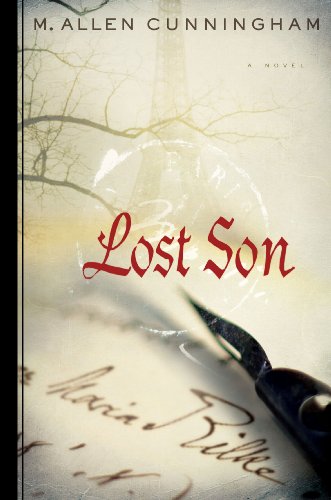
Spanning western Europe from 1875 to 1917 and presenting a gothic historical Paris that subverts our old assumptions regarding the City of Light, M. Allen Cunningham’s new novel brings a brooding atmosphere and human complexity to an intimate and imaginative portrait of one of the most uniquely sensitive artists of his time, a poet whose odd childhood and difficult early life will both fascinate and perhaps help explain his determination to stay true to his artistic vision at almost any cost. Here is Rainer Maria Rilke in the grip of his greatest artistic struggle: life itself.
Rilke’s gripping emotional drama as child, lover, husband, father, protégé, misfit soldier, and wanderer is framed by a haunted young figure, a researcher who, a century later, feels compelled to trace Rilke’s itinerant footsteps and those of Rilke’s fictional alter ego, the bewitched poet Malte Laurids Brigge. The result is an exploration of the forever imperfect loyalties we face in work and life, the seemingly immeasurable distances that can separate life and art, and the generational tensions between masters and admirers.
Rilke’s gripping emotional drama as child, lover, husband, father, protégé, misfit soldier, and wanderer is framed by a haunted young figure, a researcher who, a century later, feels compelled to trace Rilke’s itinerant footsteps and those of Rilke’s fictional alter ego, the bewitched poet Malte Laurids Brigge. The result is an exploration of the forever imperfect loyalties we face in work and life, the seemingly immeasurable distances that can separate life and art, and the generational tensions between masters and admirers.
"synopsis" may belong to another edition of this title.
Reviews
Cunningham follows The Green Age of Asher Witherow (2004) with a dense novelization of the life of the poet Rainer Maria Rilke. An account of Rilke's baptism gives over to a chronicle of his time in Paris, where he ruminates on life and befriends sculptor Auguste Rodin. From Rodin's residence, the narrative episodically follows Rilke from his days as a sickly military cadet and his meeting the writer Lou Andreas-Salome—his muse with whom he travels widely—to an interlude with Lord Chamberlain's skeleton in a crypt and eventually to the double heartbreak of Rilke's father's death and his final parting with Rodin, which inspires the poet to wall himself away behind his writer's desk. Cunningham is a talented writer, although unwelcome shifts into second-person and passages rife with adjective abuse mar this ambitious undertaking. (June)
Copyright © Reed Business Information, a division of Reed Elsevier Inc. All rights reserved.
Technique remains popular in historical fiction. Rather than insert imaginary characters in historical settings where they interact with real historical figures, novelists are creating fictional biographies of real people. This can be a tricky approach because it mixes fact and fiction even more than usual for the genre. The approach can be particularly tricky when the subject is himself a writer. Should the fictional writer talk like the historical writer's writings? One of the ways this fictionalized biography of poet Rainer Maria Rilke attempts to overcome the problem is by mixing styles. The novel is a mix of first-, third-, and even second-person narration, as well as some of Rilke's actual writings. The result is itself mixed. Some passages are lyrical and moving; others seem unnecessarily dense. Fans of Rilke will be curious about this take on his life, but those not already interested are unlikely to find this a compelling starting point. Marta Segal
Copyright © American Library Association. All rights reserved
"About this title" may belong to another edition of this title.
Search results for Lost Son

Stock Image
Lost Son
Published by
Unbridled Books (edition 1), 2007
ISBN 10: 1932961348
ISBN 13: 9781932961348
Used
Hardcover
Seller: BooksRun, Philadelphia, PA, U.S.A.
Seller rating 5 out of 5 stars

Hardcover. Condition: Very Good. 1. With dust jacket. It's a well-cared-for item that has seen limited use. The item may show minor signs of wear. All the text is legible, with all pages included. It may have slight markings and/or highlighting. Seller Inventory # 1932961348-8-18-29
Stock Image
Lost Son
Published by
Unbridled Books, 2007
ISBN 10: 1932961348
ISBN 13: 9781932961348
Used
Hardcover
First Edition
Seller: Better World Books, Mishawaka, IN, U.S.A.
Seller rating 5 out of 5 stars
Condition: Good. 1st Edition. Pages intact with minimal writing/highlighting. The binding may be loose and creased. Dust jackets/supplements are not included. Stock photo provided. Product includes identifying sticker. Better World Books: Buy Books. Do Good. Seller Inventory # 15067006-6
Stock Image
Lost Son
Published by
Unbridled Books, 2007
ISBN 10: 1932961348
ISBN 13: 9781932961348
Used
Hardcover
First Edition
Seller: Better World Books: West, Reno, NV, U.S.A.
Seller rating 5 out of 5 stars
Condition: Very Good. 1st Edition. Pages intact with possible writing/highlighting. Binding strong with minor wear. Dust jackets/supplements may not be included. Stock photo provided. Product includes identifying sticker. Better World Books: Buy Books. Do Good. Seller Inventory # 9955303-75
Stock Image
Lost Son
Published by
Unbridled Books, 2007
ISBN 10: 1932961348
ISBN 13: 9781932961348
Used
Hardcover
First Edition
Seller: Better World Books, Mishawaka, IN, U.S.A.
Seller rating 5 out of 5 stars
Condition: Fine. 1st Edition. Used book that is in almost brand-new condition. May contain a remainder mark. Better World Books: Buy Books. Do Good. Seller Inventory # 52388401-6
Stock Image
Lost Son
Seller: HPB Inc., Dallas, TX, U.S.A.
Seller rating 5 out of 5 stars
hardcover. Condition: Very Good. Connecting readers with great books since 1972! Used books may not include companion materials, and may have some shelf wear or limited writing. We ship orders daily and Customer Service is our top priority! Seller Inventory # S_481045355
Stock Image
Lost Son
Published by
Unbridled Books (Denver), 2007
ISBN 10: 1932961348
ISBN 13: 9781932961348
New
Hardcover
First Edition
Seller: Dan Pope Books, West Hartford, CT, U.S.A.
Seller rating 5 out of 5 stars
Hardcover. Condition: New. Dust Jacket Condition: New. 1st Edition. First edition, first printing (indicated by full number sequence, including the 1). Hardbound. NEW. Fine in a fine dust jacket. Slight bruise top corners. A tight, clean copy, new and unread. NOT price-clipped. Comes with archival-quality mylar dust jacket protector. Shipped in well padded box. SALE. Seller Inventory # SALE-fiction-115
Stock Image
Lost Son
Published by
Unbridled, Denver, 2007
ISBN 10: 1932961348
ISBN 13: 9781932961348
Used
Hardcover
First Edition
Seller: Price-less Books, Urbana, IL, U.S.A.
Seller rating 4 out of 5 stars

Hb. Condition: VG. Dust Jacket Condition: VG. 1st. 474pp. Wear boards, DJ: wear extremities. Seller Inventory # 211409
Stock Image
Lost Son (Advanced Reading Copy/ARC)
Seller: gigabooks, Spokane, WA, U.S.A.
Seller rating 5 out of 5 stars
Trade Paperback. Condition: Very Good. First Edition. Trade Paperback - VG - Book is clean and tight with light wear - ARC - 478 pages. Seller Inventory # 253686
Stock Image
Lost Son
Seller: MostlySignedBooks, Kensington, CA, U.S.A.
Seller rating 5 out of 5 stars
Hardcover. Condition: Very Good. Advanced Reading Copy. First edition. Very good, no dust jacket as issued. SIGNED and inscribed "For Julie with fondness and thanks" by the author on the title page. Softcover advance reading copy. Mild dusting to the edges of the pageblock. Some soft creases in the front cover. A card with a picture of the front cover is laid in. By the author of 'The Green Age of Asher Witherow' and 'The Prosperous Peasant'. Where possible, all books come with dust jacket in a clear protective plastic sleeve, sealed in a ziplock bag, wrapped in bubble wrap, shipped in a box. Signed by Author(s). Seller Inventory # 008880
Stock Image
LOST SON
Published by
Unbridled Books, Denver, 2006, 2006
ISBN 10: 1932961348
ISBN 13: 9781932961348
Used
Soft cover
Signed
Seller: Gene W. Baade, Books on the West, Renton, WA, U.S.A.
Seller rating 5 out of 5 stars
Soft cover. Condition: Fine. ARC. Uncorrected Proof. Glossy trade wraps. 478pp. Index of Rilke quotations. Signed & dated by Cunningham. Included is also publisher's promo, and an excerpt in the same glossy wraps. Historical novel of the famous poet, Rainer Maria Rilke. Fine, like new. Signed by Author(s). Seller Inventory # 5004054ARC