
Synopsis
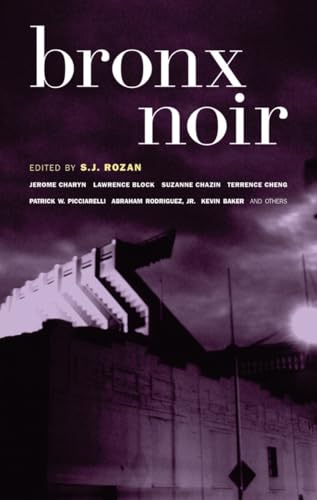
Akashic Books continues its groundbreaking series of original noir anthologies, launched in 2004 with Brooklyn Noir. Each story is set in a distinct neighborhood or location within the city of the book.
Brand new stories by: Jerome Charyn, Lawrence Block, Suzanne Chazin, Terrence Cheng, Pat Picciarelli, Abraham Rodriguez, Kevin Baker, S.J. Rozan, Steven Torres, and others.
From the introduction by S.J. Rozan:
You can’t pack so much yearning, so many people, such a range of everything—income, ethnicity, occupation, land use—into a single borough, even one as big as the Bronx, and not force the kind of friction that slices and sparks. The Bronx has been the home to big-time gangsters—from the Jewish organized crime of Murder Inc. and the Italian Cosa Nostra to the equally organized drug-dealing gangstas of today. The Third Avenue El was a Hopperesque symbol of urban hopelessness; it’s been demolished, but trains on other lines still rumble through the roofscapes of the borough. Prosperity is increasing and drug use is decreasing, but the public housing projects in the Bronx are some of the nation’s largest and remain some of its toughest. Many places in the Bronx seem hidden in shadows, just as the Bronx itself is in Manhattan’s shadow. And dark stories develop best in shadows . . .
"synopsis" may belong to another edition of this title.
About the Author
S.J. ROZAN was born and raised in the Bronx and is a life-long New Yorker. She’s the author of eight novels in the Lydia Chin/Bill Smith series, the stand-alones Absent Friends and In This Rain, and is the editor of Bronx Noir. Her book Winter and Night won the Edgar, Nero, and Macavity Awards for Best Novel, and was nominated for the Shamus, Anthony, and Barry Awards. Two of her previous books have won the Shamus for Best Novel and another won the Anthony for Best Novel. Her most recent novel is The Mayors of New York.
Reviews
Akashic's latest city-themed crime anthology successfully captures the immense diversity of the Bronx, from the mean streets of the South Bronx to affluent Riverdale, in 19 tales by authors both well known and obscure. The most imaginative entry, Joseph Wallace's The Big Five, about a hunter who targets his prey in the Bronx Zoo as part of a national contest, concludes with a satisfying noir twist. Lawrence Block's Riverdale story, Rude Awakening, also surprises the reader with its clever resolution of a one-night stand. Particularly inventive is Kevin Baker's grim The Cheers Like Waves, set in the shadow of Yankee Stadium. Rozan, herself a contributor, has put together one of the series' better entries, with memorable tales of betrayal and despair that reflect the borough's varied ethnic populations and geography. (Aug.)
Copyright © Reed Business Information, a division of Reed Elsevier Inc. All rights reserved.
Excerpt. © Reprinted by permission. All rights reserved.
Bronx Noir
Akashic Books
Copyright © 2007 Akashic BooksAll right reserved.
ISBN: 978-1-933354-25-5
Contents
IntroductionPART I: BRING IT ON HOME...............................................................19Jerome Charyn White Trash Claremont/Concourse........................................26Terrence Cheng Gold Mountain Lehman College..........................................52Joanne Dobson Hey, Girlie Sedgwick Avenue............................................66Rita Lakin The Woman Who Hated the Bronx Elder AvenuePART II: IN THE STILL OF THE NIGHT.....................................................87Lawrence Block Rude Awakening Riverdale..............................................97Suzanne Chazin Burnout Jerome Avenue.................................................114Kevin Baker The Cheers Like Waves Yankee Stadium.....................................136Abraham Rodriguez, Jr. Jaguar South BronxPART III: ANOTHER SATURDAY NIGHT.......................................................153Steven Torres Early Fall..............................................................177S.J. Rozan Hothouse Botanical Garden.................................................191Thomas Bentil Lost and Found Rikers Island...........................................206Marlon James Look What Love Is Doing to Me WilliamsbridgePART IV: THE WANDERER..................................................................221Sandra Kitt Home Sweet Home City Island..............................................242Robert J. Hughes A Visit to St. Nick's Fordham Road..................................273Miles Marshall Lewis Numbers Up Baychester...........................................289Joseph Wallace The Big Five Bronx ZooPART V: ALL SHOOK UP...................................................................313Ed Dee Ernie K.'s Gelding Van Cortlandt Park.........................................328Patrick W. Picciarelli The Prince of Arthur Avenue Arthur Avenue.....................342Thomas Adcock You Want I Should Whack Monkey Boy? Courthouse..........................362About the Contributors
Introduction
Welcome to Da Bronx
The Bronx is a wonderful place.
"Wonderful" in the literal sense: full of wonders.
Wonders everyone's heard of, like the Bronx Zoo and Yankee Stadium; wonders that make presidents cry, as Jimmy Carter famously did in 1977, standing in the rubble of the South Bronx; and wonders only we Bronxites seem to know about, like Wave Hill, City Island, and Arthur Avenue.
People are always discovering the Bronx. Native Americans, of course, discovered it first, fishing and hunting in its woods and streams long before Europe discovered the New World. The first European to settle north of the Harlem River was one Jonas Bronck, in 1639. Jonas and his family worked part of his huge swath of land and leased the rest to other farmers. Everyone in the area gave their address as "the Broncks' farm," giving rise to the "the" and eventually the "x." (There-we're giving you not only great stories, but a party trick fact.) And development and industrialization, sparked by the railroad in the early 1840s, probably took care of the "farm."
In 1895, New York City discovered the Bronx, and Westchester discovered it didn't own the place anymore. In 1914, New York State discovered it needed a sixty-second county, and Bronx County was born.
Immigrants discovered the Bronx in waves. Germans, Italians, and Irish came early, and then European Jews. The Grand Concourse, modeled on the Champs-lyses in Paris, was built to draw them northward. In the 1960s, as the second and third generations of those immigrants moved to the suburbs, Puerto Ricans and blacks took their places. Now they're being joined by Latinos from all over Central and South America, Caribbean islanders, Eastern Europeans, Africans, Asians, and, of course, yuppies. Sooner or later, everyone discovers the Bronx.
Parts of the Bronx suffered badly from the governmental anti-urbanism and heavy-handed "city planning" of the '50s and '60s, and to a lot of people "the Bronx" became another term for "urban decay." 'Twas never true. Though the worst America has to offer its poorer citizens can be found in some areas of the Bronx-this is what brought Jimmy Carter to tears-great stretches are what they've always been: neighborhoods of working-class people, native-born and immigrants, looking for a break. And there were two-family row houses along Sedgwick Avenue, mansions in Riverdale, and fishing boats sailing out from City Island before, during, and after the filming of Fort Apache, The Bronx. (A personal note: In my previous life as an architect, my firm did the new building for the 41st Precinct, which had been Fort Apache until the city clear-cut the blocks around it and the NYPD started calling it Little House on the Prairie.)
If you want to discover the Bronx yourself, you might go up to Van Cortlandt Park to watch white-uniformed West Indians playing cricket on the emerald grass. They're there most summer Sundays, just north of the swimming pool, south of a rowdy soccer game, west of the riding stable, and east of the elevated subway that runs along Broadway. That subway line-the Number 1, by the way, and need I say more?-ends there, at 242nd Street, but the Bronx goes on for another mile. Or you might try the Botanical Garden, the Zoo, the House That Ruth Built-Yankee Stadium, for you tinhorns-or the new Antiques Row just over the Third Avenue Bridge. These are all terrific destinations, but the real discovery will be the size of the place and the diversity of the lives you'll glimpse as you pass through.
And in this wondrous Bronx, the exceptional writers in this collection have found noir corners, dark moments, and rich places of astonishing variety. You can't pack so much yearning, so many people, such a range of everything-income, ethnicity, occupation, land use-into a single borough, even one as big as the Bronx, and not force the kind of friction that slices and sparks. The Bronx has been home to big-time gangsters-from the Jewish organized crime of Murder Inc. and the Italian Cosa Nostra to the equally organized drug-dealing gangstas of today. The Third Avenue El was a Hopperesque symbol of urban hopelessness; it's been demolished, but trains on other lines still rumble through the roofscapes of the borough. Prosperity is increasing and drug use is decreasing, but the public housing projects in the Bronx are some of the nation's largest and remain some of its toughest. Many places in the Bronx seem hidden in shadows, just as the Bronx itself is in Manhattan's shadow. And dark stories develop best in shadows.
From Abraham Rodriguez, Jr.'s South Bronx to Robert Hughes's Fordham Road, from Joseph Wallace's Bronx Zoo to Terrence Cheng's Lehman College, from Joanne Dobson's post-WWII Sedgwick Avenue to Lawrence Block's new wave-yuppie Riverdale, it's all here. In this book, we offer a hint of the cultural, social, economic, and geographic range of the only New York City borough on the mainland of North America. Ladies and gentlemen, welcome to Da Bronx.
S.J. Rozan The Bronx June 2007
(Continues...)
Excerpted from Bronx Noir Copyright © 2007 by Akashic Books. Excerpted by permission.
All rights reserved. No part of this excerpt may be reproduced or reprinted without permission in writing from the publisher.
Excerpts are provided by Dial-A-Book Inc. solely for the personal use of visitors to this web site.
"About this title" may belong to another edition of this title.
Search results for Bronx Noir (Akashic Noir)

Stock Image
Bronx Noir
Seller: Better World Books, Mishawaka, IN, U.S.A.
Seller rating 5 out of 5 stars

Condition: Good. Former library copy. Pages intact with minimal writing/highlighting. The binding may be loose and creased. Dust jackets/supplements are not included. Includes library markings. Stock photo provided. Product includes identifying sticker. Better World Books: Buy Books. Do Good. Seller Inventory # 3833505-6
Stock Image
Bronx Noir
Seller: Better World Books, Mishawaka, IN, U.S.A.
Seller rating 5 out of 5 stars
Condition: Good. Pages intact with minimal writing/highlighting. The binding may be loose and creased. Dust jackets/supplements are not included. Stock photo provided. Product includes identifying sticker. Better World Books: Buy Books. Do Good. Seller Inventory # 3833504-6
Stock Image
Bronx Noir
Seller: TotalitarianMedia, Los Angeles, CA, U.S.A.
Seller rating 4 out of 5 stars

Soft cover. Condition: Good. No Jacket. Bronx Noir. ed. S. J. Rozan. Akashic Books, 2007. 361p. trade paperback, covers bumped/scuffed, binding tight, text clean/unmarked, sticker ff--1933354259 ISBN 13: 9781933354255--3.00. Seller Inventory # ABE-1558551925167
Stock Image
Bronx Noir
Seller: ThriftBooks-Dallas, Dallas, TX, U.S.A.
Seller rating 5 out of 5 stars
Paperback. Condition: Fair. No Jacket. Former library book; Readable copy. Pages may have considerable notes/highlighting. ~ ThriftBooks: Read More, Spend Less. Seller Inventory # G1933354259I5N10
Seller Image
Bronx Noir (Akashic Noir)
Seller: Greenworld Books, Arlington, TX, U.S.A.
Seller rating 5 out of 5 stars
Condition: good. Fast Free Shipping â" Good condition. It may show normal signs of use, such as light writing, highlighting, or library markings, but all pages are intact and the book is fully readable. A solid, complete copy that's ready to enjoy. Seller Inventory # GWV.1933354259.G
Seller Image
Bronx Noir
Seller: GreatBookPrices, Columbia, MD, U.S.A.
Seller rating 5 out of 5 stars
Condition: New. Seller Inventory # 4962055-n
Stock Image
Bronx Noir (Akashic Noir)
Seller: Lakeside Books, Benton Harbor, MI, U.S.A.
Seller rating 5 out of 5 stars
Condition: New. Brand New! Not Overstocks or Low Quality Book Club Editions! Direct From the Publisher! We're not a giant, faceless warehouse organization! We're a small town bookstore that loves books and loves it's customers! Buy from Lakeside Books! Seller Inventory # OTF-S-9781933354255
Stock Image
Bronx Noir (Akashic Noir)
Seller: Books From California, Simi Valley, CA, U.S.A.
Seller rating 4 out of 5 stars
paperback. Condition: Very Good. Seller Inventory # mon0004091849
Seller Image
Bronx Noir (Paperback or Softback)
Published by
Akashic Books 8/1/2007, 2007
ISBN 10: 1933354259
ISBN 13: 9781933354255
New
Paperback or Softback
Seller: BargainBookStores, Grand Rapids, MI, U.S.A.
Seller rating 5 out of 5 stars
Paperback or Softback. Condition: New. Bronx Noir. Book. Seller Inventory # BBS-9781933354255
Stock Image
Bronx Noir (Akashic Noir)
Seller: California Books, Miami, FL, U.S.A.
Seller rating 4 out of 5 stars
Condition: New. Seller Inventory # I-9781933354255