
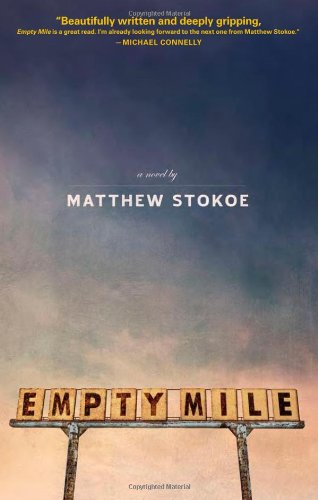
Items related to Empty Mile: A Novel
Synopsis
When Johnny Richardson returns to Oakridge he has one thing on his mind--correcting a terrible mistake that caused him to flee his hometown eight years ago. Revisiting the past, though, is a dark and dangerous game in small-town America. When a careless sexual episode leads to the suicide of the town s first lady, Johnny finds himself the target of a revenge campaign that threatens to tear apart the fragile world he s built among the gold-bearing mountains of Northern California.Left an unexplained piece of land when his father mysteriously disappears, Johnny must unravel its secrets in a desperate bid to protect those he loves. But his efforts to do this have deadly consequences and will ultimately force him to confront not only his own failings, but the very nature of guilt.A searing meditation on the futility of trying to right the wrongs of the past, Empty Mile blends elements of thrilling urban noir with the wide-open spaces of outdoor advent
"synopsis" may belong to another edition of this title.
About the Author
Matthew Stokoe was born in England grew up in Australia. Since then, he has lived in a number of places in between. He is the author of the groundbreaking novels Cows and High Life, and presently lives in Sydney, Australia.
From the Back Cover
“Like the best noir, Empty Mile is rife with desire, desperation, and despair. Matthew Stokoe’s people have dubious motives, ugly secrets, crushing guilt, and suffer dire consequences. But they’re redeemed by the rarest gold in contemporary crime fiction--an author’s genuine empathy."
--Eddie Muller, author of Dark City: The Lost World of Film Noir
“No point in turning up the ‘brightness’ on your set. Empty Mile is a failed-brakes careen of guilt and payback, a Lynchian labyrinth of obsession, secrets, and revenge in small-town America.”
--Janet Fitch, author of Paint It Black
“The tension builds unbearably in this magnificent ‘Sierras Noir’ novel. Stokoe writes damaged people worthy of James M. Cain and Jim Thompson. His star-crossed lovers and broken families will steal your heart, even as Stokoe drives the knife home. I couldn’t stop reading.”
Denise Hamilton, author of the best-selling Eve Diamond series
“Matthew Stokoe’s Empty Mile exemplifies everything that makes good noir so gut-strumming. Surprising, edgy, dangerous, nihilistic, and totally bad-ass.”
--Tom Piccirilli, author of Shadow Season
From the Inside Flap
“High Life is perhaps the greatest neglected masterpiece of true noir. I’ve never read anything like it before or since.”
--Ken Bruen, author of The Guards
“One of the most unstinting, imaginative, brutal, and original contemporary novels ever written about the punishments that come with the prioritization of fame . . . The fact that High Life isn’t regularly mentioned in the same breath with classic, transgressive social satires like American Psycho and Fight Club is a mystery and an injustice . . .”
--Dennis Cooper, author of Ugly Man
Reviews
Starred Review. From the outset of this heartbreakingly powerful contemporary noir, Stokoe (High Life) gets the reader deeply emotionally invested in his guilt-ridden narrator, Johnny Richardson. Eight years after leaving his hometown of Oakridge, Calif., in the foothills of the Sierra Nevada mountains, Johnny returns to face the consequences of a reckless youthful act. Instead of keeping an eye on his then 11-year-old brother, Stan, during an outing to a local lake, Johnny slipped off with his girlfriend, Marla, into the surrounding woods. Left alone, Stan, a smart kid but a poor swimmer, suffered brain damage after nearly drowning in the lake. In the present, Johnny and Marla reconnect, but a suicide prompted by sexual betrayal leads to more deaths. When Stan and Johnny's widowed father disappears, Johnny must look after his brother on his own. Stokoe stays true to a bleak vision of the world as he enmeshes his characters in the kinds of tragic setups reminiscent of a Thomas Hardy novel.
Copyright © Reed Business Information, a division of Reed Elsevier Inc. All rights reserved.
Johnny Richardson returns to Oakridge, California, his hometown, after eight years of self-imposed exile. His inattention allowed his younger brother, Stan, to nearly drown and suffer brain damage, and Johnny's guilt hasn't diminished with time. He resumes his relationship with Marla, his former lover, and agrees to help Stan start a business to lease and maintain decorative plants in the gentrifying former gold rush town, but his own emotional burdens and other events soon lead to suicide, murder, and existential threats to Johnny and the people he cares about. Empty Mile recalls the early David Lynch films Blue Velvet and Twin Peaks, which dwelled on sordid and creepy events in picturesque small towns. Stokoe, like Lynch, portrays Oakridge as a place of stunning beauty that happens to house a roiling cauldron of human jealousy, venality, depravity, and violence. His pace may be a bit too measured. Some crime fans might lose patience, but as the threats mount, he'll have readers right where he wants them: by the throat. --Thomas Gaughan
Excerpt. © Reprinted by permission. All rights reserved.
EMPTY MILE
a novel By MATTHEW STOKOEAkashic Books
Copyright © 2010 Matthew StokoeAll right reserved.
ISBN: 978-1-936070-12-1
Chapter One
Eight years. And now I was back. Back on my street. Back in my town. The house was still two hundred yards away, but I pulled over and killed the engine. From London to San Francisco, from San Francisco to this basin-shaped valley in the foothills of the Sierra Nevada mountains, the anxiety of my return had grown like some ravening tumor until now, with so little left between me and my past, I could no longer stand the tightening cage of the pickup's cabin.I got out and started walking. Fast along the sidewalk. Past houses I had seen a thousand times before. But it wasn't enough. This last distance, this final minute between me and my homecoming was a pain that threatened to blow apart my soul. So I ran. I ran with my arms pumping and my head thrown back. If I had had the breath I would have screamed.
Finally, in front of the house. Finally. Panting, pushing through the low gate, running the short path to the front door, and the front door opening, opening as I approached, swinging back into the house and Stan standing there, shaking his hands and running on the spot in his excitement. My brother Stan, eight years older and bigger, but still everything I remembered.
"Johnny!"
My name leaping from him like it was alive.
"Johnny!"
In that one word, in that snapshot frame of him shaking and running in the doorway, there was everything I needed to tell me that what I had done in leaving Oakridge was irredeemably, indisputably, wrong.
He danced backwards in front of me all the way along the hall, lunging in to hug me over and over, hanging on so tight we almost fell, yelling questions a million miles an hour, faster and faster, gulping for breath until the things he wanted to say outstripped his mouth and all he could manage was "Johnny, Johnny, Johnny, Johnny ..." clapping his hands and smiling so hard I thought his lips would tear.
And then he stepped close and held me, hung on with his arms and pressed his forehead against the side of my neck ... and in doing so tore open the memory by which I was most haunted—Stan in my room on the night I left Oakridge all those years ago, his face pressed against my chest as I hugged him goodbye, the silence drawing out around us, around my awful inability to make my leaving even slightly less catastrophic an event for him, hating the pain I was causing and hating myself because of it.
And the sound that had echoed through all my days afterwards, the only sound he had made against me—a single dreadful sob, bitten down on as soon as it was out. And as we stepped back from each other, seeing that he had forced himself not to cry so that I might not feel any worse than I already did. So that I could go and do what I had to do without the weight of his unhappiness holding me back.
Now, Stan pulled away and he was smiling.
"Hey, I want to see who's tallest."
We stood back-to-back and he ran the flat of his hand across his head to feel where it hit mine. He was much taller than he had been and his body, which had begun to soften in the years after his accident, had grown bulky and curved. I wanted him to be small again, to be the boy I towered over and my arms fit around, but he outweighed me now by forty pounds.
"You're still bigger than me, Johnny, but I'm almost there."
It seemed to me that morning that so much needed to be explained to him, to be made right, to be excused. But all I could do was say lamely, "I'm sorry I stayed away so long."
Stan laughed.
"But you're back now! Dad'll be here tonight."
"He couldn't take time off?"
Stan shrugged. "Do you have a car?"
"A pickup."
"I'm not allowed to drive. Look, I'm wearing your jacket."
In my early twenties I'd lived in a black leather biker jacket. I'd given it to him as a going-away present. At twenty-three it fit him now, though tightly. Under it he wore a pale blue bowling shirt with his name embroidered on the left breast. With his dark hair slicked back and his square blackframed glasses he looked like some chubby '50s garage attendant.
"I like the look, Stan."
"Yeah, it's sharp."
We went out into the back garden. It was long and narrow and from our position on the northern slope of the Oakridge basin it gave a view back across the town. Beds of flowers and small shrubs had been newly planted against the enclosing wooden fence. They were tidy and well cared for. Stan saw me looking at them and puffed up.
"I do the garden."
"Really?"
"I've got green fingers."
He fluttered his fingers in front of my face and began to point out his work.
"These are blue pearl. They flower in spring and summer and they like the sun. This one here is a peace lily, you have to give it a lot of water."
"How do you know all this stuff?"
Stan tried to hold it in but couldn't. "It's my job."
"You got a job?"
"At the garden center. I catch the bus. I've been working all year."
"Why didn't you tell me?"
"So it was a surprise."
Below us on the floor of the valley, Old Town—Oakridge's original Gold Rush heart of 1800s wooden buildings—glowed whitely at the center of town. In the distance, further south, a thin curve of the Swallow River glittered.
"Stan, do you ever see Marla around?"
"Sure."
"How does she look?"
"She looks good."
"Does she ever say anything about me?"
"Of course she does, Johnny. She always asks how you are."
Later, I walked up the street and showed Stan my pickup and moved it closer to the house. I carried my things inside and went upstairs. I'd been traveling solidly for a day and a half and I was tired.
Despite the sunlight that fell dustily through the windows, my bedroom was cold. When I was twenty-one I'd moved out of the house to live with Marla and my father had stripped it bare. It had been empty ever since and on the day of my return all I could find of the time I had spent there was a set of grubby outlines on the cream walls where my posters had been. A single bed had been placed under one of the windows and there was a small table beside it. There was nothing else.
I had not expected a magically reconstructed teenage cocoon, but the barrenness of the room was dispiriting. Like my father not being there to meet me.
I sat on the edge of the bed. Outside, I could hear a bird singing and further away the occasional distant grinding of an engine as someone drove up the slope from town. The scent of the carpet, the walls, the dusty air ... All of it closed about me and for a moment I was able to force a sense of belonging. But it wouldn't hold and I was left with what the room most meant to me—sitting, like this, every night when I was eighteen and nineteen and twenty, staring at nothing, wishing that I had not left Stan alone the day we went up to Tunney Lake.
I lay down on the bed and after a while I fell asleep.
(Continues...)
Excerpted from EMPTY MILEby MATTHEW STOKOE Copyright © 2010 by Matthew Stokoe. Excerpted by permission of Akashic Books. All rights reserved. No part of this excerpt may be reproduced or reprinted without permission in writing from the publisher.
Excerpts are provided by Dial-A-Book Inc. solely for the personal use of visitors to this web site.
"About this title" may belong to another edition of this title.
Search results for Empty Mile: A Novel

Stock Image
Solving Problems In Couples And Family Therapy: Techniques And Tactics
Seller: HPB-Diamond, Dallas, TX, U.S.A.
Seller rating 5 out of 5 stars

hardcover. Condition: Very Good. Connecting readers with great books since 1972! Used books may not include companion materials, and may have some shelf wear or limited writing. We ship orders daily and Customer Service is our top priority! Seller Inventory # S_470468049
Stock Image
Empty Mile
Seller: Better World Books, Mishawaka, IN, U.S.A.
Seller rating 5 out of 5 stars
Condition: Good. Former library copy. Pages intact with minimal writing/highlighting. The binding may be loose and creased. Dust jackets/supplements are not included. Includes library markings. Stock photo provided. Product includes identifying sticker. Better World Books: Buy Books. Do Good. Seller Inventory # 2768654-6