
Items related to Last of the Giants: The Rise and Fall of Earth s Most...
Synopsis
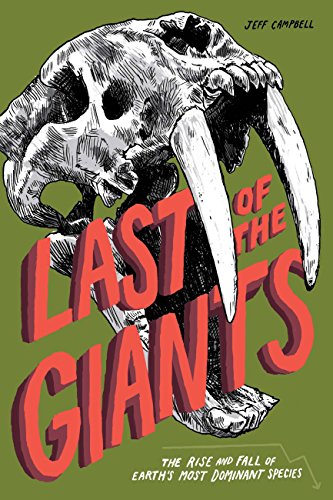
Today, an ancient world is vanishing right before our eyes: the age of giant animals. Over 40,000 years ago, the earth was ruled by megafauna: mammoths and mastodons, saber-toothed tigers and giant sloths. Of course, those creatures no longer exist, due to the evolution and arrival of the wildly adaptive human species, among other factors. Many more of the world's biggest and baddest creatures - including the black rhino, the dodo, giant tortoises, and the great auk - have vanished since our world became truly global. Last of the Giants chronicles those giant animals and apex predators who have been pushed to extinction in the modern era.
"synopsis" may belong to another edition of this title.
About the Author
Jeff Campbell, author of Daisy to the Rescue (2014) and Last of the Giants (2015), is a writer and book editor who has enjoyed a diverse 25-year career in publishing. He was an award-winning travel writer for Lonely Planet for over a decade, coauthoring a dozen travel guides, including several editions of USA, Hawaii, Florida, and Southwest. As a book editor, he has specialized in nonfiction, notably helping to develop four of Dr. Marc Bekoff’s books on the emotional lives of animals, which inspired his passion for his own writing about animals. Currently, Jeff is also a part-time creative writing teacher for grade school students in Morristown, New Jersey, where he lives with his wife and children.
Reviews
Gr 9 Up—The extinctions of giant (both in size and number) species at the mercy of nature and humanity turn out to be a fascinating and jarring lesson for our present. Chronicling the fates of aurochs, moa, passenger pigeons, and sea cows, alongside the unresolved destinies of today's lions and tigers, this work gazes back at evolutionary history through a retrospect that, with the aid of Campbell's humorous and scientific tone, is truly 20/20. Thankfully, the text's explorations of these annihilated species are complex and perceptive and go beyond the usual worn conclusion of human-wrought woe. Mixing geology, ethnography, history, zoology, biology, industry, and sociology, Campbell demonstrates how interconnected Earth's species and societies—human and nonhuman—are. By examining the complex web of evolution through the misfortunes of these lost species, the author drives home that our present is not a final, linear result of history but rather an ever-evolving system that needs care and attention. To that end, a "Call to Action" section laden with resources for the aspiring activist appears at the end; though there is no index, an extensive list of works cited illuminates a path for those who wish to read further. VERDICT Required reading for the budding naturalist and a good pairing for a STEM or history curriculum, too.—Chelsea Woods, New Brunswick Free Public Library, NJ
"About this title" may belong to another edition of this title.
Search results for Last of the Giants: The Rise and Fall of Earth s Most...

Seller Image
Last of the Giants: The Rise and Fall of Earth s Most Dominant Species
Seller: Bay State Book Company, North Smithfield, RI, U.S.A.
Seller rating 5 out of 5 stars

Condition: good. The book is in good condition with all pages and cover intact, including the dust jacket if originally issued. The spine may show light wear. Pages may contain some notes or highlighting, and there might be a "From the library of" label. Boxed set packaging, shrink wrap, or included media like CDs may be missing. Seller Inventory # BSM.17LSC
Stock Image
Last of the Giants: The Rise and Fall of Earth's Most Dominant Species
Seller: World of Books (was SecondSale), Montgomery, IL, U.S.A.
Seller rating 5 out of 5 stars
Condition: Very Good. Item in very good condition! Textbooks may not include supplemental items i.e. CDs, access codes etc. Seller Inventory # 00108825494
Stock Image
Last of the Giants: The Rise and Fall of Earth's Most Dominant Species
Seller: World of Books (was SecondSale), Montgomery, IL, U.S.A.
Seller rating 5 out of 5 stars
Condition: Acceptable. Item in Acceptable condition. Textbooks may not include supplemental items i.e. CDs, access codes etc. Seller Inventory # 00110201376
Stock Image
Last of the Giants: The Rise and Fall of Earth's Most Dominant Species
Seller: ThriftBooks-Dallas, Dallas, TX, U.S.A.
Seller rating 5 out of 5 stars
Paperback. Condition: As New. No Jacket. Pages are clean and are not marred by notes or folds of any kind. ~ ThriftBooks: Read More, Spend Less. Seller Inventory # G1942186045I2N00
Stock Image
Last of the Giants: The Rise and Fall of Earth's Most Dominant Species
Seller: ThriftBooks-Dallas, Dallas, TX, U.S.A.
Seller rating 5 out of 5 stars
Paperback. Condition: Very Good. No Jacket. Former library book; May have limited writing in cover pages. Pages are unmarked. ~ ThriftBooks: Read More, Spend Less. Seller Inventory # G1942186045I4N10
Stock Image
Last of the Giants: The Rise and Fall of Earth's Most Dominant Species
Seller: ThriftBooks-Atlanta, AUSTELL, GA, U.S.A.
Seller rating 5 out of 5 stars
Paperback. Condition: Very Good. No Jacket. Former library book; May have limited writing in cover pages. Pages are unmarked. ~ ThriftBooks: Read More, Spend Less. Seller Inventory # G1942186045I4N10
Stock Image
Last of the Giants: The Rise and Fall of Earth's Most Dominant Species
Seller: ThriftBooks-Reno, Reno, NV, U.S.A.
Seller rating 5 out of 5 stars
Paperback. Condition: Very Good. No Jacket. Former library book; May have limited writing in cover pages. Pages are unmarked. ~ ThriftBooks: Read More, Spend Less. Seller Inventory # G1942186045I4N10
Stock Image
Last of the Giants: The Rise and Fall of Earth's Most Dominant Species
Seller: The Maryland Book Bank, Baltimore, MD, U.S.A.
Seller rating 5 out of 5 stars
paperback. Condition: Good. Cormers are slightly bent. Used - Good. Seller Inventory # 1-y-5-1234
Stock Image
Last of the Giants : The Rise and Fall of Earth's Most Dominant Species
Published by
Lerner Publishing Group, 2016
ISBN 10: 1942186045
ISBN 13: 9781942186045
Used
Softcover
Seller: Better World Books, Mishawaka, IN, U.S.A.
Seller rating 5 out of 5 stars
Condition: Very Good. Pages intact with possible writing/highlighting. Binding strong with minor wear. Dust jackets/supplements may not be included. Stock photo provided. Product includes identifying sticker. Better World Books: Buy Books. Do Good. Seller Inventory # 7704443-6
Stock Image
Last of the Giants : The Rise and Fall of Earth's Most Dominant Species
Published by
Lerner Publishing Group, 2016
ISBN 10: 1942186045
ISBN 13: 9781942186045
Used
Softcover
Seller: Better World Books, Mishawaka, IN, U.S.A.
Seller rating 5 out of 5 stars
Condition: Very Good. Former library copy. Pages intact with possible writing/highlighting. Binding strong with minor wear. Dust jackets/supplements may not be included. Includes library markings. Stock photo provided. Product includes identifying sticker. Better World Books: Buy Books. Do Good. Seller Inventory # 11985202-6