
Items related to The Long Descent: A User's Guide to the End of...
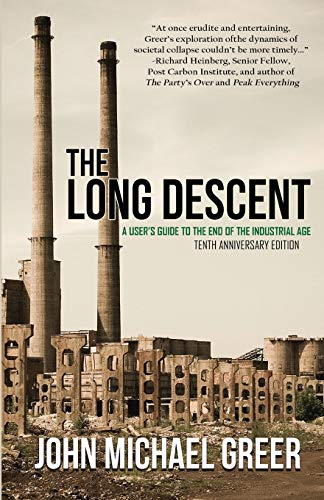
Synopsis
The visionary classic that traces out the twilight of the petroleum age
In 2008, as the price of crude oil spiked to record levels, John Michael Greer's The Long Descent pushed past the stereotyped debates of the time to offer a harrowing but hopeful vision of the future of industrial society. As believers in perpetual progress insisted that something would turn up to replace depleting petroleum reserves, and believers in apocalypse insisted just as fervently that the spike in oil prices would send industrial society crashing down in ruin overnight, Greer's epochal book reframed the entire debate in terms of the great rhythm of rise and fall the marks the history of civilizations.
The Long Descent traces out the ragged course of decline that has brought every previous civilization to its end, and is doing the same with ours. It takes the average civilization one to three hundred years to descend from its peak into a dark age out of which new civilizations will be born, and that same process is visibly under way in our own lives. The global challenges facing industrial civilization are not problems that we can solve, but predicaments that all of us must live with, as our societies stumble down the long slope to the deindustrial future.
Much can still be done as the petroleum age winds down, and the interval between one spike in oil prices and the next offers opportunities that will no longer be available when the price of everything made from petroleum starts soaring again — as it will. The Long Descent offers crucial insights into what individuals, families, small groups, and local communities can do to brace themselves for the changes to come.
"synopsis" may belong to another edition of this title.
Search results for The Long Descent: A User's Guide to the End of...

Stock Image
The Long Descent: A User's Guide to the End of the Industrial Age
Published by
Founders House Publishing LLC, 2019
ISBN 10: 1945810289
ISBN 13: 9781945810282
Used
Paperback
Seller: ThriftBooks-Atlanta, AUSTELL, GA, U.S.A.
Seller rating 5 out of 5 stars

Paperback. Condition: As New. No Jacket. Pages are clean and are not marred by notes or folds of any kind. ~ ThriftBooks: Read More, Spend Less. Seller Inventory # G1945810289I2N00
Stock Image
The Long Descent: A User's Guide to the End of the Industrial Age
Published by
Founders House Publishing LLC, 2019
ISBN 10: 1945810289
ISBN 13: 9781945810282
Used
Paperback
Seller: World of Books (was SecondSale), Montgomery, IL, U.S.A.
Seller rating 5 out of 5 stars
Paperback. Condition: Good. A harrowing but ultimately hopeful vision of the aftermath of the age of oil. Americans are expressing deep concern about US dependence on petroleum, rising energy prices and the threat of climate change. Unlike the energy crisis of the 1970s, however, there is a lurking fear that, now, the times are different and the crisis may not easily be resolved. The Long Descent examines the basis of such fear through three core themes: Industrial society is following the same well-worn path that has led other civilizations into decline, a path involving a much slower and more complex transformation than the sudden catastrophes imagined by so many social critics today. The roots of the crisis lie in the cultural stories that shape the way we understand the world. Since problems cannot be solved with the same thinking that created thyem, these ways of thinking need to be replaced with others better suited to the needs of our time. It is too late for massive programs for top-down change; the change must come from individuals. Hope exists in actions that range from taking up a handicraft or adopting an obsolete technology, through planting an organic vegetable garden, taking charge of your own health care or spirituality, and building community. Focusing eloquently on constructive adaptation to massive change, this book will have wide appeal. Seller Inventory # 00110860775
Stock Image
The Long Descent: A User's Guide to the End of the Industrial Age
Published by
Founders House Publishing LLC, 2019
ISBN 10: 1945810289
ISBN 13: 9781945810282
Used
Paperback
Seller: World of Books (was SecondSale), Montgomery, IL, U.S.A.
Seller rating 5 out of 5 stars
Paperback. Condition: Very Good. A harrowing but ultimately hopeful vision of the aftermath of the age of oil. Americans are expressing deep concern about US dependence on petroleum, rising energy prices and the threat of climate change. Unlike the energy crisis of the 1970s, however, there is a lurking fear that, now, the times are different and the crisis may not easily be resolved. The Long Descent examines the basis of such fear through three core themes: Industrial society is following the same well-worn path that has led other civilizations into decline, a path involving a much slower and more complex transformation than the sudden catastrophes imagined by so many social critics today. The roots of the crisis lie in the cultural stories that shape the way we understand the world. Since problems cannot be solved with the same thinking that created thyem, these ways of thinking need to be replaced with others better suited to the needs of our time. It is too late for massive programs for top-down change; the change must come from individuals. Hope exists in actions that range from taking up a handicraft or adopting an obsolete technology, through planting an organic vegetable garden, taking charge of your own health care or spirituality, and building community. Focusing eloquently on constructive adaptation to massive change, this book will have wide appeal. Seller Inventory # 00110402344
Seller Image
The Long Descent: A User's Guide to the End of the Industrial Age
Published by
Founders House Publishing LLC, 2019
ISBN 10: 1945810289
ISBN 13: 9781945810282
Used
Softcover
Seller: -OnTimeBooks-, Phoenix, AZ, U.S.A.
Seller rating 5 out of 5 stars
Condition: very_good. Gently read. May have name of previous ownership, or ex-library edition. Binding tight; spine straight and smooth, with no creasing; covers clean and crisp. Minimal signs of handling or shelving. 100% GUARANTEE! Shipped with delivery confirmation, if you're not satisfied with purchase please return item! Ships USPS Media Mail. Seller Inventory # OTV.1945810289.VG
Stock Image
The Long Descent: A User's Guide to the End of the Industrial Age
Published by
Founders House Publishing LLC, 2019
ISBN 10: 1945810289
ISBN 13: 9781945810282
Used
Paperback
Seller: World of Books Inc, Montgomery, IL, U.S.A.
Seller rating 4 out of 5 stars

Paperback. Condition: Good. A harrowing but ultimately hopeful vision of the aftermath of the age of oil. Americans are expressing deep concern about US dependence on petroleum, rising energy prices and the threat of climate change. Unlike the energy crisis of the 1970s, however, there is a lurking fear that, now, the times are different and the crisis may not easily be resolved. The Long Descent examines the basis of such fear through three core themes: Industrial society is following the same well-worn path that has led other civilizations into decline, a path involving a much slower and more complex transformation than the sudden catastrophes imagined by so many social critics today. The roots of the crisis lie in the cultural stories that shape the way we understand the world. Since problems cannot be solved with the same thinking that created thyem, these ways of thinking need to be replaced with others better suited to the needs of our time. It is too late for massive programs for top-down change; the change must come from individuals. Hope exists in actions that range from taking up a handicraft or adopting an obsolete technology, through planting an organic vegetable garden, taking charge of your own health care or spirituality, and building community. Focusing eloquently on constructive adaptation to massive change, this book will have wide appeal. Seller Inventory # CIN1945810289G
Stock Image
The Long Descent: A User's Guide to the End of the Industrial Age
Published by
Founders House Publishing LLC, 2019
ISBN 10: 1945810289
ISBN 13: 9781945810282
Used
Paperback
Seller: World of Books Inc, Montgomery, IL, U.S.A.
Seller rating 4 out of 5 stars
Paperback. Condition: Very Good. A harrowing but ultimately hopeful vision of the aftermath of the age of oil. Americans are expressing deep concern about US dependence on petroleum, rising energy prices and the threat of climate change. Unlike the energy crisis of the 1970s, however, there is a lurking fear that, now, the times are different and the crisis may not easily be resolved. The Long Descent examines the basis of such fear through three core themes: Industrial society is following the same well-worn path that has led other civilizations into decline, a path involving a much slower and more complex transformation than the sudden catastrophes imagined by so many social critics today. The roots of the crisis lie in the cultural stories that shape the way we understand the world. Since problems cannot be solved with the same thinking that created thyem, these ways of thinking need to be replaced with others better suited to the needs of our time. It is too late for massive programs for top-down change; the change must come from individuals. Hope exists in actions that range from taking up a handicraft or adopting an obsolete technology, through planting an organic vegetable garden, taking charge of your own health care or spirituality, and building community. Focusing eloquently on constructive adaptation to massive change, this book will have wide appeal. Seller Inventory # CIN1945810289VG
Seller Image
The Long Descent: A User's Guide to the End of the Industrial Age
Published by
Founders House Publishing LLC, 2019
ISBN 10: 1945810289
ISBN 13: 9781945810282
Used
Softcover
Seller: Goodwill Books, Hillsboro, OR, U.S.A.
Seller rating 5 out of 5 stars
Condition: good. Signs of wear and consistent use. Seller Inventory # GICWV.1945810289.G