
Items related to Civilization in Overdrive: Conversations at the Edge...
Synopsis
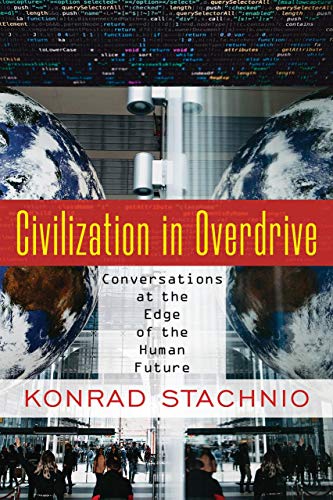
CIVILIZATION IN OVERDRIVE: Conversations at the Edge of the Human Future provides an astonishing tour of how the world's future looks to those likely to know the most about it. Journalist Konrad Stachnio engages 17 experts, global opinion leaders in their respective fields, in discussions on artificial intelligence, finance, the economy, technology, world order, the military, cultural change and more. His well-researched and probing questions draw out striking revelations from his guests on where 21st century civilization is leading us, raising further questions as to whether we want to go there, and if that could be prevented. The trends anticipated by the interviewees are ground-breaking, sometimes shocking. This book is a plunge into the unexpected, forcing us to bid farewell to our familiar yet increasingly complex world which is irrevocably disappearing before our eyes and morphing into dimensions even more complex and less comprehensible. Interviewees and topics include:
Douglas Rushkoff, named by MIT as one of the “world's ten most influential intellectuals,” on whether we still have the chance to be self-determining individuals in the all-encompassing world of algorithms and AI.
John Perkins, the author of the book Confessions of an Economic Hit Man, which spent over 70 weeks on the New York Times bestseller list and has been published in 32 languages worldwide on the global revolution just around the corner.
Aleksandr Dugin, one of the best-known writers and political commentators in post-Soviet Russia, considered one of the most contentious thinkers of the modern world, on whether the modern technological path we take is inevitable.
Tim Draper, one of the most successful venture capitalists of all time, as well as among the most instrumental and prominent people in Silicon Valley today, on Blockchain, cryptocurrencies, and how they will affect finance, economics, and work.
William Binney former geopolitical world Technical Director of NSA about what digital terrorism will look like in the future and whether we already live in the Chinese model of 'social credit'.
Mikhail A. Lebedev, award-winning scientist in the fields of Neurophysiology and Brain-Computer Interfaces on the impact connecting their brains with machines and implanting chips into them will have on people.
Paul Craig Roberts, former Assistant Treasury Secretary, Wall Street Journal Associate Editor,
And more...
"synopsis" may belong to another edition of this title.
About the Author
Konrad Stachnio is an independent journalist whose main interests include AI, science, geopolitics, armed conflicts, terrorism, broadly understood social and cultural changes in the world. He collaborated with news websites such as New Eastern Outlook and Vice. His articles have been reprinted and translated into many languages: Italian, Spanish, French, Norwegian, Russian, Hungarian, Czech etc
Excerpt. © Reprinted by permission. All rights reserved.
From Rushkoff interview:
Are technologies and social media making us more connected or rather alienating people now?
Right now, more alienated, and that's because people … they are not engaging face to face. They are losing some of the evolved abilities to establish rapport with other humans. We cannot establish solidarity on the Internet; solidarity is between living people.
Human beings have the home field advantage on planet earth in the real world, and we lose that advantage when we migrate into cyberspace which is the home field for the AIs. So, the more time we spend there, the more time we're away from home.
Elon Musk is currently building the Neuralink company, dealing with communication between our brains. Is this a new kind of interpersonal communication between people, or rather a sign of a complete change in the definition of human itself?Are these maybe the last days of the old type of human being?
Well, it depends. There are so many conversations you can have. You could do it from the transhumanist perspective; how is it changing? What does it mean to be human? Does the definition of the human change or are we sub-speciating? So, there is the original species and there is the new species that has all these technologies or moves to something else.
I now see Silicon Valley more as a kind of religious movement than pure business oriented toward utilitarianism. Would you agree with me?
They are religious, but utilitarianism is a core tenet of their religion. They believe AI will deliver them on the day of the singularity. If you look at the classes they took at Stanford, they all took philosophy with Rene Girard. He was their teacher and he kind of saw human beings as problematic, as evil. So, then you get that when Google says don't do evil, they really mean, don't be human. So, this is sort of sad. But the computer technologists also overestimate their ability and they underestimate the complexity of the human mind. You talk to any real neuroscientist and they say, we have no idea what consciousness is, and you talk to Elon Musk and he is, like, of course, we know what consciousness is!
We don't even know what goes on in one cubic centimetre of soil. So, how're we going to know what goes on in the square foot of a human brain? We have no idea; we are so primitive. To me, worrying about AI replacing our minds is the equivalent of a caveman making a wheel and then saying, so, now we lose our legs.
"About this title" may belong to another edition of this title.
Search results for Civilization in Overdrive: Conversations at the Edge...

Stock Image
Civilization in Overdrive: Conversations at the Edge of the Human Future
Seller: Books From California, Simi Valley, CA, U.S.A.
Seller rating 4 out of 5 stars

Paperback. Condition: Fine. Seller Inventory # mon0004053424
Stock Image
Civilization in Overdrive: Conversations at the Edge of the Human Future
Seller: Books From California, Simi Valley, CA, U.S.A.
Seller rating 4 out of 5 stars
Paperback. Condition: Very Good. Seller Inventory # mon0002960176
Stock Image
Civilization in Overdrive: Conversations at the Edge of the Human Future
Seller: Books From California, Simi Valley, CA, U.S.A.
Seller rating 4 out of 5 stars
Paperback. Condition: New. Seller Inventory # mon0004052348
Seller Image
Civilization in Overdrive: Conversations at the Edge of the Human Future
Published by
CLARITY PR INC, 2020
ISBN 10: 1949762289
ISBN 13: 9781949762280
New
Kartoniert / Broschiert
Seller: moluna, Greven, Germany
Seller rating 5 out of 5 stars

Kartoniert / Broschiert. Condition: New. KlappentextCIVILIZATION IN OVERDRIVE: Conversations at the Edge of the Human Future provides an astonishing tour of how the world s future looks to those likely to know the most about it. Journalist Konrad Stachnio engages 17 expe. Seller Inventory # 394030545
Buy New
US$ 30.56
US$ 54.88 shipping
Ships from Germany to U.S.A.
Ships from Germany to U.S.A.
Quantity: 1 available