
Items related to Music and Power in the Baroque Era (Music, Criticism...
Music and Power in the Baroque Era (Music, Criticism & Politics) (English and Italian Edition) - Hardcover
Synopsis
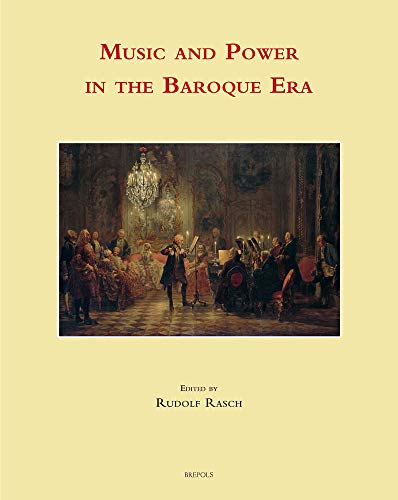
Music always functions in a specific environment and, viewed from the other side, environments use music to confirm and strengthen their identities. Institutions of power have in all times employed music to present themselves to the outside world, alongside other means such as architecture, fine arts, design and fashion. The present volume brings together a number of studies that all deal, in one way or another, with the question of how power was implemented in music in what is called the Baroque Era, roughly the seventeenth century and the first half of the eighteenth. The essays can be grouped under four main headings: court opera, ceremonial music, musicians and miscellaneous studies. Several essays discuss court opera, one of the most conspicuous musical forms with which a monarch could display his power. Music could also accompany festivities and ceremonies of all sorts, of very different kinds of institutions, courtly, civil or ecclesiastical. Not only sovereign rulers could employ music to confirm their power, also lower-ranking powers such as nobility often invested in music in order to gain prestige. Various studies highlight this aspect of music andpower. Finally, there are studies that deal with more general questions, such as the representation of power in Baroque opera, dedications of musical works to royals and other patrons, and the social status of musicians as they are positioned between patrons and public.
"synopsis" may belong to another edition of this title.
Search results for Music and Power in the Baroque Era (Music, Criticism...

Stock Image
Music and Power in the Baroque Era (Music, Criticism & Politics) (English and Italian Edition) [Hardcover] Rasch, Rudolf
Seller: The Scholar's Choice, Wolcott, NY, U.S.A.
Seller rating 4 out of 5 stars

hardcover. Condition: As New. Hardback book with dust jacket. Light shelf wear to the dust jacket, but pages are clean and unmarked. Seller Inventory # W19-005MusicLib30
Stock Image
Music and Power in the Baroque Era
Published by
Brepols Publishers, 2018
ISBN 10: 2503580718
ISBN 13: 9782503580715
New
Hardcover
First Edition
Seller: ISD LLC, Bristol, CT, U.S.A.
Seller rating 5 out of 5 stars

hardcover. Condition: New. 1st. Seller Inventory # 964101
Seller Image
Music and Power in the Baroque Era
Seller: GreatBookPrices, Columbia, MD, U.S.A.
Seller rating 5 out of 5 stars
Condition: As New. Unread book in perfect condition. Seller Inventory # 33127170
Seller Image
Music and Power in the Baroque Era
Seller: GreatBookPrices, Columbia, MD, U.S.A.
Seller rating 5 out of 5 stars
Condition: New. Seller Inventory # 33127170-n
Stock Image
Music and Power in the Baroque Era
Seller: Kennys Bookshop and Art Galleries Ltd., Galway, GY, Ireland
Seller rating 5 out of 5 stars
Condition: New. 2018. Hardcover. . . . . . Seller Inventory # V9782503580715
Buy New
US$ 236.65
US$ 10.64 shipping
Ships from Ireland to U.S.A.
Ships from Ireland to U.S.A.
Quantity: 2 available
Stock Image
Music and Power in the Baroque Era
Seller: Kennys Bookstore, Olney, MD, U.S.A.
Seller rating 5 out of 5 stars
Condition: New. 2018. Hardcover. . . . . . Books ship from the US and Ireland. Seller Inventory # V9782503580715
Seller Image
Music and Power in the Baroque Era
Seller: Joseph Burridge Books, Dagenham, United Kingdom
Seller rating 5 out of 5 stars
Hardcover. Condition: New. XII+463 p., 41 b/w ill., 220 x 280 mm. Languages: English, Italian This book focuses on the relationship between music and power in Baroque Era Music always functions in a specific environment and, viewed from the other side, environments use music to confirm and strengthen their identities. Institutions of power have in all times employed music to present themselves to the outside world, alongside other means such as architecture, fine arts, design and fashion. The present volume brings together a number of studies that all deal, in one way or another, with the question of how power was implemented in music in what is called the Baroque Era, roughly the seventeenth century and the first half of the eighteenth. The essays can be grouped under four main headings: court opera, ceremonial music, "musicians" and miscellaneous studies. Several essays discuss court opera, one of the most conspicuous musical forms with which a monarch could display his power. Music could also accompany festivities and ceremonies of all sorts, of very different kinds of institutions, courtly, civil or ecclesiastical. Not only sovereign rulers could employ music to confirm their power, also lower-ranking powers such as nobility often invested in music in order to gain prestige. Various studies highlight this aspect of "music and power". Finally, there are studies that deal with more general questions, such as the representation of power in Baroque opera, dedications of musical works to royals and other patrons, and the social status of musicians as they are positioned between patrons and public. Seller Inventory # PGBREPOLS53
Buy New
US$ 313.52
US$ 35.73 shipping
Ships from United Kingdom to U.S.A.
Ships from United Kingdom to U.S.A.
Quantity: 1 available
Stock Image
Music and Power in the Baroque Era (Music, Criticism & Politics) (English and Italian Edition)
Seller: Mispah books, Redhill, SURRE, United Kingdom
Seller rating 4 out of 5 stars
hardcover. Condition: New. NEW. SHIPS FROM MULTIPLE LOCATIONS. book. Seller Inventory # ERICA82925035807186
Buy New
US$ 402.13
US$ 33.09 shipping
Ships from United Kingdom to U.S.A.
Ships from United Kingdom to U.S.A.
Quantity: 1 available