
Items related to ACE Inhibitors (Milestones in Drug Therapy)
Synopsis
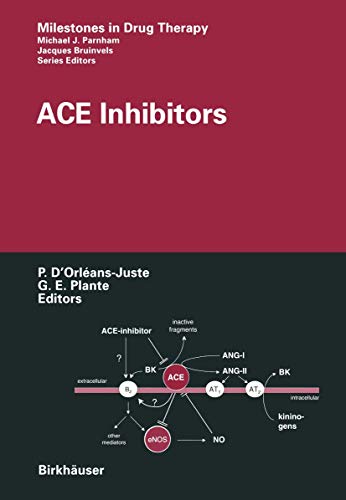
Angiotensin converting enzyme inhibitors (ACEI) represent the first class of antihypertensive agents that was designed and developed on the basis of a well-defined physiopathological axis of arterial hypertension, a vascular dis order that is now becoming one of the major causes of morbidity/mortality, not only in developed societies but also in the highly populated developing coun tries [1]. CAPTOPRIL, the prototype of the "PRIL" family, which now comprises more than 40 molecule-species, was quite hazardous and the clinical develop ment almost failed when serious side-effects were reported in an alarmist fash ion in reputable scientific journals, such as the New England Journal of Medicine and Lancet. Squibb & Sons came very close to withdrawing CAPTOPRIL from clinical investigation [2]. However, after re-examination of the data obtained from different categories of patients and appropriate dose-adjustments, the clinical use of CAPTOPRIL turned out to be revolutionary. The prototype, as well as other members of the "PRIL" family became the starting point for numerous basic and clinical research programs, focusing on the interactions of ACEI with the kinin, endothelin, and nitric oxide systems, and the contribution of the receptors for AT I, AT 2, bradykinin Bland B , ETA and ET B to the pharmacological actions 2 of the respective peptides. This research activity led to the development of new pharmacological agents, such as the angiotensin receptor antagonists and, more recently, the neutral endopeptidase inhibitors. In the near future, bradykinin receptor antagonists also will be available to modulate ACEI phar macological actions.
"synopsis" may belong to another edition of this title.
Search results for ACE Inhibitors (Milestones in Drug Therapy)

Stock Image
ACE Inhibitors (eng)
Print on DemandSeller: Brook Bookstore On Demand, Napoli, NA, Italy
Seller rating 5 out of 5 stars

Condition: new. Questo è un articolo print on demand. Seller Inventory # 9WPIPHAKUK
Buy New
US$ 53.34
US$ 6.16 shipping
Ships from Italy to U.S.A.
Ships from Italy to U.S.A.
Quantity: Over 20 available
Seller Image
ACE Inhibitors
Seller: moluna, Greven, Germany
Seller rating 5 out of 5 stars
Condition: New. Seller Inventory # 4319152
Buy New
US$ 55.81
US$ 54.88 shipping
Ships from Germany to U.S.A.
Ships from Germany to U.S.A.
Quantity: Over 20 available
Stock Image
ACE Inhibitors
Print on DemandSeller: Chiron Media, Wallingford, United Kingdom
Seller rating 5 out of 5 stars
PF. Condition: New. This item is printed on demand. Brand new book, sourced directly from publisher. Dispatch time is 6-7 days from our warehouse. Book will be sent in robust, secure packaging to ensure it reaches you securely. Seller Inventory # 6666-IUK-9783034875813
Buy New
US$ 104.58
US$ 6.68 shipping
Ships from United Kingdom to U.S.A.
Ships from United Kingdom to U.S.A.
Quantity: 20 available
Seller Image
ACE Inhibitors
Seller: AHA-BUCH GmbH, Einbeck, Germany
Seller rating 5 out of 5 stars
Taschenbuch. Condition: Neu. Druck auf Anfrage Neuware - Printed after ordering - Angiotensin converting enzyme inhibitors (ACEI) represent the first class of antihypertensive agents that was designed and developed on the basis of a well-defined physiopathological axis of arterial hypertension, a vascular dis order that is now becoming one of the major causes of morbidity/mortality, not only in developed societies but also in the highly populated developing coun tries [1]. CAPTOPRIL, the prototype of the 'PRIL' family, which now comprises more than 40 molecule-species, was quite hazardous and the clinical develop ment almost failed when serious side-effects were reported in an alarmist fash ion in reputable scientific journals, such as the New England Journal of Medicine and Lancet. Squibb & Sons came very close to withdrawing CAPTOPRIL from clinical investigation [2]. However, after re-examination of the data obtained from different categories of patients and appropriate dose-adjustments, the clinical use of CAPTOPRIL turned out to be revolutionary. The prototype, as well as other members of the 'PRIL' family became the starting point for numerous basic and clinical research programs, focusing on the interactions of ACEI with the kinin, endothelin, and nitric oxide systems, and the contribution of the receptors for AT I, AT 2, bradykinin Bland B , ETA and ET B to the pharmacological actions 2 of the respective peptides. This research activity led to the development of new pharmacological agents, such as the angiotensin receptor antagonists and, more recently, the neutral endopeptidase inhibitors. In the near future, bradykinin receptor antagonists also will be available to modulate ACEI phar macological actions. Seller Inventory # 9783034875813
Buy New
US$ 76.62
US$ 39.21 shipping
Ships from Germany to U.S.A.
Ships from Germany to U.S.A.
Quantity: 1 available
Seller Image
ACE Inhibitors
Published by
Springer, Basel, Birkhäuser Basel, Birkhäuser Sep 2012, 2012
ISBN 10: 3034875819
ISBN 13: 9783034875813
New
Taschenbuch
Seller: BuchWeltWeit Ludwig Meier e.K., Bergisch Gladbach, Germany
Seller rating 5 out of 5 stars
Taschenbuch. Condition: Neu. This item is printed on demand - it takes 3-4 days longer - Neuware -Angiotensin converting enzyme inhibitors (ACEI) represent the first class of antihypertensive agents that was designed and developed on the basis of a well-defined physiopathological axis of arterial hypertension, a vascular dis order that is now becoming one of the major causes of morbidity/mortality, not only in developed societies but also in the highly populated developing coun tries [1]. CAPTOPRIL, the prototype of the 'PRIL' family, which now comprises more than 40 molecule-species, was quite hazardous and the clinical develop ment almost failed when serious side-effects were reported in an alarmist fash ion in reputable scientific journals, such as the New England Journal of Medicine and Lancet. Squibb & Sons came very close to withdrawing CAPTOPRIL from clinical investigation [2]. However, after re-examination of the data obtained from different categories of patients and appropriate dose-adjustments, the clinical use of CAPTOPRIL turned out to be revolutionary. The prototype, as well as other members of the 'PRIL' family became the starting point for numerous basic and clinical research programs, focusing on the interactions of ACEI with the kinin, endothelin, and nitric oxide systems, and the contribution of the receptors for AT I, AT 2, bradykinin Bland B , ETA and ET B to the pharmacological actions 2 of the respective peptides. This research activity led to the development of new pharmacological agents, such as the angiotensin receptor antagonists and, more recently, the neutral endopeptidase inhibitors. In the near future, bradykinin receptor antagonists also will be available to modulate ACEI phar macological actions. 187 pp. Englisch. Seller Inventory # 9783034875813
Buy New
US$ 98.77
US$ 25.77 shipping
Ships from Germany to U.S.A.
Ships from Germany to U.S.A.
Quantity: 2 available
Seller Image
ACE Inhibitors
Published by
Birkhäuser, Birkhäuser Sep 2012, 2012
ISBN 10: 3034875819
ISBN 13: 9783034875813
New
Taschenbuch
Seller: buchversandmimpf2000, Emtmannsberg, BAYE, Germany
Seller rating 5 out of 5 stars
Taschenbuch. Condition: Neu. This item is printed on demand - Print on Demand Titel. Neuware -Angiotensin converting enzyme inhibitors (ACEI) represent the first class of antihypertensive agents that was designed and developed on the basis of a well-defined physiopathological axis of arterial hypertension, a vascular dis order that is now becoming one of the major causes of morbidity/mortality, not only in developed societies but also in the highly populated developing coun tries [1]. CAPTOPRIL, the prototype of the 'PRIL' family, which now comprises more than 40 molecule-species, was quite hazardous and the clinical develop ment almost failed when serious side-effects were reported in an alarmist fash ion in reputable scientific journals, such as the New England Journal of Medicine and Lancet. Squibb & Sons came very close to withdrawing CAPTOPRIL from clinical investigation [2]. However, after re-examination of the data obtained from different categories of patients and appropriate dose-adjustments, the clinical use of CAPTOPRIL turned out to be revolutionary. The prototype, as well as other members of the 'PRIL' family became the starting point for numerous basic and clinical research programs, focusing on the interactions of ACEI with the kinin, endothelin, and nitric oxide systems, and the contribution of the receptors for AT I, AT 2, bradykinin Bland B , ETA and ET B to the pharmacological actions 2 of the respective peptides. This research activity led to the development of new pharmacological agents, such as the angiotensin receptor antagonists and, more recently, the neutral endopeptidase inhibitors. In the near future, bradykinin receptor antagonists also will be available to modulate ACEI phar macological actions.Springer Nature c/o IBS, Benzstrasse 21, 48619 Heek 200 pp. Englisch. Seller Inventory # 9783034875813
Buy New
US$ 61.72
US$ 67.22 shipping
Ships from Germany to U.S.A.
Ships from Germany to U.S.A.
Quantity: 1 available
Stock Image
ACE Inhibitors (Milestones in Drug Therapy)
Seller: Ria Christie Collections, Uxbridge, United Kingdom
Seller rating 5 out of 5 stars
Condition: New. In English. Seller Inventory # ria9783034875813_new
Buy New
US$ 119.07
US$ 12.53 shipping
Ships from United Kingdom to U.S.A.
Ships from United Kingdom to U.S.A.
Quantity: Over 20 available