
Items related to Discourses of Power: Ideology and Politics in Neo-Latin...
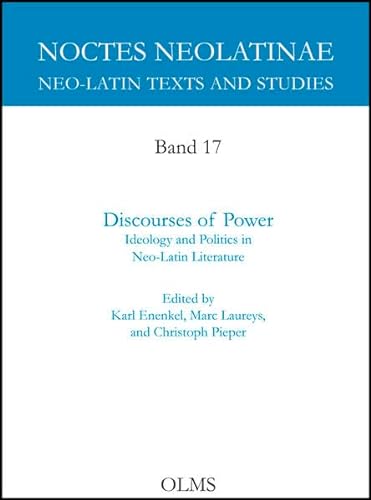
Discourses of Power: Ideology and Politics in Neo-Latin Literature (17) (Noctes Neolatinae Neo-latin Texts and Studies, 17) - Softcover
Synopsis
In the early modern period, Latin was the most important international language and was therefore regularly used in political contexts in order to shape ideological discourses of the time. The present volume collects papers of a conference dedicated to these ideological impacts of Neo-Latin literature. The contributions cover a wide range of texts connected with some of the most prominent political discussions in Europe during the 15th, 16th, and 17th centuries. Not only do they shed light on the historical context, but they also describe more general discursive mechanisms on which the specific texts are relying (e.g., the role of exemplary texts and figures from antiquity, the importance of literary genres, the connection with vernacular traditions). Thus, the volume makes an important contribution to understanding the crucial importance of Latin literature within the political culture of early modern Europe.
"synopsis" may belong to another edition of this title.
Review
"[...] if it is evaluated for what it is—a collection of essays on an important topic in Neo-Latin studies—it succeeds admirably." —Craig Kallendorf, The Neo-Latin News
"About this title" may belong to another edition of this title.
Search results for Discourses of Power: Ideology and Politics in Neo-Latin...

Seller Image
Discourses of Power
Seller: SKULIMA Wiss. Versandbuchhandlung, Westhofen, Germany
Seller rating 5 out of 5 stars

Condition: Neu. Ideology and Politics in Neo-Latin Literature. Edited by Karl Enenkel, Marc Laureys, and Christoph Pieper. In der frühen Neuzeit war Latein die wichtigste internationale Sprache, die daher regelmäßig in politischen Kontexten verwendet wurde und somit auch die zeitgenössischen ideologischen Diskurse prägte. Der Band versammelt acht englisch- und fünf deutschsprachige Tagungsbeiträge (Leiden 2009), die diesen ideologischen Einflüssen der Neulateinischen Literatur gewidmet sind. Behandelt wird eine große Bandbreite von Texten (unter anderem von Jean Bodin, Giovanni Gemisto oder Girolamo Faletti), die sich auf einige der berühmtesten politischen Diskussionen in Europa während des 15.-17. Jahrhunderts beziehen. Die Beiträge beleuchten nicht nur den spezifischen historischen Kontext, sondern beschreiben auch allgemeinere diskursive Techniken, die den einzelnen Texten zugrunde liegen. So stehen unter anderem die Rolle von exemplarischen Texten und Gestalten aus der Antike, die Bedeutung von literarischen Genres und die Verbindungen mit muttersprachlichen Überlieferungen im Fokus. XXXV,338 Seiten, broschiert (Noctes Neolatinae. Neo-Latin Texts and Studies; Vol. 17/Olms Verlag 2012). Früher EUR 49,80. Gewicht: 602 g - Softcover/Taschenbuch. Seller Inventory # 883119
Buy New
US$ 17.06
US$ 44.78 shipping
Ships from Germany to U.S.A.
Ships from Germany to U.S.A.
Quantity: 11 available