
Items related to A View from the Machan: How Science Can Save the Fragile...
Synopsis
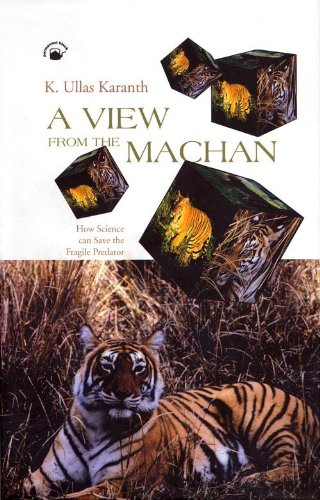
Is natural history a science? Are there scientific ways in which we can give wild animals a better chance of survival? How does conservation actually work? Ullas Karanth has been evolving practical, science-based conservation solutions for over a quarter of a century. He has developed camera-trap sampling techniques that are now employed to monitor predators such as tigers, jaguars, cheetahs, and leopards across the world. His book provides a unique insight into wildlife conservation from the perspective of an internationally renowned tiger biologist. Karanth opens up the secret world of predators from wild dogs and leopards to tigers in Nagarahole. He talks about hours of walking trails in the jungle, setting up camera traps, collecting big cat faeces and examining them: he evokes both the drudgery and the thrill of being a scientist in the wild. His writing is marked by a passionate, yet rational, commitment to saving the animals he works amongst. With his special interest in tigers, Karanth explains with rare clarity the evolutionary and ecological forces that shape predation, and the reasons why predators inevitably come into conflict with humans. He makes a compelling case for effectively protected nature reserves, which he terms sacred groves for the new century . This provocative collection, a tour de force of science-driven conservation advocacy, goes beyond the usual platitudes and political correctness that permeate official and academic conservation today. Karanth s vivid style communicates the excitement of the forest, while his lucidity disentangles complex scientific ideas for general readers.
"synopsis" may belong to another edition of this title.
About the Author
K. ULLAS KARANTH is a Senior Conservation Scientist with the New York-based Wildlife Conservation Society (WCS) and the Director of its Indian programme. He is a Scientific Fellow of the Zoological Society of London and serves on the boards of WWF India and the Ranthambhore Foundation. Karanth has researched tigers and other predators in the Western Ghats, as well as at a dozen other wildlife reserves across India. His areas of expertise include radio-telemetry of big cats, animal population sampling methodologies, and the mitigation of human wildlife conflicts. His research findings have been published in reputed journals such as Proceedings of the National Academy of Sciences (USA), Ecology, Journal of Animal Ecology, Journal of Zoology (London), Journal of Tropical Ecology, Conservation Biology, Biological Conservation, as well as in several scientific books. His book, The Way of the Tiger, is widely acclaimed.
"About this title" may belong to another edition of this title.
Search results for A View from the Machan: How Science Can Save the Fragile...

Seller Image
A View from the Machan How Science Can Save the Fragile Predator
Published by
Permanent Black / Distributed by Orient Longman, Delhi, 2006
ISBN 10: 8178241374
ISBN 13: 9788178241371
Used
Hardcover
Signed
Seller: Fox & Hedgehog, Moraga, CA, U.S.A.
Seller rating 5 out of 5 stars

Hardcover. Condition: Very Good-. Dust Jacket Condition: Very Good. B&W illustrations (illustrator). Sewn binding in pictorial boards, in dustjacket. xvi, 153 p. Includes bibliographical references (p. [151]-153). Inscribed and signed by Karanth on the half-title page, else no marks. A solid copy with firm binding, intact hinges and square spine. Bumping to lower corners and spine-ends. A couple tiny specks top edge, and a faint smudge on half-title page. Unclipped dustjacket has creasing to spine-ends and a small scratch on the front panel, else not much wear. Seller Inventory # 1961
Seller Image
A View from the Machan: How Science Can Save the Fragile Predator
Published by
Orient Blackswan, 2005
ISBN 10: 8178241374
ISBN 13: 9788178241371
Used
Hardcover
First Edition
Seller: Southampton Books, Sag Harbor, NY, U.S.A.
Seller rating 5 out of 5 stars
Hardcover. Condition: Very Good. First Edition. First Edition, First Printing. Published by Orient Blackswan, 2005. Octavo. Hardcover. Book is very good. Dust jacket is very good, with some shelf/edgewear. Spotting along page ends. Seller Inventory # 558746