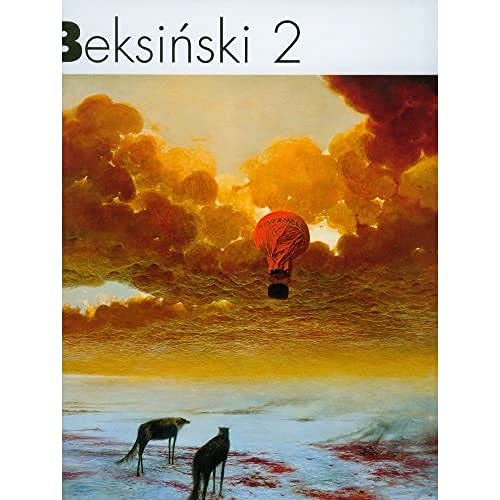
This striking hardcover volume with dust jacket is the second in the Bosz Publishing House series devoted to the visionary art of Zdzisław Beksiński. Measuring 10.6 × 11.8 inches and weighing 3.3 pounds, the bilingual Polish-English edition spans 144 pages and features 120 full-color photographs.
Volume 2 delves into Beksiński’s prolific body of work, encompassing his 1970s drawings and paintings across all creative periods. Uniquely, it also presents computer-generated collages, revealing how Beksiński embraced digital technology as a new artistic tool, exploring its vast possibilities and integrating it seamlessly into his creative process.
The album is enriched with archival photographs by Beksiński himself, sourced from private collections and published here for the first time. These rare images offer an intimate glimpse into the artist’s personal archive, deepening the reader’s appreciation of his legacy.
Introductions by distinguished opera tenor Wiesław Ochman, a close friend of Beksiński, and Wiesław Banach, director of the Sanok History Museum, provide insightful context into the artist’s journey and the significance of his work.
Key details:
Language:English-Polish
Format: 10.6 × 11.8 inches
Weight: 3.3 pounds
Pages: 144
Photographs: 120
Binding: Hardcover with dust jacket
Volume 2 complements the first album, expanding on the extraordinary world of Beksiński’s art and offering art enthusiasts a comprehensive and nuanced exploration of his visionary work. Importantly, this series comprises a total of five volumes, with three additional volumes further illuminating Beksiński’s creative legacy and providing collectors and scholars with a complete panorama of his oeuvre.
"synopsis" may belong to another edition of this title.
Beksiński was born on 24th February 1929 in Sanok, though he used to say that this date was not at all certain. Apparently, during the German occupation of Poland during the Second World War he was given a false year of birth to save him from deportation to Germany to slave labour. During the War, he attended clandestine grammar school, and after the war ended he wanted to study film and to become a movie director. But his father did not consent, thinking it would not secure his son's future. In line with the family tradition, he made him apply to the Faculty of Architecture & Engineering at the Krakow Polytechnic. He studied there and graduated with MSc received in 1952. Later in his life he commented on his choice of architectural studies over art: “I hated architecture so much that architecture is a plan, a project and as boring as a mechanical saw execution”. On April 30th, 1951 Beksiński married Zofia Helena Stankiewicz, and they remained married until her death on September 22nd, 1998. His wife became his muse, and he often used her as a principal model, especially in his photographic works. In May 1957 Beksiński set up an informal group of art photographers and their expositions were soon held in various galleries in Poland. In 1958 Beksiński became a member of the Association of Polish Art Photographers, and in 1959 he and his two friends exhibited for the first time abroad, at the prestigious gallery in Cologne, Germany. In 1959 Beksiński stopped working as an art photographer. The exhibition organized in 1964 in the Old Orange House Gallery in Warsaw brought him his first financial success: he sold all the exhibits. He gave up working at Autosan and devoted all his time to art. The next exhibition organized in 1972 showed a completely different Beksiński. The exhibits were spacious paintings presenting dismal visions completely free of abstraction. Years later he called this his “fantastic” period, which would last until the early 1980s. In 1977 Beksiński moved from Sanok to Warsaw, over the next three decades, Beksiński created his entire artistic output in this Warsaw’s studio. When he worked there, he always had to have music playing, and he preferred music of 19th and 20th-century composers, accompanying him at work. In 1984 he established contact with Piotr Dmochowski, a Parisian art dealer who tried for many years to promote Beksiński’s work in France and Germany. Beksiński himself had no part in this and was absolutely indifferent to having his work advertised. The Sanok Historical Museum embarked on a systematic publicity campaign for his work, especially after 1990, arranging over 40 exhibitions in various Polish cities. His first permanent gallery was set up in the newly renovated rooms of Sanok Castle and initially exhibited about 100 of his works. By late 1994 Beksiński was becoming more and more fed up with his contract with Dmochowski. Continual mix-ups were making him tense and feeling guilty, unable to cope with a situation in which he was partly dependent on another person. He wanted to be free, even at a cost of financial problems. The decision to break off the contract was maturing. On November 16th he finally wrote a letter to Dmochowski ending the contract. He did not want and was not able to organize his exhibitions and delegated all this business to the director of the Sanok Historical Museum. He never turned up at official events and took no part in artistic affairs or political life. He devoted his last years to painting and computer art. Thou his friends used to visit him from time to time, he felt that no-one could fill the void left by his dear ones. In 2001 he drew up his last will and testament, making the Historical Museum in Sanok his sole beneficiary. In the evening of February 21st, 2005 Beksiński was murdered in his Warsaw flat by a teenage son of his caretaker.
"About this title" may belong to another edition of this title.
Seller: Revaluation Books, Exeter, United Kingdom
Hardcover. Condition: Brand New. 144 pages. 11.97x10.63x0.79 inches. In Stock. Seller Inventory # 8375760811
Quantity: 1 available