
Items related to Introduction To Programming Using Python
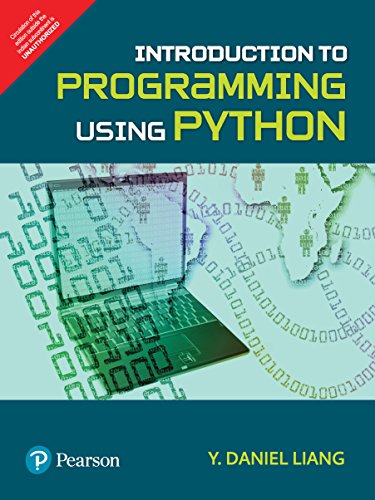
Synopsis
Brand New International Paper-back Edition Same as per description, **Economy edition, May have been printed in Asia with cover stating Not for sale in US. Legal to use despite any disclaimer on cover. Save Money. Contact us for any queries. Best Customer Support! All Orders shipped with Tracking Number
"synopsis" may belong to another edition of this title.
Search results for Introduction To Programming Using Python

International Edition
Introduction To Programming Using Python
Published by
Pearson India Education (edition First Edition), 2017
ISBN 10: 9332551847
ISBN 13: 9789332551848
Used
Paperback
First Edition
Seller: BooksRun, Philadelphia, PA, U.S.A.
Seller rating 5 out of 5 stars

Paperback. Condition: Very Good. First Edition. It's a well-cared-for item that has seen limited use. The item may show minor signs of wear. All the text is legible, with all pages included. It may have slight markings and/or highlighting. International edition. Seller Inventory # 9332551847-11-1-7

Stock Image
Introduction To Programming Using Python
Seller: World of Books (was SecondSale), Montgomery, IL, U.S.A.
Seller rating 5 out of 5 stars
Paperback. Condition: Fair. NOTE: You are purchasing a standalone product; MyProgrammingLab does not come packaged with this content. If you would like to purchase both the physical text and MyProgrammingLab search for ISBN-10: 0133050556/ISBN-13: 9780133050554. That package includes ISBN-10: 0132747189/ISBN-13: 9780132747189 and ISBN-10: 0133019861/ISBN-13: 9780133019865 . MyProgrammingLab should only be purchased when required by an instructor. Introduction to Programming Using Python is intended for use in the introduction to programming course. Daniel Liang is known for his fundamentals-first approach to teaching programming concepts and techniques. Fundamentals-first means that students learn fundamental programming concepts like selection statements, loops, and functions, before moving into defining classes. Students learn basic logic and programming concepts before moving into object-oriented programming, and GUI programming. Another aspect of Introduction to Programming Using Python is that in addition to the typical programming examples that feature games and some math, Liang gives an example or two early in the chapter that uses a simple graphic to engage the students. Rather than asking them to average 10 numbers together, they learn the concepts in the context of a fun example that generates something visually interesting. Using the graphics examples is optional in this textbook. Turtle graphics can be used in Chapters 1-5 to introduce the fundamentals of programming and Tkinter can be used for developing comprehensive graphical user interfaces and for learning object-oriented programming. Seller Inventory # 00102328814
Stock Image
Introduction To Programming Using Python
Seller: World of Books Inc, Montgomery, IL, U.S.A.
Seller rating 4 out of 5 stars

Paperback. Condition: Fair. NOTE: You are purchasing a standalone product; MyProgrammingLab does not come packaged with this content. If you would like to purchase both the physical text and MyProgrammingLab search for ISBN-10: 0133050556/ISBN-13: 9780133050554. That package includes ISBN-10: 0132747189/ISBN-13: 9780132747189 and ISBN-10: 0133019861/ISBN-13: 9780133019865 . MyProgrammingLab should only be purchased when required by an instructor. Introduction to Programming Using Python is intended for use in the introduction to programming course. Daniel Liang is known for his fundamentals-first approach to teaching programming concepts and techniques. Fundamentals-first means that students learn fundamental programming concepts like selection statements, loops, and functions, before moving into defining classes. Students learn basic logic and programming concepts before moving into object-oriented programming, and GUI programming. Another aspect of Introduction to Programming Using Python is that in addition to the typical programming examples that feature games and some math, Liang gives an example or two early in the chapter that uses a simple graphic to engage the students. Rather than asking them to average 10 numbers together, they learn the concepts in the context of a fun example that generates something visually interesting. Using the graphics examples is optional in this textbook. Turtle graphics can be used in Chapters 1-5 to introduce the fundamentals of programming and Tkinter can be used for developing comprehensive graphical user interfaces and for learning object-oriented programming. Seller Inventory # CIN9332551847A