Synopsis
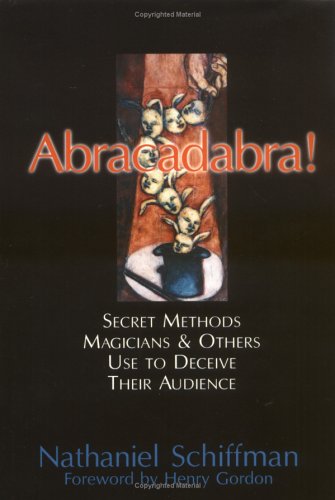
Explains the precepts of misdirection, optical illusion, and other techniques used by magicians to manipulate an audience
Reviews
A dozen triumphs of optical deception fill Walter Wick's book of large-page color photographs, almost all of them showing puzzling scenes exquisitely built and lucidly explained. Few are novel in idea, but they are so well presented that they are compelling. Thoughtful kids eight and up will delight in them, just as will anyone who likes to think clearly about images. They include a forklike object, impossibly made with three tines and two tines all at once; surfaces with hollows as abundant as moon craters (or maybe they are bumps); and a cubical "box" that casts no shadows. Mirrors, shadows and cunning cabinetry act both to induce illusions and to reveal them. The details of that strange open framework of wood that looks as though it passes through itself are viewed here in a mirror placed just right, although the false fit is so elegant that even as you see it you can hardly accept what you know. Abracadabra! is another unusually captivating book of the strange. A well-documented argument at book length, it is open to interested readers from their teens on up. Most books on magic are mainly broad historical accounts or detailed explanations of how to carry out some specific deception as entertainment. This is, instead, a wide-ranging analysis of the principles of illusion, and it is a hard book to lay down. To sample minimally: the key words are two--misdirection and professionalism. Misdirection in space is familiar, waving a left hand while putting the right one into a pocket. Misdirection in time can be examined through a version of an escape illusion of Houdini's, often brilliantly done these days by a husband-wife team in Las Vegas. The man is tied into a bag and placed within a locked trunk. Much is made of lacing a large canvas around the trunk. The woman stands on the trunk holding a silk curtain. She lifts the curtain once before her face and form; it is lowered in seconds, but now only the man is there. He proceeds to unlace the trunk, open the bag and recover his magical wife. The exchange seems to have taken place in a blink of the eye as the silk fell. Not at all: the man's escape can begin as soon as the trunk is closed. He is soon out--if he ever was within. The second exchange really lasted a minute; its abruptness was an illusory emphasis, a powerful misdirection in time. The performer's guiding patter, the side view, the sounds, even the smell--any information channel can be used to mislead. Yet how can anyone enter and leave those trunks and bags in a minute? Her entry was sudden, dropping down into the trunk via an unseen open trapdoor into the bag. The bag may have no bottom or one held by Velcro. Here the entire development of an illusionary technology is drawn on, a culture of ingenious professionals who design and make such devices and of the skills and theatricality of the performers. How can a spectator outwit them? That needs a viewer cleverer than they--by no means a likely assumption. A close-up video recording is a minimum of what is needed: one such study is narrated here. The lesson of these two fine books runs deep. Studied illusion, old as the shamans, lies near physical science, for both analyze false perceptions, the older art to induce them, the newer to avoid them. Albert Einstein once explained what he saw in this difference: "The Lord God is subtle, but malicious he is not." Humankind cannot claim that same innocence, and illusion is a much more serious matter offstage than on.
"About this title" may belong to another edition of this title.