Synopsis
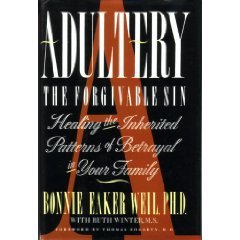
Argues that often adultery is an inherited pattern of behavior, describes how adultery affects a relationship, and offers advice on forgiveness and rebuilding a marital relationship
Reviews
Everybody but your maiden aunt appears in this somewhat disorganized but ultimately helpful book. Woody and Mia mix it up with almost the entire House of Windsor. Tips to would-be paramours for avoiding triangles, scripts for discussions between cheater and cheatee, pre-relationship contracts outlining acceptable behavior and the ultimate in inner child work (embracing the wounded inner child of the spouse who cheated on you). Weill, a family therapist, and Winter, a syndicated columnist, maintain that cheating runs in families and is done to fill emotional rather than sexual needs, but their analysis lacks depth and is the least interesting aspect of the book. And by encouraging wounded spouses to be more sexually giving to their wandering partners, they belie their point that adultery is not about sex. They do point out that married men aren't the only ones on the prowl--so there is much to study here for the suspicious of both sexes.
Copyright 1993 Reed Business Information, Inc.
Here, Eaker-Weil (a family therapist and frequent TV talk-show guest), with the help of health-writer Winter (The Scientific Case against Smoking, 1980, etc.), tackles a thorny problem that visits about 70% of married couples these days: infidelity. Though she cites statistics indicating that 35% of the marriages disrupted by this problem end in divorce, Eaker-Weil claims that only 2% of the couples she herself has treated fail to reconcile. The author's core thesis is that the tendency for infidelity is transgenerational--indeed, that in nine out of ten cases, there's unfaithfulness in the family trees of either the betrayer or the betrayed (causing individuals either to repeat inherited patterns of unfaithfulness or to seek out partners who are bound to betray them). Eaker-Weil urges both parties in a situation of infidelity to complete ``genograms'' that track down family penchants for unfaithfulness: She even serves up a chart of this kind for Prince Charles and Princess Di. The author also expresses great concern about how infidelity affects children, proposing that parents try play therapy to help their kids cope. But when Eaker- Weil gets down to what the man and woman directly involved should do, her prescriptions are narrow (``what concerns me most is the current argument that you can't be a liberated woman unless you fool around''); formulaic (``don't call a divorce lawyer''); or embarrassing (as in the case of the ``funeral game,'' in which traumatized spouses are supposed to enact each other's funeral rites). Meanwhile, the author overloads us with case studies bearing titles like ``Patty's Lost Paradise'' or ``Lars Confronts his Facade.'' Perhaps wise for its stress on transgenerational patterns, but too unsubtle to help people make sense of a problem that has infinite varieties and ramifications. -- Copyright ©1993, Kirkus Associates, LP. All rights reserved.
Weil, a family therapist who works with individuals, families, and couples, has appeared on such television shows as Oprah , Geraldo , Good Day New York, and Maury Povich. Here, she contends that adultery is a cry for help in stabilizing a dysfunctional marriage and that many adulterers are themselves the children of adulterers. Drawing upon her patients' and her own experiences, Weil describes how knowledge of family intimacy patterns can be used to develop insight, understanding, and forgiveness in a relationship stressed by adultery. Numerous checklists and exercises assist readers in the identification and resolution of adultery conflicts. For popular self-help collections.
- Jodith Janes, Cleveland Clinic Fdn.
Copyright 1993 Reed Business Information, Inc.
"About this title" may belong to another edition of this title.