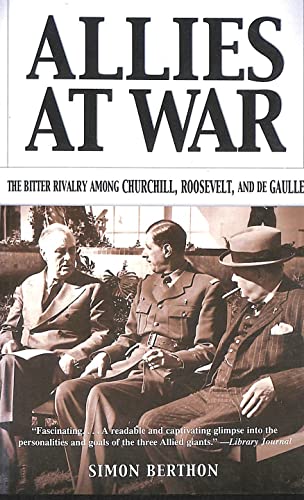
Based on the BBC/PBS television documentary series and selected by the History Book Club, this is the revelatory account of the plots and enmity behind the Allied leaders' united front. Franklin Delano Roosevelt, Winston Churchill, Charles De Gaulle held the destiny of the Free World in their hands as Nazi forces stormed through Europe in the 1940s. Together, they stood firmly against Hitler. They inspired their troops; they gave their nations confidence in the prospect of an Allied victory. Yet the relations between these three preeminent statesmen, outside the public eye, were continually riven by rivalry, distrust, contention, and often ruthless duplicity, as this probing volume shows. With access to official archives never before available, Simon Berthon examines the antipathy that increasingly eroded the negotiations among three of the most powerful world leaders in the twentieth century and that significantly colored not only Allied policy during the war but also the relations of General Charles De Gaulle's France with Britain and America after it. For even as late as 1943, by virtue of misinformation being fed to him about De Gaulle, Roosevelt was still supporting the collaborative Vichy government in France. Yet, as Berthon's compelling chronicle demonstrates, De Gaulle would heroically hold his ground in the cause of a Free France and ultimately—in the eleven years of his presidency—would exact against the "Anglo-Saxon powers" his own revenge. Allies at War is indexed and illustrated with 8 pages of historical photographs. "Fascinating ... A readable and captivating glimpse into the personalities and goals of the three Allied giants."—Library Journal "A valuable reminder that even great statesmen can occasionally act according to foolish whims and pride."—Booklist
Berthon's narrative accompanies his forthcoming PBS telecast about Charles de Gaulle's struggles once France fell to the Nazis in 1940 to play the modern Joan of Arc. Aged 49 and a one-star general for only three weeks, he had flown to London five days before Paris was surrendered. Legally, Marshal P‚tain's collaborationist regime at Vichy represented France, but de Gaulle almost singlehandedly established the exile "Free French" to continue the war from England and some of the colonies. In Berthon's view, de Gaulle had four enemies Germany, Vichy, a skeptical Churchill and a hostile Roosevelt. This hostility, fed by at best half-truths from Roosevelt's rightist links to P‚tain ambassador Admiral Leahy, State Department adviser Charles Murphy and Secretary of State Cordell Hull more than by Churchill, shackled and even undermined de Gaulle. Berthon describes vividly the wartime climate of duplicity and distrust: Churchill tried to "straddle the two Frances"; de Gaulle compensated for his powerlessness with haughty pride; Roosevelt (for whom "France had lost all right to...respect by her abject failure in 1940") excluded de Gaulle from all decisions affecting France. Relations worsened in victory, when the French embraced de Gaulle and reality forced British/U.S. recognition of his legitimacy. In Berthon's opinion, Churchill equivocated, and U.S. players were villainous. Though he makes little of de Gaulle's postwar promotion of the myth of mass French resistance to fascism, his wartime de Gaulle is convincingly heroic. None of the three leaders comes off well which may give the book a controversial edge. 8 pages of b&w illus. (Oct.)Forecast: The three-part TV series is scheduled to run in 2002; in the meantime, the book is a History Book Club selection and should have broad appeal to readers of WWII titles.
Copyright 2001 Cahners Business Information, Inc.