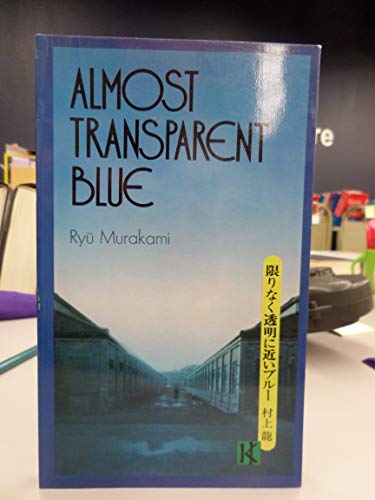
A youth of college age, his older mistress, friends--random friends, they might be called--living near an American military base and experimenting with drugs both hard and soft.
In rapidly sketched scenes gliding from the everyday real to the hallucinatory, the author has used what he himself calls his "narrative zoom lens." The novel is all but plotless, but the imagery is tellingly vivid, "the literary equivalent of genre painting," according to one critic.
The participants seem caught in their hard-rock scene, sadly unfree, having neither the will nor the energy to break away. And over all there seems to hang the heavy shadow of self-destructiveness, not only in terms of their present situation but with regard to what the future holds for them--and the question is inescapable, for human society as well? In this mirror reflecting the present, personal relations deteriorate, violence of the moment erupts, and communication inches slowly towards nullity. One asks, eventually, if the hallucinations, whatever their source, are so very far from the vague misgivings and hopeful imaginings of the man in the street.
The author coolly and unsentimentally distills from this morass a feeling of something pure and unsullied. His technique, with its lack of taboos, of moral condemnation, and of the superfluous, comes very close to the insouciance of cinema verite, in which there is also a touch of surrealism.
Representing a sharp and conscious turning away from the introspective trend of postwar Japanese literature, this work polarized critics and public alike and soon attracted international attention, a sign of winds of change, if not specifically of things to come.
Ryu Murakami was born in 1952. The only son of schoolteacher parents, he grew up in the port city of Sasebo in southwestern Japan. After graduating from a local high school, where he played the drums in a band called Coelacanth, he went to an art college in Tokyo. It was while studying there that he entered his first novel, Almost Transparent Blue, in a competition for new writers. Published in 1976, the book won a major literary award and sold over a million copies. Since then, he has worked for a publishing house, presented a weekly music and interview radio program, and hosted a TV talk show. His literary output includes two collections of stories Run, Takahashi (1985) and Topaz (1988), and the novel Coin Locker Babies (1980), which made its debut in English early in 1995. His roman a clef 69 appeared in English in 1993. He has also directed four movies based on his writing, causing a sensation at an Italian film festival when Tokyo Decadence was shown there in 1992. His latest film is set in the U.S. and Cuba.