Synopsis
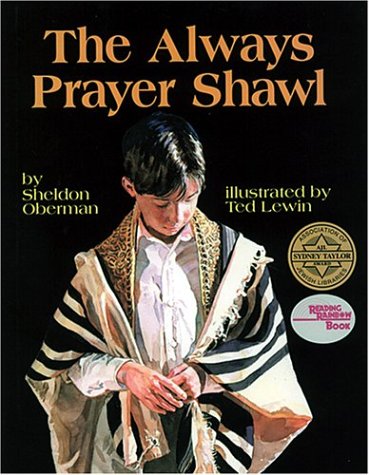
An ancient prayer shawl teaches Adam the importance of tradition and change in a story that spans six generations, from czarist Russia to the present day.
Reviews
Kindergarten-Grade 3-When Adam, a young boy growing up in Czarist Russia, emigrates to the United States with his family, his grandfather gives him the prayer shawl that his grandfather had given him. Throughout his life, Adam continues to wear and repair the shawl, hanging on to his grandfather's statement that "'Everything about it has changed. But it is still my Always Prayer Shawl. It is just like me. I have changed and changed and changed. But I am still Adam.'" He explains to his own grandson the story behind the shawl, and the young boy pledges to carry on the tradition of naming a son Adam and passing the heirloom on to him. The book effectively illustrates how different life was for a child growing up in Russia than it is for modern children. The major theme that some things change while others never do is worth exploring, but the story leaves little to the imagination and hammers the message home. Non-Jewish children may wonder what makes the prayer shawl so special; Oberman never explains its use in worship. Lewin's paintings feature gracefully drawn figures that look especially good at a distance. But at times, the pictures fail to convey the full range of emotion described in the narrative, such as in the scene in which Adam says good-bye to his grandfather. Additionally, it seems almost arbitrary that the black-and-white illustrations change to lushly colored watercolors when Adam becomes an adult. When books about family traditions, especially those of Jewish people, are needed, this one will suffice, with the help of an adult who can answer the anticipated questions.
Ellen Fader, Oregon State Library, Salem
Copyright 1994 Reed Business Information, Inc.
Oberman's ( Lion in the Lake ) simply told and moving story invokes the power of tradition. Adam is a Jewish boy growing up in czarist Russia, where his grandfather, also named Adam, teaches him the importance of Jewish beliefs and customs, stressing that "some things change and some things don't." Without distancing the reader, comparisons crystallize the differences between Adam's time and the present: "When Adam went for eggs, he did not get them from a store. He got them from a chicken. When Adam felt cold, he did not turn a dial for heat. He chopped wood for a fire." When Adam and his parents emigrate, Adam's grandfather gives his prayer shawl to the boy, who responds with a promise: "I am always Adam and this is my always prayer shawl. That won't change." In America, Adam learns to live, dress and speak differently. The prayer shawl changes, too--first the fringe is replaced, then the collar and finally the cloth. But, as Adam is to explain to his own grandson, "It is still my Always Prayer Shawl." As a tender conclusion brings Adam's spiritual life full circle, Lewin underscores the cyclical theme by picturing the grandson as very like the young Adam. His realistic watercolors dynamically depict the Old World in black and white, changing to color as Adam grows up, and his affecting portraits match the quiet passion of Oberman's prose. Ages 7-up.
Copyright 1993 Reed Business Information, Inc.
``Now I can teach you something that my grandfather taught me,'' says Adam to his grandson at the end of this generational story, ``...some things change and some things don't.'' As a boy in rural Russia, the man who's now a suburban American got eggs direct from chickens and chopped wood to keep warm, but--as Adam is doing now, in their synagogue--his grandfather told him about the Jewish people and his own family: Adam was named for his grandfather's grandfather. When Adam and his parents set out for America, his grandfather gave him the earlier Adam's prayer shawl. While Adam grows up and has a family of his own, the shawl wears thin and he replaces the fringes, then the collar, at last even the cloth. But as he explains as an old man, ``It is just like me. I have changed...But I am still Adam.'' The idea is simple yet resonant, and well supported in Lewin's watercolors, rendered in the black and white of old photos until Adam's middle age in what might be the 50's; as always, his subtle, warm characterizations steal the show, though the composition and detail in the b&w section are also especially fine. An engaging book, sure to find many uses. (Picture book. 5-10) -- Copyright ©1993, Kirkus Associates, LP. All rights reserved.
Ages 6-9. In a quiet story with just the right touch of sentimentality, Oberman beautifully evokes a sense of continuity across generations. Enhancing his third-person narrative with a smattering of dialogue, he tells of the Jewish boy Adam, growing up in a shtetl, whose life drastically changes when famine and chaos in old Russia force his parents to immigrate to America. At parting, Adam's beloved grandfather gives the boy a gift, a prayer shawl ("my always prayer shawl"), which was presented to the grandfather by his grandfather, for whom Adam was named. Lewin's first paintings, in black and white, show the white-bearded grandfather in the shtetl, the soldiers with their guns, the tall buildings in America dramatically dwarfing Adam and his parents. Then, in one double-page spread that telescopes Adam's growing into manhood, the artwork leaps into glorious color. While Oberman's controlled text capsulizes the passage of time in words, the color paintings show Adam the man proudly wearing his Russian grandfather's shawl, then Adam the grandfather, passing the shawl and what it represents on to his own young grandson. As good as any of Lewin's best work, the watercolors are abundantly detailed and wonderfully expressive (the grandfathers and grandsons are at once different and the same). The pictures enrich the tranquil telling, which harks back to the biblical Adam, as it movingly depicts how memory and tradition add texture and richness to our lives--even as other things around us change. Stephanie Zvirin
"About this title" may belong to another edition of this title.