Synopsis
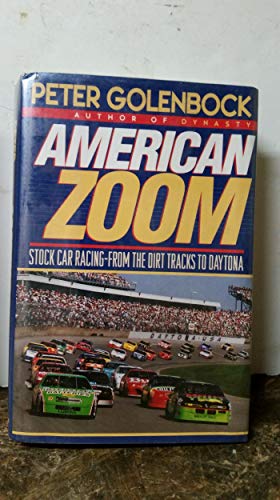
A noted sportswriter takes a look at the homegrown American history of stock car racing, tracing the sport's evolution from moonshine runners to the multimillion-dollar Winston Cup circuit, with an oral history that captures the sport's unique personality.
Reviews
Auto racing is followed by 26% of the American public, stresses Golenbock ( Fenway ) in this survey which will serve as an ideal introduction for those interested in but unfamiliar with the sport. Beginning with the top event, the Daytona 500, he presents a brief history of the National Association for Stock Car Automobile Racing (NASCAR), founded in 1948, tracing its origins to Southern bootleggers who developed their driving skills fleeing the law. The major portion of the book is oral history by and about track figures, including Richard Petty, "The King," who won 200 races in his career, car-builder Ralph Moody, engine-builder Waddell Wilson, crew chief Andy Petree, unsponsored independent Dave Marcis (most drivers now have corporate bankrollers) and the current ruler of the raceways, Dale Earnhardt. Richly anecdotal, the book is a rollicking account of roistering individuals in a high-tension sport. Photos not seen by PW.
Copyright 1993 Reed Business Information, Inc.
Golenbock, best known for baseball histories (Fenway, 1992; The Forever Boys, 1991, etc.), now turns his diligent attention to stock-car racing--a sport he calls ``chess on wheels.'' In what's primarily an oral history patched together with generous helpings of his own commentary, Golenbock enthusiastically examines the history, personalities, and ins-and-outs of NASCAR's Winston Cup circuit. The circuit's 29 races, starting with ``opening day'' at the Daytona 500 (``the Super Bowl, the World Series'' of racing) in February, comprise a spectator sport ``every bit as great...and as much fun to follow as major league baseball.'' NASCAR, we learn, was the brainchild of Bill France, who organized a December 1947 meeting to set standards, rules, and policy for a circuit that would feature ``standard street stock cars'' that ``ordinary working people'' could identify with. Noting that the early drivers were ``the real Dukes of Hazzard,'' Golenbock traces the origins of stock-car racing back to the days of southern bootleggers--but at $85 per ticket, ``the days of the redneck, fried-chicken-and beer crowd [are] a distant memory.'' The sport boomed into a multibillion-dollar industry in the early 1970's when nonautomotive sponsors like R.J. Reynolds got involved, and its early heroes--like Junior Johnson, who won 50 races and is now a top owner; Glenn ``Fireball'' Roberts, the ``first superstar'' of racing, who was killed in a 1964 crash at Charlotte; and Richard ``The King'' Petty, who raced for over 30 years, from 1958 to 1992, and won an incredible 200 times--are to racing what Mickey Mantle and Babe Ruth are to baseball. Not for casual readers--but sure to get stock-car enthusiasts' engines running. -- Copyright ©1993, Kirkus Associates, LP. All rights reserved.
Golenbock, author of the controversial Personal Fouls (Pocket Bks., 1989), offers this oral history of stock car racing from its crude beginnings as a contest among Southern bootleggers to its present status as a billion-dollar industry. The author wisely employs an oral history format to relate the background of this sport, and the technique best suits the subjects: jovial men with colorful personalities and nicknames, fondly remembering the "good old days." All the great names of stock car racing are here, from Richard Petty to Smokey Unick, from Bill France to Junior Johnson, from Bill Elliott to Dale Earnhardt. Strangely, this well-written account is the only comprehensive survey of stock car racing available, as most works on the subject are collections of photographs or coffee-table books. Recommended for most public libraries. Previewed in Prepub Alert, LJ 5/15/93.
- Eric C. Shoaf, Brown Univ. Lib., Providence, R.I.
Copyright 1993 Reed Business Information, Inc.
"About this title" may belong to another edition of this title.