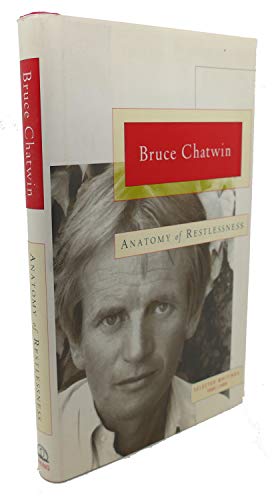
Synopsis
It is commonly supposed that Bruce Chatwin was an ingenuous latecomer to the profession of letters, a misapprehension given apparent credence by that now famous passage in his lyrical, autobiographical "I Always Wanted to Go to Patagonia," in which we are told that this indefatigable traveler's literary career began in midstride, almost on a whim, with a telegram announcing his departure for the farthest-flung corner of the globe: "Have gone to Patagonia."
Such a view overlooks the fact that from the late 1960s onward Chatwin was already fashioning the tools of his future trade in the columns of a variety of magazines and journals. And that he continued to do so through every twist and turn of his career, from art expert to archaeologist, to journalist and author, right up until his death in 1989. These previously neglected or unpublished pieces - short stories, travel sketches, essays, articles, and criticism - gathered together here for the first time, cover every period and aspect of the writer's career, and reflect the abiding themes of his work: roots and rootlessness, exile and the exotic, possession and renunciation.
Reviews
Chatwin (In Patagonia), who died in 1989 at 49, was a brilliant writer of travel-related essays and fiction. This aptly titled posthumous volume brings together nearly all that remains of his uncollected writings. Even the book reviews fit Chatwin's passion for renunciation of anything tying one to a fixed abode. The collection scrapes the bottom of the barrel, for included is a long letter to his London publisher projecting a book on the nomadic life he would never complete. However, two essays intended for it follow, and they make the reader regret the decision to abandon the book. Two autobiographical pieces set his life in context, describing his beginnings as a writer and the background of his rejection of "things." Of the four short pieces characterized as fiction, at least two are also closely autobiographical. Chatwin quotes Robert Burton (The Anatomy of Melancholy) as claiming that everything we experience in nature teaches us "that we should ever be in motion." Whatever hampers mobility, Chatwin contends?and urban civilization is the chief obstacle?diminishes independence by attaching us to emotional and economic "anchors." These disparate pieces hang together thematically but will be attractive largely to Chatwin's legion of loyalists who want to learn more about him.
Copyright 1996 Reed Business Information, Inc.
The travel writer and memoirist Andrew Harvey said of the late Chatwin (What Am I Doing Here?, 1989, etc.) that ``nearly every writer of my generation has wanted, above all, to have written his books.'' This collection of miscellaneous pieces published for the first time in book form will only fuel that envy. There is a little something here for everyone: short stories of smoky debauch, like ``Milk,'' or ``The Attractions of France,'' with its quick slap at racism; singular takes on place, from Timbuktu to the venues in which Chatwin liked to write--a mud hut, a signaling tower in Tuscany; a wicked social history of Capri during the early part of this century, featuring the exotic figures of Axel Munthe, Baron Jacques Adelsw„rd-Fersen, and Curzio Malaparte; an essay renouncing possessions and collecting (an interesting sidebar to his novel Utz); a critique of the ``second-rate'' Robert Louis Stevenson; a history of the doomed efforts of Antonio Soto to bring anarchism to Patagonia; formal essays on nomadism, pilgrimage, and the traveler's experience of returning home. He allows readers into his London bedsitter, though it is evident that he is more at home on the road, persistently drawn to strange landscapes and weird personalities (all the better if they are touched by evil or asceticism). The writing is tense, wound as tight as a clock's spring, the author seeming by turns sinister and superior and often on a very ragged edge, constantly testing his power of endurance, obsessively seeking a measure of himself in each piece. He crawls all over his topics, gets immersed, so much so that he has been labeled by some with his subjects' qualities: fascist, dilettante, deeply strange. But he is too fast-footed to fall for smoke and nonsense--confrontational and oblique, wry and enthralled, uneasy and opinionated, snob, amateur, always original--and specious categorizations simply don't stick. Even posthumously Chatwin remains, in a word, awesome. -- Copyright ©1996, Kirkus Associates, LP. All rights reserved.
This collection is simultaneously so cohesive and so varied as to be difficult to characterize. The late Chatwin's abiding, passionate interests in nomadism, exile, restlessness, art, and culture--in that word's many senses--are all evident here, but they appear in essays, criticism, short fiction, and even correspondence with his editor. Individual pieces range from a luminous 400-word short story entitled "Bedouin," to the aforementioned letter outlining the contents of a book that was never written, to strongly opinionated, almost polemical book reviews. Throughout, these pieces display the author's profound, if seemingly randomized, erudition. He can, for example, startle readers with how much he knows about Robert Louis Stevenson's love life or by offering a brief, intriguing critique of civilization--from Mesopotamia to McLuhan's "global village." This coda to a memorable career will be welcomed by Chatwin's fans and could serve to introduce him posthumously to thousands of new readers. Thomas Gaughan
In 1977, British travel writer Chatwin seemed to achieve overnight success with In Patagonia. His unconventional, highly literate, and semi-autobiographical style evolved through six more books and numerous articles, but it was only after his sudden death in 1989 that his early development as a writer and his pre-Patagonia work came to notice. An earlier collection, What Am I Doing Here? (LJ 7/89), showcased his own selection of shorter works, but this collection aims to fill the gaps, with fiction, short autobiographical pieces, and book reviews. Also included are the surviving remnants of Chatwin's study of nomadism, most of which he had destroyed as unpublishable. Although always interesting, these 17 pieces are not Chatwin's best?some read almost like parodies?and add little to his reputation. A good collection of his short work is still needed. With an excellent bibliography and notes; for specialized collections.?Shelley Cox, Southern Illinois Univ., Carbondale, Ill.
Copyright 1996 Reed Business Information, Inc.
"About this title" may belong to another edition of this title.