Synopsis
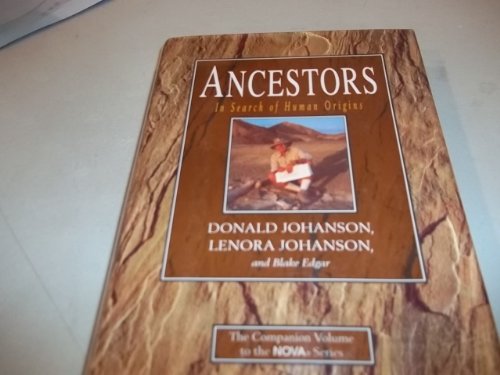
Recounts the world-famous paleoanthropologist's attempts to solve the mystery of human evolution, using evidence uncovered during his recent forays into the fossil-rich regions of Eastern Africa. TV tie-in. 35,000 first printing. $35,000 ad/promo. Tour.
Reviews
This copiously illustrated companion to a PBS-TV Nova series stands on its own as an exciting, balanced survey of raging controversies in the study of human origins. Paleoanthropologist Johanson, famed for his 1974 discovery of "Lucy," an Ethiopian hominid fossil, takes readers to Australia to assess significant new fossil evidence supporting the "Multiregional Model," which holds that modern humans arose in various parts of the world over the last million years (as opposed to the rival "Out of Africa," model which posits Africa as the single geographical source for our species). Writing in the first person in collaboration with his scientist-filmmaker wife Lenora and science writer Edgar, Johanson ( Lucy ) re-creates field expeditions and interviews scientists as he scrutinizes such questions as why hominids bothered to walk erect and whether Neanderthals coexisted (and interbred) with Homo sapiens . Newbridge Natural Science Book Club main selection; BOMC alternate; author tour.
Copyright 1994 Reed Business Information, Inc.
Forget bipedalism. Forget language. Forget pair-bonding and cooperation. What distinguishes Homo sapiens from all other species is the need to explain. And what better explainer than paleoanthropologist Johanson, here joined by his filmmaker/scientist spouse and science writer and editor Edgar (Pacific Discovery magazine) in the text that's to accompany a three-part PBS series celebrating Nova's 25th anniversary. Much of the book reprises earlier accounts by Johanson, Leakey, and other popularizers, absent the acrimony that accompanied Johanson's landmark discovery of Lucy in the Afar region of Ethiopia. Uninformed readers would receive no idea here of the contention that surrounded the naming of Lucy as Australopithecus afarensis. Not that the authors bury the debates. They are forthright and fair in discussing the pros and cons of current theories: out-of-Africa origins vs. the ``Multiregional Model''; man the hunter vs. man the scavenger; Neanderthals as ancestors vs. Neanderthals as an interesting but failed experiment. New to the history are recent findings in Ethiopia and a fascinating account of the 40,000-year history of the aborigines of south-central Australia. The latter sparks a theory that the human ``revolution'' (that's ``evolution'' plus an ``r'') is due to the birth of art: the symbol-making and/or sacred activity that bespeaks a mind that can dream--and explain. The 175 visuals should be splendid. (Color halftones, illustrations, and maps throughout--not seen) -- Copyright ©1994, Kirkus Associates, LP. All rights reserved.
A companion volume to the PBS Nova television series, this book reads much like a nature documentary soundtrack. Johanson, the paleoanthropologist world famous for his discovery of the "Lucy" Australopithecine fossil and director of the Institute of Human Origins, ably guides the reader on a quick tour of our hominid ancestors. Along the way we visit several current controversies, including the evolution of bipedalism, Homo sapiens ' place of origin, and the question of whether Neanderthals are ancestral to modern humans. Johanson does a good job of sketching conflicting interpretations of the fossil record, giving time to differing viewpoints while being honest about his own beliefs. This book's readability and nontechnical, chatty, yet authoritative tone make it an excellent choice for school and public libraries.--Previewed in Prepub Alert, LJ 10/15/93.
- Eric Hinsdale, Trinity Univ. Lib., San Antonio
Copyright 1994 Reed Business Information, Inc.
Paleoanthropologist Johanson is the man who discovered the hominid skeleton known as Lucy and, in a highly publicized feud, broke ranks with the prestigious Leakeys. Here he describes his latest expeditions and the new answers to old questions they've inspired. He begins in Africa's fossil-rich Great Rift Valley, where ecological archaeologists have carefully observed the hunting and consumption patterns of lions and leopards, fieldwork that disputes the long-treasured belief that the first bipeds were noble hunters; evidence indicates that they were, instead, wily scavengers. Other stops on Johanson's evolutionary quest include the Dordogne region of France, home of some of the world's most astonishing cave paintings as well as the site of the much mythologized Neanderthals, hominids that Johanson claims became extinct and were therefore not our ancestors. After visiting some exciting digs in Israel, Johanson finally ends up in Australia, where rock paintings once again provide keys to the past in unexpected ways. In a moving conclusion, Johanson explains why he now believes that "art was at the center of the revolution from which fully modern humans emerged." Ancestors is the companion volume to a forthcoming PBS Nova series. Donna Seaman
"About this title" may belong to another edition of this title.