Synopsis
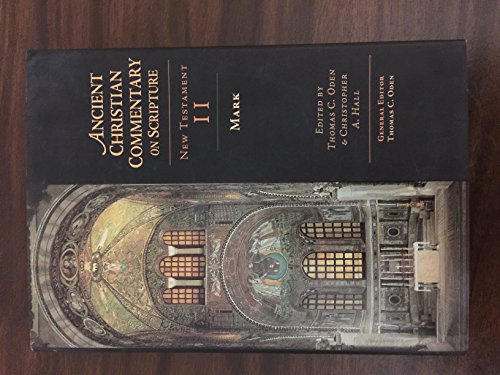
A Christianity Today 1999 Book of the Year The early church valued the Gospel of Mark for its preservation of the apostolic voice and gospel narrative of Peter. Yet the early church fathers very rarely produced sustained commentary on Mark. This brisk-paced and robust little Gospel, so much enjoyed by modern readers, was overshadowed in the minds of the fathers by the magisterial Gospels of Matthew and John. But now with the assistance of computer searches, an abundance of comment has been discovered to be embedded and interleaved amidst the textual archives of patristic homilies, apologies, letters, commentaries, theological treatises and hymnic verses. In this Ancient Christian Commentary on Mark, the insights of Augustine of Hippo and Clement of Alexandria, Ephrem the Syrian and Cyril of Jerusalem join in a polyphony of interpretive voices of the Eastern and Western church from the second century to the seventh. St. Mark's Gospel displays the evocative power of its story, parables and passion as it ignites a brilliant exhibit of theological insight and pastoral wisdom. The Ancient Christian Commentary on Mark (now in its second edition) opens up a long-forgotten passage through the arid and precipitous slopes of post-Enlightenment critical interpretation and bears us along to a fertile valley basking in the sunshine of theological and spiritual interpretation. In these pages we enter the interpretive world that long nurtured the great premodern pastors, theologians and saints of the church.
Reviews
These are the first two volumes published in the "Ancient Christian Commentary on Scripture" series intended for educated laity and the clergy, which aims to introduce the reader to the church fathers and their exegesis of the Bible. The scope of Mark is impressive and the format generally easy to use. It presents the gospel in its entirety in the Revised Standard Version, with each passage followed by an overview of selected comments from the church fathers of the first seven centuries and then by the full comments themselves. To find these comments, the editors ran computerized searches of the whole body of patristic literature in Greek, Latin, Syriac, and Coptic; comments are limited to the church fathers, including nothing from the Arians or Gnostics, for example. Individual passages are fully referenced for easy location in the original, but while there is a list of writers at the end, there is no list of their works. From the appendix, it appears that far more passages were omitted than included, and a list of omitted passages would have been useful. Hall (biblical and theological studies, Eastern Coll.) has written a useful introduction to the series. He discusses the methods used by the church fathers in their exegesis of scripture, concentrating on Athanasius, Gregory of Nazianzus, Basil the Great, and John Chrysostom in the East and Ambrose, Jerome, Augustine, and Gregory the Great in the West, then moving back in time to their predecessors. Again, no references are made to those outside mainstream Christianity. Little is said about rabbinic or philosophical influences on the church fathers' methods, and one might wish that the influence of the New Testament, and its use of the Old, had been more fully explored. Nevertheless, this book is thorough and informative on the methods and controversies of the church fathers. For public, academic, and church libraries.?Michael S. Borries, CUNY
Copyright 1998 Reed Business Information, Inc.
"About this title" may belong to another edition of this title.