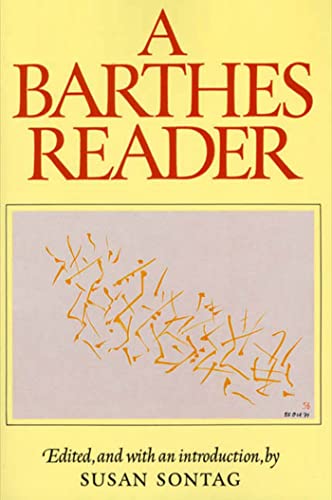
A Barthes Reader gives one the image of Barthes as one of the great public teachers of our time, someone who thought out, argued for, and made available several steps in a penetrating reflection on language sign systems, texts- and what they have to tell us about the concept of being human. Susan Sontag's prefatory essay is one of her finest acts of criticism, informed by intellectual sympathy and a sure sense of the contours of the mind she is describing.
Roland Barthes changed the way a generation read. A cultural commentator before his time, his careful if playful analysis of texts revolutionised the way we comprehend cultural products. Both critic and literary essayist, his writings continue to provoke. His best known work includes Mythologies, Camera Lucida, Image-Music-Text, The Empire of Signs, A Lover's Discourse, Writing Degree Zero, S/Z and The Fashion System.
Translated by Andy Stafford, Senior Lecturer in French Studies, University of Leeds and edited by Andy Stafford and Michael Carter, Department of Art History and Theory, University of Sydney.
Roland Barthes (1915-1980) was a major French writer, literary theorist and critic of French culture and society.
Susan Sontag was the author of four novels, including
The Benefactor,
Death Kit,
The Volcano Lover, and
In America, which won the 2000 National Book Award for fiction; a collection of stories,
I, etcetera; several plays, including
Alice in Bed; and nine works of essays, among them
On Photography, which won the National Books Critics Circle Award for criticism. In 2001, Sontag was awarded the Jerusalem Prize for the body of her work. She died in New York City in 2004.