Synopsis
In 2003, the President’s budget for bioterrorism defense totalled more than $5 billion. Today, the nation’s top academic scientists are scrambling to begin work to understand Bacillus anthracis and develop new vaccines and drugs. However, just five years ago, only the US Department of Defense (DOD) seemed concerned about these “exotic” agents. In 1997, the DOD spent approximately $137 million on biodefense to protect the deployed force, while academe, industry, local governments, and most of our federal leadership was oblivious to, and in some cases doubtful of, the seriousness of the threat. The National Institutes of Health (NIH) received the largest budget increase in the organization’s history. Fortunately, during this time of national urgency, a sound base exists on which to build our defenses against this new threat. A relatively small cadre of dedicated scientists within the US Army Medical Research and Materiel Command (USAMRMC) laid this foundation over the past 20 years.
From the Back Cover
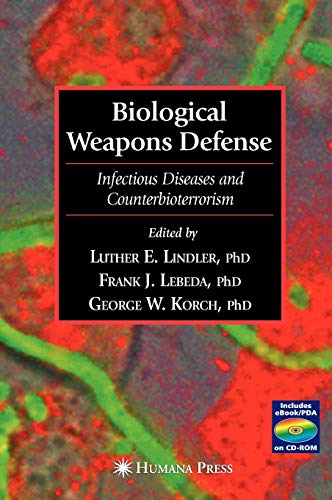
The release of nerve gas in the Tokyo subways, the spread of biological weapons, and the anthrax attack of 2001 in the United States demonstrate that not only is the threat of such menacing weapons real, but also that we must urgently prepare to deal with future acts of bioterrorism. In Biological Weapons Defense: Infectious Diseases and Counterbioterrorism, prominent experts in biodefense research-many from the US Army Medical Research Institute of Infectious Diseases-authoritatively delineate the universe of scientific, medical, and legal issues facing the biodefense research community. Regarding medical countermeasures and decontamination, the authors review the facts about both the aerosol route of infection and decontamination processes, and fully describe the pathogenesis and treatment of a variety of established pathogens (anthrax, plague, smallpox, Brucellosis, glanders, and Coxiella burnetii). They also examine how to discover the presence of these agents, or other previously unknown biological weapons, and the ongoing efforts to counter such agents, including proteomic and genomic analysis as a gateway to better diagnostics, therapeutics, vaccinations, genotyping, and forensics. Additional chapters discuss the development and use of technology to identify and characterize these infectious organisms and their emerging threats.
Comprehensive and authoritative, Biological Weapons Defense: Infectious Diseases and Counterbioterrorism provides researchers, physicians, and policymakers with a sound basis for understanding not only the diseases caused by these infectious organisms, but also an appreciation of the universe of bioterrorism problems that must be mastered to develop effective countermeasures.
"About this title" may belong to another edition of this title.