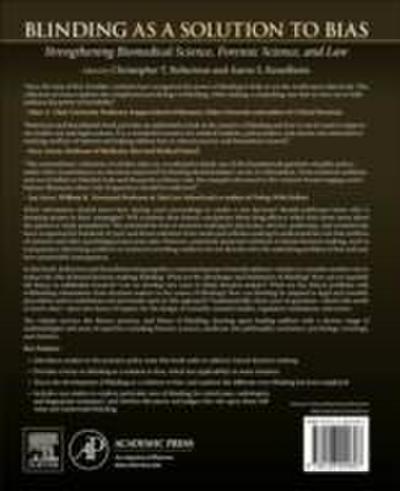
What information should jurors have during court proceedings to render a just decision? Should politicians know who is donating money to their campaigns? Will scientists draw biased conclusions about drug efficacy when they know more about the patient or study population? The potential for bias in decision-making by physicians, lawyers, politicians, and scientists has been recognized for hundreds of years and drawn attention from media and scholars seeking to understand the role that conflicts of interests and other psychological processes play. However, commonly proposed solutions to biased decision-making, such as transparency (disclosing conflicts) or exclusion (avoiding conflicts) do not directly solve the underlying problem of bias and may have unintended consequences.
Robertson and Kesselheim bring together a renowned group of interdisciplinary scholars to consider another way to reduce the risk of biased decision-making: blinding. What are the advantages and limitations of blinding? How can we quantify the biases in unblinded research? Can we develop new ways to blind decision-makers? What are the ethical problems with withholding information from decision-makers in the course of blinding? How can blinding be adapted to legal and scientific procedures and in institutions not previously open to this approach? Fundamentally, these sorts of questions―about who needs to know what―open new doors of inquiry for the design of scientific research studies, regulatory institutions, and courts.
The volume surveys the theory, practice, and future of blinding, drawing upon leading authors with a diverse range of methodologies and areas of expertise, including forensic sciences, medicine, law, philosophy, economics, psychology, sociology, and statistics.
- Introduces readers to the primary policy issue this book seeks to address: biased decision-making.
- Provides a focus on blinding as a solution to bias, which has applicability in many domains.
- Traces the development of blinding as a solution to bias, and explores the different ways blinding has been employed.
- Includes case studies to explore particular uses of blinding for statisticians, radiologists, and fingerprint examiners, and whether the jurors and judges who rely upon them will value and understand blinding.
Christopher Robertson is an expert at the intersection of science, health, decision sciences, and law. He serves as associate dean for research and innovation and professor at the James E. Rogers College of Law, University of Arizona, and is affiliated faculty with the Petrie Flom Center for Health Care Policy, Bioethics and Biotechnology at Harvard. Robertson also leads the University of Arizona Regulatory Science program, which identifies and resolves legal issues that impede scientific progress. Robertson has received research support from the Robert Wood Johnson Foundation, the Safra Center for Ethics at Harvard, and the Greenwall Foundation. He graduated magna cum laude from Harvard Law School, and earned a doctorate in Philosophy at Washington University in St. Louis. He has taught at Harvard Law, NYU Law, and Washington University in St. Louis. Robertson has other forthcoming books with Johns Hopkins University Press and Harvard University Press.
Aaron S. Kesselheim, M.D., J.D., M.P.H., is an Associate Professor of Medicine at Harvard Medical School and a faculty member in the Division of Pharmacoepidemiology and Pharmacoeconomics in the Department of Medicine at Brigham and Women’s Hospital. His research focuses on the effects of intellectual property laws and regulatory policies on pharmaceutical development, the drug approval process, and the costs, availability, and use of prescription drugs both domestically and in resource-poor settings. Dr. Kesselheim leads the Program On Regulation, Therapeutics, And Law (PORTAL), an interdisciplinary research core focusing on intersections among prescription drugs and medical devices, patient health outcomes, and regulatory practices and the law. In 2013, Dr. Kesselheim was named a Greenwall Faculty Scholar in Bioethics by the Greenwall Foundation, which supports innovative empirical research in bioethics. Dr. Kesselheim’s work is also currently funded by the Harvard Program in Therapeutic Science, the FDA, and the Laura and John Arnold Foundation. Dr. Kesselheim serves as a faculty member at the Harvard Medical School Center for Bioethics, has been a Visiting Associate Professor of Law at Yale Law School, where he teaches Food and Drug Administration Law. He is Board Certified in Internal Medicine, working as a primary care physician at the Phyllis Jen Center for Primary Care at BWH.