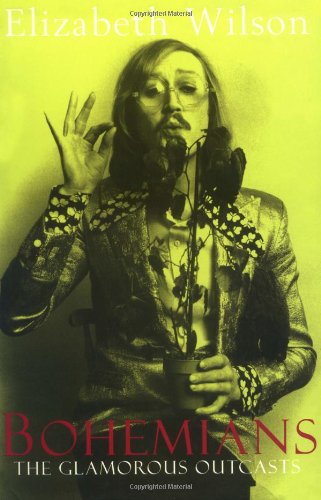
Since the early nineteenth century, the bohemian has been the protagonist of the story the West has wanted to hear about its artists-a story of genius, glamour, and doom. The bohemian takes on many guises: the artist dying in poverty like Modigliani or an outrageous entertainer like Josephine Baker. Elizabeth Wilson's enjoyable book is a quest for the many shifting meanings that constitute the bohemian and bohemia.
She tells unforgettable stories of the artists, intellectuals, radicals, and hangers-on who populated the salons, bars, and cafs of Paris, London, New York, Los Angeles, and San Francisco, including Djuna Barnes, Juliette Greco, Allen Ginsberg, William Burroughs, Jack Kerouac, Amiri Baraka, Andy Warhol, and Jackson Pollock. Bohemians also follows the women who contributed to the myth, including the wives and mistresses, the muses, lesbians, and independent artists. Wilson explores the bohemians' eccentric use of dress, the role of sex and erotic love, the bohemian search for excess, and the intransigent politics of many.
As a new millennium begins, Wilson shows how notions of bohemianism remain at the core of heated cultural debates about the role of art and artists in an increasingly commodified and technological world.
A British professor of cultural studies weaves a heavily footnoted but clearly developed history of the idea and culture of the bohemian. Lord Byron was perhaps the first to embody the myths of art becoming life, of transgressive sexuality, and of opposition to bourgeois mentality. Wilson moves easily from London to Paris to New York's Greenwich Village and the Weimar Republic, from the nineteenth century to the 1960s, as she tells mesmerizing stories of Augustus John and Baudelaire, of Jackson Pollock and Neal Cassady, of Kiki and Caitlin Thomas. She illuminates the paradoxes inherent in the bohemian ideal, such as the view of drink as both enhancing the creative process and dulling the oversharp senses. She traces with particular skill the place of women, who almost universally end up in the role of support and mop-up. She even traces the "been there, done that" phrase to the early nineteenth-century Parisians, whose habitual response was a blase "Seen it!" Bohemian themes of dress, eroticism, and excess are thoroughly explored. Fascinating. GraceAnne DeCandido
Copyright © American Library Association. All rights reserved