Synopsis
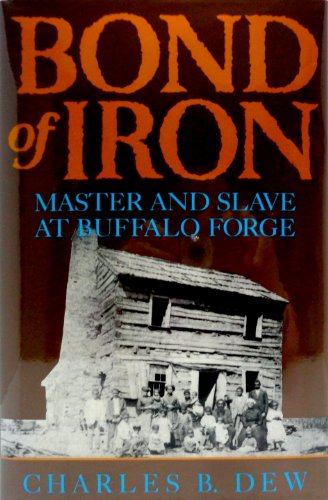
Dew (history, Williams College) describes working and living conditions for slave families at the Buffalo Forge, an ironmaking and farming enterprise in Virginia. He traces patterns of accommodation and resistance, and elucidates the interaction between white and black that constituted the master-slave relationship. Dew draws on detailed records kept by the forge's owners describing epidemics, industrial accidents, slave genealogies and slave-naming practices; records from the Freedman's Bureau Marriage Register; and a three-volume journal kept by one of the Forge's owners. Includes a few b&w photos. Annotation copyright Book News, Inc. Portland, Or.
Reviews
This is an original, unusually detailed contribution to the study of slavery. Dew, who teaches American Studies at Williams College, draws on extensive records to portray the slave system at an ironworks near Lexington, Va., in the decades preceding the Civil War. He begins with owner William Weaver, who purchased Buffalo Forge in 1814; born in 1781 to a German Baptist family opposing slavery, Weaver nevertheless found slaves far more productive than white laborers. Recognizing that slaves could sabotage his business, he controlled them not through threats but through rewards, paying for their "overwork" at a rate artisans earned. Another example Dew provides of this "complex give-and-take" between slaves and master is how Weaver gave a valuable slave he proposed to buy the right to veto his own sale. Dew closely reconstructs the texture of slave life at Buffalo Forge, which provided, after the Civil War, some of the few work opportunities for freedmen. Certain details may interest historians more than general readers, but Dew makes accessible to all the essential dignity of the slaves he studies here. Photos not seen by PW.
Copyright 1994 Reed Business Information, Inc.
Dew (American Studies/Williams) uses the meticulously kept records of Virginia slaveholders to create an engrossing, often surprising record of everyday life on an estate in the antebellum South. Initially, Dew gives a matter-of-fact account of the prosperous business of entrepreneur William Weaver and Daniel Brady, Weaver's niece's husband, at Buffalo Forge and Etna Furnace, Weaver's western Virginia ironworks. The industrious and litigious Weaver was a shrewd businessman whose humanity to his slaves was practical rather than altruistic. Dew tells how Weaver built his slave labor force, trained them in the intricacies of forge work, and motivated them to work hard through incentives--notably, his ``overwork'' system in which he paid the slaves wages for tons of iron manufactured in excess of production quotas. Then Dew goes on to tell the stories of the slaves themselves--including Sam Williams, a master refiner at Buffalo Forge and Baptist community leader who earned overwork only when he chose but who also maintained a high standard of living for his family; Garland Thompson, ``an imposing figure of a man, courageous and unflinching when confronted by white authroity and capable of prodigious feats of strength and workmanship.'' Finally, Dew tells how the Buffalo Forge community broke up during the crisis of the Civil War, with the growing demand for iron finally exhausting the supply. Diphtheria, typhoid, and tuberculosis epidemics claimed slaves' lives, and Weaver's death in 1863 ended Buffalo Forge's productive life. After 1868, the forge finally closed and sharecropping replaced industiral work among the black community at Buffalo Forge. A novel contribution to the massive corpus of literature on American slavery--one that shows slaves as skilled artisans leading lives of considerable dignity and achievement, who despite their accomplishments under the slave regime never stopped yearning for freedom. -- Copyright ©1994, Kirkus Associates, LP. All rights reserved.
Dew (history, Williams Coll.) reveals fascinating details of an unusual master-slave relationship. Buffalo Forge, near Lexington, Virginia, was a thriving enterprise from 1812 to the Civil War. Owners William Weaver and his nephew-in-law Daniel Brady kept meticulous personal records that illuminate the lives of Sam Williams, Tooler, Henry Towles, Harry Hunt, and Garland Thompson and their families, skilled artisans and slaves. Weaver cannily permitted his slaves to "overwork" to earn money and credit to purchase luxuries like white flour, sugar, store-bought furniture, and clothing, thus motivating his workers while helping them transcend their status as slaves. Fortuitously, Dew was able to locate both written records of Buffalo Forge and oral narratives of descendants of Brady and Thompson. He skillfully weaves historical minutiae into a lucid and seamless narrative. Recommended for regional history collections, informed lay readers, and scholars in the field.
- Jamie S. Hansen, Univ. of South Carolina, Columbia
Copyright 1994 Reed Business Information, Inc.
"About this title" may belong to another edition of this title.