Synopsis
Leaving the palace where he had been sheltered from a prediction that destined him to be a holy man, Prince Siddhartha sees for the first time the suffering in the world, and begins the journey that transforms him into the Buddha.
Reviews
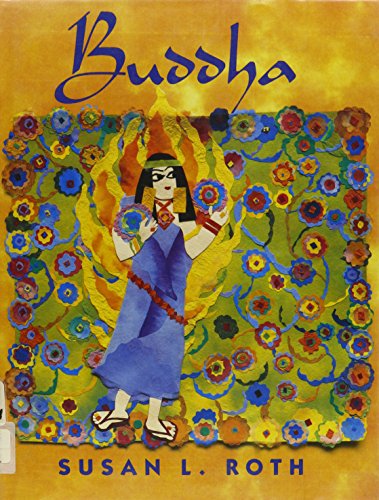
Grade 3-5-Beginning with Siddhartha's birth and his father's forewarning about his future, Roth recounts her subject's protected childhood, marriage, and first excursions beyond the palace grounds where he learns of the existence of poverty, illness, and death. After meeting a holy man, he realizes his destiny. Leaving his family and worldly possessions, Siddhartha sets himself on the path to find truth and wisdom. The text ends here. An afterword summarizes the rest of his life, including how he became known as Buddha, and briefly discusses the growth, spread, and influence of Buddhism. It is unfortunate that this information is relegated to a single page in small type at the back of the text because it is essential to understand who Buddha was and why he is important. The handmade-paper collage illustrations feature the stylized figures, rich colors, and ornate decoration typical of Indian art. They are well done and suited to the subject, but the extensive use of symbolic images makes them often difficult to understand. Buddhism is a growing religion in the United States, and books on this level are needed. Even though it is a picture book, the art is sophisticated, and there is sufficient information to make it an adequate introduction to this world religion for older children.
Jane Gardner Connor, South Carolina State Library, Columbia
Copyright 1994 Reed Business Information, Inc.
In a lucid text and characteristically vivid cut-paper collages, Roth tells the story of Buddha, from his mother's dream of "carrying a milky-white elephant in her swollen belly" to the day he casts off his finery to become a holy man. She chronicles his transition from sheltered prince to concerned young man as he ventures beyond the walls of his garden paradise. The sudden realities of old age, disease and death resonate against a backdrop of luscious nature and youthful servants, conveyed here in richly hued scenes dominated by scatterings of flowers. Roth's writing stresses the vitality of this tale from one of the world's great religions; she underscores its impact with a factual afterword. The collages here are especially beautiful, radiant in color and zestful in spirit. They hum with details of another culture, and yet retain a universal simplicity. Ages 5-9.
Copyright 1994 Reed Business Information, Inc.
Buddha's early life as Prince Siddhartha--the prophecy that caused his father to protect him from the world's woes lest he become a holy man; his discovery, nonetheless, of old age, disease, and death. The book ends as he leaves his new wife and son to ``find his own inner peace'' and ``a way to end suffering.'' A note summarizes Buddha's later life and the extent of the religion he founded. Roth's narrative is graceful and respectful; her collages of brilliant colors (inspired by a Buddhist manuscript) are beautifully designed and, though her bold simplified forms and crisp facial features snipped from black paper are in a radically different style from traditional Indian art, they are akin to it in their rich expressiveness and emotional import. A handsome book, apparently the only one on Buddha at this level. (Nonfiction/Picture book. 4-10) -- Copyright ©1994, Kirkus Associates, LP. All rights reserved.
Ages 6-9. The life of Siddhartha, the Buddha, is unusual fare for a picture book, even one aimed at older children. This unique offering succeeds in many respects, especially in its marvelous illustrations, but the transformation of Siddhartha from prince to Buddha may still puzzle children by the book's conclusion. In its simplest form, the story of Siddhartha is simply a folktale, and that is the way Roth frames her telling. At Siddhartha's birth, a wise man predicts that the baby will become a very holy man. Siddhartha's father, fearing such a life is too difficult for his son, shelters the boy throughout his childhood, never allowing him outside the palace walls. When the young man finally comes in contact with old age, illness, and death, he is stunned. He leaves his expectant wife to seek the truth about the nature of the world and what can be done to alleviate suffering. An afterword gives a too brief description of Siddhartha's life after he becomes enlightened. The extraordinary illustrations are collage torn from handmade paper. Although highly stylized, especially in the design work, there is a childlike simplicity in the figures of Siddhartha and the others that makes the art very accessible to the audience. An ambitious offering. Ilene Cooper
"About this title" may belong to another edition of this title.