
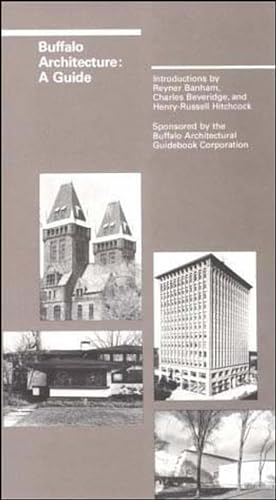
Buffalo Architecture: A Guide
Banham, Reyner; Beveridge, Charles; Hitchcock, Henry-Russell
ISBN 10: 026252063X ISBN 13: 9780262520638
Published by MIT Press, 1981
Used
Paperback
From
ThriftBooks-Atlanta, AUSTELL, GA, U.S.A.
Seller rating 5 out of 5 stars

AbeBooks Seller since March 24, 2009
This specific item is no longer available.
About this Item
Description:
Pages are clean and are not marred by notes or folds of any kind. ~ ThriftBooks: Read More, Spend Less. Seller Inventory # G026252063XI2N00
Synopsis:
Buffalo's rich architectural and planning heritage has attracted the attention of several prominent historians, whose work here is accompanied by over 250 illustrations and photographs.
For its size, the city of Buffalo, New York, possesses a remarkable number and variety of architectural masterpieces from the late nineteenth and early twentieth centuries: Adler and Sullivan's Prudential building, H. H. Richardson's massive Buffalo State Hospital, Richard Upjohn's Sr. Paul's Episcopal Cathedral, five prairie houses by Frank Lloyd Wright, and building by Daniel Burnham, Albert Kahn, and the firms of McKim, Mead, and White, and Lockwood, Green and Company, among others.
These structures by prominent "outsiders" served to spur the efforts of local architects, builders, and craftsmen, and all of them built within the context of the city-wide park and parkway system designed by Frederick Law Olmsted. In addition, the city and its environs exhibit representative works by more recent architects, among them Eero and Eliel Saarinen, Walther Gropius, Marcel Breuer, Paul Rudloph, Minoru Yamasaki, and the firm of Skidmore, Owings, and Merrill.
Buffalo's rich architectural and planning heritage has attracted the attention of several prominent historians, capable of the challenge of evaluating its significance. Reyner Banham is one of the world's leading authorities on the theory and practice of architecture, and he has written extensively on design in the industrial age (and Buffalo's innovative manufacturing plants and grain elevators are important exemplars of such design). Charles Beveridge, whose essay covers the park and parkway system, is editor of the Olmsted papers at The American University. And Henry Russell Hitchcock is the dean of American architectural historians, and the organizer of a 1940 exhibition on Buffalo's built environment.
Their essays are followed by seven sections that delineate the city's neighborhoods, each provided with a map, neighborhood history, and a full complement of photographs with descriptive building captions. An eighth section, "Lost Buffalo," describes demolished buildings, chief among them Wright's great Larkin administration building, while the remaining sections venture out of town, exploring Erie and Niagara Counties, other parts of Western New York, and southern Ontario.
About the Author: Henry Russell Hitchcock was a well known architectural historian and Professor at the New York University Institute of Fine Arts.
"About this title" may belong to another edition of this title.
Bibliographic Details
Title: Buffalo Architecture: A Guide
Publisher: MIT Press
Publication Date: 1981
Binding: Paperback
Condition: As New
Dust Jacket Condition: No Jacket