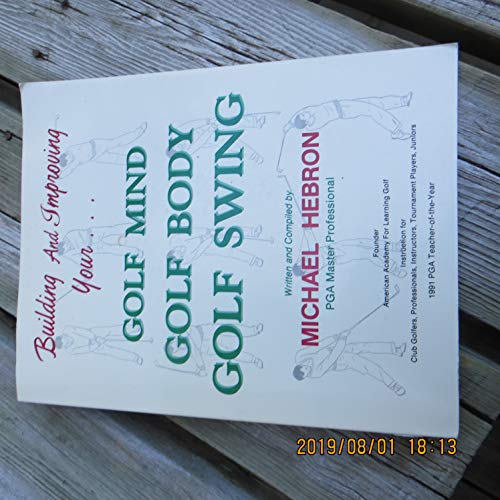
Building and Improving Your.Golf Mind, Golf Body, Golf Swing
Hebron, Michael Michael Hebron,
ISBN 10: 0962021423 ISBN 13: 9780962021428
Published by Smithtown Landing Country Club -, 1993
Used
paperback
From
Bahamut Media, Reading, United Kingdom
Seller rating 4 out of 5 stars

AbeBooks Seller since August 15, 2012
This book is no longer available. AbeBooks has millions of books. Please enter search terms below to find similar copies.
About this Item
Description:
Shipped within 24 hours from our UK warehouse. Clean, undamaged book with no damage to pages and minimal wear to the cover. Spine still tight, in very good condition. Remember if you are not happy, you are covered by our 100% money back guarantee. Seller Inventory # 6545-9780962021428
Synopsis:
The quintessential manual for golf instructors, coaches and curious minds of any sport. This manual, filled with powerful photos and drawings, is a must for any serious golfer's bookshelf. Each of the 3 sections is a manual in and of itself. Hebron shares a lifetime of extensive research on the sports mind and body, then relates the information to the golf swing. By understanding the roll of each moving and thinking part in a motor skill, readers are placed in a position to build a golf swing (or any motor skill) that is controlled, repeatable and permanently learned. Hebron, who holds one of the first PGA Master Professional designations for golf instruction, has been recognized for his achievements through such prestigious awards as The Horton Smith Trophy, PGA Teacher of the Year, Golf Magazine's Top 50 Instructors in America and voted by his piers as one of the Top 5 Instructors in America according to Golf Digest. 420 pages (8 1/2" X 11")
Excerpt. © Reprinted by permission. All rights reserved.: Golf Mind-Golf Body-Golf Swing, by Michael Hebron(c) GOLF MIND CHAPTER SAMPLE THE CONTEXTUAL MODEL TRANSLATED FOR LEARNING GOLF Past Assumptions &
Suggested New Approaches Approaches For Learning Golf
For Learning Golf Treatment of symptoms
Search for patterns and root of poor golf
causes plus treatment of symptoms.
Look for one cause.
Integrated concerns with the
whole learner and swing. Emphasis on a quick fix.
Emphasis on long range goal. Poor golf and causes are
Poor golf and causes are wholly negative.
information about conflict,
disharmony. Primary intervention with
Minimal intervention and drills, lessons, and practice
only with "appropriateattempting to teach motor
technology." Supporting skills.
non-invasive techniques that
support the learning process. Body and swing seen as
Body seen as a dynamic machine in good or bad
system and swing and field repair.
of energy, within other fields. Poor performance seen as
Understanding the difference poor learning.
between learning and
performance, and not evaluating
performance when learning. Emphasis on eliminating.
Emphasis on achieving
maximum potential. Learner is dependent on
Learner is (or should be) instructor.
responsible. Professional is authority.
Professional is therapeutic
partner and support system. Body and mind are separate.
Body/mind are not separate. We
must improve and treat both
equally. Mind is secondary factor in
Mind is primary but coequal in body and swing dysfunction.
all body and swing dysfunction. Placebo effect shows the
Power of Suggestion shows power of suggestion.
the mind's role in both
dysfunction and healing. Primary reliance on swing
Primary reliance on objective information.
information, including learners.
Objective laws of learning, laws
of motion, biomechanics and
physics. Progress based on swing
Progress is synonymous with information, drills, and
wholeness, work habits, practice.
relationships, goals, body-mind
spirit, swing information, diet,
exercise, drills, and practice. All
influence progress. GOLF BODY CHAPTER *
The human body is built for range of motion advantages not force advantages. 0
A lever creates a mechanical advantage. The body is basically a Class III Lever System where the force (motive) is greater than the resistance from the momentum of the system. The resistance arm will be moved very fast and great distances when the motion force moves slow and a short distance. 0
The upper body is designed for reaching and throwing, the heavier more stable lower body is designed for weight bearing. 0
The thorax, vertebra column and pelvis make up the trunk. 0
Probably the most significant functional unit of the body, from the biomechanical point of view, is the vertebra column. It provides the foundation for most movement of the body and its extremities. 0
Small amounts of rotation of one vertebra is passed to the next to make it possible for a fairly large amount of trunk rotation. 0
During striking activities, the vertebra movements function not only to contribute force for the movement, but also to position and reposition the extremities. 0
The prevalent movements of the vertebra column are transverse rotation of the trunk and lateral flexion. 0
Training programs for striking skills should include strength and power training for the transverse rotation of the vertebra column. 0
Transverse rotation for the vertebra column combines with pelvic medial rotation to initiate acceleration of the arms. This rotation has also been shown to play a major role in producing high velocity of digital end links. 0
The "S" shape curves in the vertebra column are not present at birth, they develop as infants crawl and begin to walk. 0
The muscles that can produce rotation of the pelvic at the hip are the same ones that can produce medial rotation of the thigh. GOLF SWING CHAPTER THROW-AWAY Any breakdown of a flat left wrist before or during impact will cause a loss of power (club head throw away). Until a player knows how to avoid this condition (consciously or subconsciously) power golf is impossible. Working on anything else is a waste of time. Some reasons for throw-away are: * The urge to move the club head from the wrist often caused by poor rotation (ex.: when the handle of the whip stops rotating the whip passes the handle). * Over Acceleration - when acceleration is not constant, excessive hand speed throws the club head into release orbit prematurely. Proper speed may feel incredibly slow, especially from the top. A surprising low sustained acceleration of the lever system is what's needed. * Trying to line the club face up at impact from the wrists false wrist action forces the left wrist to bend (stop) and the right wrist to flatten. * Any straightening of the right (elbow) forearm before impact causes the right wrist to flatten and left wrist to bend. * Trying to have the club face square to the target at impact will cause the left wrist to bend. * Trying to impact the back of the ball at impact will cause the right wrist to flatten and the left to bend. * Trying to move the clubhead in a straight line before or after impact causes club head throw-away.
"About this title" may belong to another edition of this title.
Bibliographic Details
Title: Building and Improving Your.Golf Mind, Golf ...
Publisher: Smithtown Landing Country Club -
Publication Date: 1993
Binding: paperback
Condition: Very Good
AbeBooks offers millions of new, used, rare and out-of-print books, as well as cheap textbooks from thousands of booksellers around the world. Shopping on AbeBooks is easy, safe and 100% secure - search for your book, purchase a copy via our secure checkout and the bookseller ships it straight to you.
Search thousands of booksellers selling millions of new & used books
New & Used Books

New and used copies of new releases, best sellers and award winners. Save money with our huge selection.
Rare & Out of Print Books
From scarce first editions to sought-after signatures, find an array of rare, valuable and highly collectible books.