
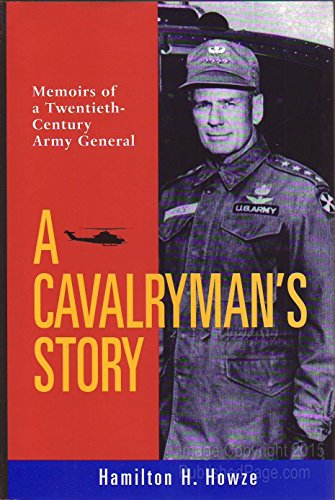
CAVALRYMANS STORY
Howze, Hamilton H.
ISBN 10: 1560986646 ISBN 13: 9781560986645
Published by Smithsonian, 1996
Used
hardcover
From
HPB Inc., Dallas, TX, U.S.A.
Seller rating 5 out of 5 stars

AbeBooks Seller since September 15, 2017
This specific item is no longer available.
About this Item
Description:
Connecting readers with great books since 1972! Used books may not include companion materials, and may have some shelf wear or limited writing. We ship orders daily and Customer Service is our top priority! Seller Inventory # S_464592439
Synopsis:
The retired general's memoir chronicles the story of a professional soldier born into West Point lineage, and today recognized as the father of US Army Airmobile tactics. Howze recaptures his experiences in World War II, and his work beginning in the 1950s to create a sky cavalry, replacing ground vehicles with helicopters. The life story portrays a "gentleman officer" in a modern army, and conveys some of the military's absurdities without a critical stance. Includes black and white photographs. Annotation c. by Book News, Inc., Portland, Or.
Reviews:
Howze began his career in the clubby, polo-playing world of the Horse Cavalry in the 1930s and went on to become a hard-bitten, tank-fighting colonel during World War II. Much later, after receiving his first star, he took to the air and became the army's first director of aviation, pioneering its current airmobile tactics and doctrines. Rather than simply retelling tales of derring-do, Howze commands interest throughout his book by means of his own personality and observations; the reader ends up genuinely liking him and his comrades. He is also a fascinating example of the nation's old-line military aristocracy. Howze's ancestors were well known to Lee, Sherman, and Teddy Roosevelt, and he himself served as the real-life model for the character Triple H. Howard in W.E.B. Griffin's currently popular fiction series "Brotherhood of War." Highly recommended for all public and professional collections.
Raymond L. Puffer, U.S. Air Force History Prog., Edwards Air Force Base, Cal.
Copyright 1996 Reed Business Information, Inc.
Howze's life nearly spans the century, and his career spanned three wars--World War II, Korea, and Vietnam. Best known as the first Director of Army Aviation and chair of the Howze Board, which developed the modern concepts of air mobility, he had a distinguished career with mounted cavalry, armor, airborne infantry, staff appointments, and both corps and army commands. He tells the whole story plainly but well, seasoning it with numerous shafts of gentle, dry, engagingly self-deprecating wit. Throughout shines his pride in service, country, and lineage (two ancestors won the Medal of Honor), and he leaves readers feeling that he did his duty, served his country, and kept his honor as a West Pointer is supposed to do, although many do not. Roland Green
"About this title" may belong to another edition of this title.
Bibliographic Details
Title: CAVALRYMANS STORY
Publisher: Smithsonian
Publication Date: 1996
Binding: hardcover
Condition: Very Good