Synopsis
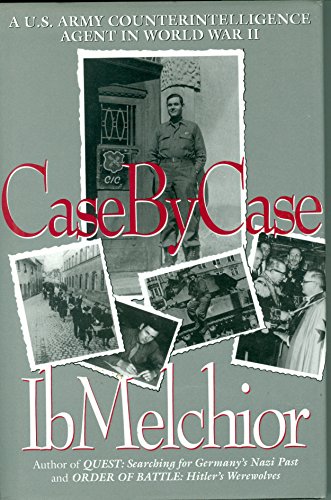
Recounts how CIC agents were trained, searched out spies and saboteurs, and worked behind enemy lines
Reviews
Melchior's WW II adventures as an Army counterintelligence agent in the European Theater of Operations included escorting a defecting German scientist through the lines and capturing a Nazi general. He admits that "working constantly with informers and saboteurs, spies and war criminals, made it difficult not to become callous," and he doesn't hesitate to recount the bullying tactics he used to force prisoners to talk. Most of the displaced persons, fugitives, miscreants and war criminals he dealt with are presented here as thoroughly loathsome--either obsequious jellyfish or bristling with Nazi arrogance. Despite its disagreeable aspects, however, the memoir is engaging, especially when Melchior recalls the interrogation techniques he devised and the imaginative schemes by which Nazis tried to escape arrest or obtain preferential treatment. Melchior is the author of Order of Battle: Hitler's Werevolves. Photos.
Copyright 1993 Reed Business Information, Inc.
An absorbing memoir of the Danish-born author's WW II experiences with the American military, which obviously provided a starting point for the many thrillers he later wrote as a civilian (Code Name: Grand Guignol, 1987, etc.). When the Japanese bombed Pearl Harbor, Melchior was working as a stage manager at Radio City Music Hall. Having already decided to become a US citizen, the multilingual author volunteered his services to the armed forces. Melchior, then 24, was rigorously trained by the OSS and subsequently assigned to the Army's Counterintelligence Corps. He eventually spent two years in the ETO, advancing with Allied troops from Normandy through France, Luxembourg (during the Battle of the Bulge), and Germany as far as the Czechoslovakian border. In the course of an eventful tour, the author proved cunning as well as effective in his pursuit of collaborators, high-ranking Nazis, saboteurs, spies, war criminals, etc. While much of his work as a field investigator was routine (e.g., screening displaced persons, discharged soldiers, undocumented travelers, or local pols whose backgrounds qualified them for office in the interim governments established by the American military), he was a party to a full ration of dramatic moments. Among other accomplishments, he and fellow operatives uncovered a band of so-called Werewolves (Wehrmacht fanatics left behind the lines to engage in terrorist acts against the populist and invasion forces). He also helped unearth stolen art treasures and caches of contraband weapons while unmasking any number of SS personnel (subject to mandatory arrest) who posed as refugees to evade capture. In 1990, Melchior and his wife retraced the route he took through Europe when it was being liberated. His brief account of this sentimental journey adds considerable resonance to a narrative already rich in anecdotal detail and high adventure. (Illustrations--not seen.) -- Copyright ©1993, Kirkus Associates, LP. All rights reserved.
Real-life spy and counterespionage stories always seem more satisfying than the most skillfully contrived fiction. In this book, action novelist Melchior recalls the World War II experiences that furnished the grist for his own thrilling titles like Order of Battle: Hitler's Werewolves (Presidio, 1991). Volunteering as a professional intelligence agent, he underwent intricate and devious training before being sent to operate on both sides of the enemy lines in France and Germany. Forty years later he revisited the sites of his clandestine activities. Numerous fascinating details of the creation, deployment, and field operations of the Allied intelligence framework make this a fast-moving and exciting book for serious military collections as well as the adventure shelves.
- Raymond L. Puffer, U.S. Air Force History Prog., Los Angeles
Copyright 1993 Reed Business Information, Inc.
"About this title" may belong to another edition of this title.