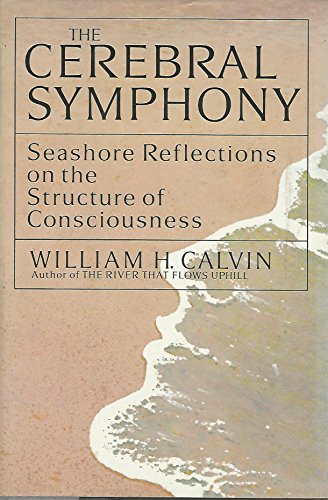
Neurobiologist William Calvin explores the human brain, positing that the neurons in the brain operate in an accelerated version of biological evolution, evolving ideas through random variations and selections, and supports his hypothesis with numerous case studies
William H. Calvin is a theoretical neurophysiologist, Affiliate Professor of Psychiatry and Behavioral Sciences, University of Washington School of Medicine. His research monograph,
The Cerebral Code: Thinking a Thought in the Mosaics of the Mind (MIT Press, 1996) concerns darwinian processes that can operate on the time scale of thought and action to resolve ambiguity and shape up novel courses of action. He recently returned from a stay at the Rockefeller Foundation's study center in Bellagio, Italy, collaborating with the linguist Derek Bickerton on their forthcoming book (MIT Press 1999) about the evolution of syntax,
Lingua ex machina: Reconciling Darwin and Chomsky with the Human Brain.
He also writes books for general readers, the most recent of which is How Brains Think, in the widely-translated Science Masters series. The Throwing Madonna, The Cerebral Symphony, and The Ascent of Mind are about brains and evolution. The River That Flows Uphill is about a two-week float trip down the rapids of the Colorado River in the bottom of the Grand Canyon, discussing evolution on the broad scale proclaimed by the book's subtitle, "A Journey from the Big Bang to the Big Brain." In Conversations with Neil's Brain, written with his neurosurgical colleague George Ojemann, he narrates a long day of neurosurgery for epilepsy, telling stories about how the brain works but focusing on how an internal voice is generated, one that occasionally speaks aloud. His October 1994 Scientific American article explores "The emergence of intelligence" and his January 1998 cover story for The Atlantic Monthly, "The great climate flip-! flop," grew out of his long-standing interest in abrupt climate change and how it influenced the evolution of a chimpanzeelike brain into a more human one.
He started out in physics at Northwestern University, then branched out into neurophysiology via studies at MIT, Harvard Medical School, and the University of Washington (Ph.D., Physiology & Biophysics, 1966). He has had a long association with academic neurosurgeons and psychiatrists without ever having to treat a patient.