Synopsis
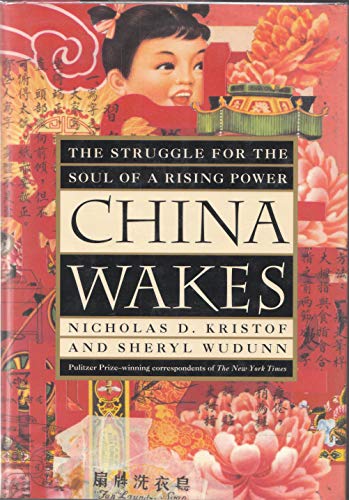
Two Pulitzer Prize-winning Beijing correspondents for The New York Times examine the evolution of China as it struggles for economic and political power, providing a fascinating portrait of the human implications of recent Chinese events. 40,000 first printing. Tour.
Reviews
In one of the best books on contemporary China, Kristoff and WuDunn ponder a central paradox: an explosion of wealth and entrepreneurship in the world's third biggest economy (after the U.S. and Japan) flourishes under a repressive, authoritarian regime. This husband-and-wife team, Pulitzer Prize-winning Beijing correspondents for the New York Times from 1988 to 1993, take us from the Xinjiang region in China's far west, where an Islamic revival threatens Party rule, to occupied Tibet seething with hatred for the Chinese overlords. They report on widespread alienation from the government, massive rural poverty, rampant bribery and corruption, increasing discrimination against women in the workplace, routine abduction and trafficking in women and children. The authors also perceive "the embryo of a civil society" emerging that may one day undermine the dictatorship. WuDunn, who is Chinese-American, writes of her sometimes frustrating search for her native identity in a regimented society pervaded by a "culture of silence." Photos. Author tour.
Copyright 1994 Reed Business Information, Inc.
A vivid and thoughtful portrait of China by a Pulitzer Prize- winning husband-and-wife team of New York Times correspondents formerly in Beijing. Allowing for the complexity of the task, and for the sad record of China watchers (almost all of whom, for example, were unaware of the greatest man-made famine in history, which followed the so-called Great Leap Forward at the end of the 1950s and killed 30 million people), Kristof and WuDunn puzzle over the great paradox of present-day China: that, amid all the signs of a dying political dynasty, there flourishes one of the most buoyant economies in the world. All the signs of the death of the Communist Party era are visible: the alienation of the people; the loss of belief in the ideology even among the Party elite; the loss of control over information; and the growth of competing centers of power. It is a regime that has ``the worst public relations sense of any major government in the world'' and is ``too corrupt, too rotten, to be very successful at being totalitarian.'' And yet, in bringing industry to the rural areas, Deng Xiaoping unleashed a second agricultural revolution which--largely by removing Party control and instituting a regime closer to that of Dickensian England--brought about an annual growth rate of 13% in 1992 and 1993. This rate, as the authors point out, is unsustainable, but it has already raised more than 100 million Chinese out of poverty. With due recognition of the fallibility of the experts, the authors think that the most likely scenario is one of peaceful evolution, along the lines of Taiwan. The authors may not always be quite as skeptical of statistics as one would like, but this is a hard-headed, clear analysis filled with anecdote and vivid reportage. -- Copyright ©1994, Kirkus Associates, LP. All rights reserved.
This thought-provoking analysis of daily life in China is the first book to rival Fox Butterfield's China: Alive in the Bitter Sea (LJ 4/15/82). All the authors are New York Times correspondents, but while Butterfield did five years of graduate work in Asian studies, Kristof graduated from law school and WuDunn has an MBA and a master's degree in public administration. As a result, they analyze China in terms of its progress in the areas of civil rights and business. The authors argue that today's leaders are remarkably similar to those of past dynasties but that, given their entrepreneurial energy, Chinese people are living better now than ever before. In interviews with many different types of people, Kristof and WuDunn (who won a Pulitzer Prize for their reporting on the Tiananmen Square massacre) observe that Chinese society is changing slowly in the face of much blatant injustice. On a positive note, they see China as a nation that is beginning to appreciate the benefits of law over imperial rule. Highly recommended.
--Peggy Spitzer Christoff, Oak Park, Ill.
Copyright 1994 Reed Business Information, Inc.
"About this title" may belong to another edition of this title.