Synopsis
Illustrates the life and struggles of American artist Chuck Close, who overcame learning disabilities as a child and fought paralysis as an adult to become a celebrated portrait painter with works appearing at New York's Museum of Modern Art.
Reviews
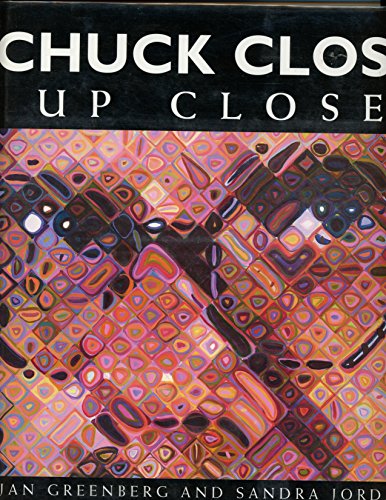
Grade 3 Up?Based on interviews, this is an inspiring look at the contemporary artist who struggled with learning disabilities as a youngster, became a celebrated painter in the late 1960s, and later overcame paralysis to continue creating huge portraits in which the image is created by a multitude of small abstract units. Sometimes Close makes the abstract units by inking his finger and pressing it on the canvas over and over. His way of working, as it developed from photorealism to his current unique style, with its relationship to computer art and photomechanical reproduction, is inherently interesting, while the way his portraits almost magically seem to emerge as one gets far enough away from the canvas is clearly shown in the excellent-quality full-color reproductions. Close's story is doubly inspiring, both for the discipline he has developed and for the importance in his life of friends and family. There is enough information for reports, but the book is engaging enough for pleasure reading. Also included are an essay, "What Is a Portrait?" illustrated with works by other artists; a bibliography (all adult titles); and a list of museums that have works by Close. Individual biographies of contemporary artists are still rather scarce. This one has more information than Mike Venezia's Jackson Pollock (1994) or Andy Warhol (1996, both Children's), and lacks the irreverent cartoons of those titles. Viewers will be instantly captured by the cover of this book, a detail of just the eyes and nose of one of Chuck Close's distinctive self-portraits.?Pam Gosner, formerly at Maplewood Memorial Library, NJ
Copyright 1998 Reed Business Information, Inc.
On the heels of John Guare's biography for adult readers, Chuck Close: Life and Work 19881995 (1995)--which covers Close's work since 1988, when a collapsed spinal artery left Close paralyzed below the shoulders--comes a biography from Greenberg and Jordan (The American Eye, 1995, etc.) that profiles the artist's entire life. As a child, art rescued Close from the frustrations of learning disabilities that made school a struggle; he developed ``painstaking discipline'' that helped him paint later in life, even when physical disabilities threatened to end his career. As in their other collaborations, the authors meld the artist's biography with their readings of his art. Close's feelings for his friends are conveyed through his gargantuan portraits of them and his multiple interpretations of their photographs. Full-color illustrations show both finished works, and the processes through which they are made, including scenes of Close on the forklift he uses to move around the canvas. In closing with a chapter on the history of portraiture that compares Close's works to those of other painters, the volume captures both the originality of Close's artwork, and the steady gifts of its creator. (glossary, bibliography) (Biography. 14+) -- Copyright ©1998, Kirkus Associates, LP. All rights reserved.
Gr. 4^-7. In a new joint venture, the authors of The Painter's Eye: Learning to Look at Contemporary American Art (1991) focus their attention on one of America's better-known contemporary artists. References to Close's wife and daughters, his learning disability, and the paralysis that put him in a wheelchair are here, but this is not a strictly chronological catalog of the specifics of his life; rather, it is a sketchy, somewhat uneven profile, but one that is full of energy and spirit, thanks in part to the inclusion of Close's own words. The real focus seems to be the artist's work (he's best known for his gigantic portraits) and what led Close to his particular choices of subject and style. As in the best adult art books, the pages here are slick and shiny, and the reproductions are excellent and intriguingly varied--from a striking detail taken from a self-portrait and a full-page head shot to a thumbnail sequence of photos picturing the artist at work in his studio. Broadening the value of the book for both budding artists and teachers is a brief discussion of portraiture, contributed by the authors. A tantalizing introduction to both the person and the art, this will leave readers eager to find out more; a short bibliography will help them get started. Stephanie Zvirin
"About this title" may belong to another edition of this title.