Synopsis
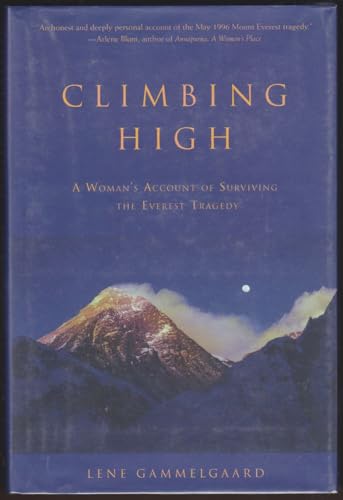
On May 10, 1996, Lene Gammelgaard became the first female Scandinavian climber ever to make it to the top of Mount Everest. By nightfall, however, treacherous weather and human error conspired to turn triumph into catastrophe. Eight climbers, including her team leader and longtime friend, Scott Fischer, would ultimately perish. This gripping account, illustrated with photos, recounts vividly the author's experiences on Everest -- including the horrible night she spent huddled in the death zone with seven other climbers -- and puts the 1996 tragedy in a new perspective. Unlike Jon Krakauer, Gammelgaard was part of Fischer's team, and she sheds new light on this legendary climber's larger-than-life personality and leadership during the ascent. And unlike other climbers who wrote about the tragedy, Gammelgaard was an amateur whose only agenda was to conquer Everest.
Reviews
Months before John Krakauer's Into Thin Air conquered bestseller lists, Gammelgaard, a member of the 1996 Mountain Madness Mt. Everest expedition, wrote an account of the catastrophe that became a bestseller in Denmark and is at last available in English. Those who have followed the controversy surrounding the tragedy will welcome this even-handed version. A lawyer and psychotherapist, Gammelgaard intended to become the first Scandinavian woman to climb Everest. Her physical and mental training for a grueling ascent without oxygen (a publicity stunt that was later aborted) may have saved her life: she climbed quickly and reached the summit early. During the team's descent in the deadly snowstorm, she was also able to trade her full canister of oxygen for a weaker teammate's nearly empty one. Gammelgaard offers keen insights into the motivations and characters of the lead climbers and guides, and frankly discusses the "megalomania" that drove her to risk her life. Dismissing accusations that hers was a glamour expedition for wealthy amateurs, she emphasizes that her co-climbers were accomplished mountaineers and that the high price of admission paid for the best quality food, equipment and support team. Still, she has powerful regrets about the loss of life, confessing, "I just didn't know how high a price the Mother Goddess of the World would exact to show us humans the consequences of hubris." Photos. 7-city author tour. (July)
Copyright 1999 Reed Business Information, Inc.
The Everest mill continues to grind the grist of May 1996, and the results get thinner and thinner, as witness this humorless, more-cosmic-than-thou account, from a Danish psychotherapist and writer. Gammelgaard relates here her preparation for, and then climb of, Mount Everest as part of the Mountain Madness group that ran into what has become history's most chronicled bit of heavy weather. The only new material she offers to readers who have had any exposure to the debacle (via Jon Krakauers bestselling Into Thin Air and other accounts) are insights into her own motivations and emotions, which she serves up in relentless and obnoxious detail. She describes herself as a ``gypsy and an adventurer,'' a ``wild animal'' who finds the Nepalese ``so little that a huge Danish machine like myself could probably take on a couple at a time.'' To soften the impact of hero personality, she sprinkles vapid spiritualisms: ``I am focused. Balanced'' and ``I seek solitude, to connect with inner peace. Tai Chi among the giants of the universe. Belonging. Absolute serenity.'' And few storms rival her blizzard of platitudes: ``The one who doubtswants not. / The one who wantsdoubts not,'' she informs us, and ``visions have to be transformed into reality, otherwise they are nothing but illusion,'' and ``It's better to be a genuine friend than greedy.'' Perhaps the most remarkable aspect of the book is that Gammelgaard wrings not a whit of suspense out of her perilous hours lost with her climbing partnersin the dark, in a blizzard with hurricane winds, within feet of one of the world's longest sheer drops. A forgettable fog of blather and self-indulgence. (photos, not seen) -- Copyright ©1999, Kirkus Associates, LP. All rights reserved.
The events of May 1996 put Mt. Everest back in bold headlines. The attention of a jaded public was recaptured by the deaths of eight people, including two of the world's foremost climbers, and the subsequent accusations that Everest had become a "trophy" peak available to the highest bidder. The first book to emerge from this tragedy was Jon Krakauer's superb Into Thin Air (LJ 4/1/97), but it was only a matter of time before other personal accounts began to appear. Breashears, an accomplished cinematographer, was approached by the IMAX Corporation with the incredible assignment to film an ascent of Everest. Anyone who has seen the finished product knows that Breashears produced an outstanding film, but his account of its making during Everest's deadliest climbing season ever is equally breathtaking. In a calm, almost detached manner, he describes the first stirrings of unease he felt when he saw the climbers, many of them woefully inexperienced, getting ready to make the ascent. His story reflects little of the heroism he and his crew showed as they shared their resources with other groups that found themselves in serious difficulty. His account of the tragedy is viewed through the eye of a cinematographer, riveting in its simplicity. Dickinson, another filmmaker, was there as part of a British team; right up front, he tells readers that he is not an expert climber. His account is the one that will appeal to readers who come no closer to climbing Everest than reading a book. His skill with words and his obviously deep respect for his mission adds a personal touch that will give readers a vicarious thrill. Gammelgaard's book appeared first in her native Denmark. She presents her information almost in the form of a diary, using brief paragraphs and intensely personal observations. There is a feminist/ ethnocentric slant to her writing; many of her comments reflect her being a woman and a Dane in a sport dominated largely by men and Americans. She was also part of the ill-fated Scott Fischer team that many felt had "bought" their way to Everest. She describes her personal feelings about the enigmatic Fischer, including the traits that eventually led to his death. Beyond Krakauer's title, Dickinson's book would be the best choice, followed by Breashears's and Gammelgaard's. All three are well written and will give readers a sense of what it feels like to punish one's body to an unbelievable degree for the thrill of standing on top of the world. [Breashears's book was previewed in Prepub Alert, LJ 1/99.]AJoseph L. Carlson, Lompoc, C.
-AJoseph L. Carlson, Lompoc, CA
Copyright 1999 Reed Business Information, Inc.
On 10 May_ 1996, Gammelgaard became the first Scandinavian woman to summit Mount Everest and deserves accolades for her triumph, which was overshadowed by the death of fellow mountaineers during a horrendous blizzard. Taken from Gammelgaard's brief journal entries, Climbing High is best when exploring her philosophical views ("Sometimes the true victory is to let go, to be capable of turning around in due time without suffering defeat") and experiences as a woman or questioning the role of personal and family responsibilities. She survives the ascent by sheer determination and repeating her mantra, "To the summit and safe return," and concludes with her lesson learned, "to never again expose myself to that amount of objective risk. Never!" The first half is more interesting than the second--no doubt, hindered by the adverse conditions--leaving one curious for more details. Those clambering for yet another viewpoint of the 1996 Mount Everest disaster can add this emotionally less revealing account to Jon Krakauer's Into Thin Air (1997) and Anatoli Boukreev's The Climb (1997). Sure to inspire women climbers. Brenda Barrera
"About this title" may belong to another edition of this title.