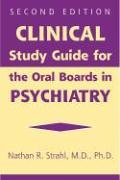
The Clinical Study Guide for the Oral Boards in Psychiatry, Second Edition, is exactly what every candidate needs to ease pre-exam anxiety and ensure success on this crucial examination.
The second edition of this unique and proven reference incorporates the updated diagnoses reflected in DSM-IV-TR, presenting pertinent clinical information regarding the assessment and treatment of patients you're most likely to encounter during the oral boards in psychiatry--all in a concise study guide that offers practical guidance on how to succeed on this rigorous examination.
This new edition retains its predecessor's easy-to-use 10-chapter format and breakthrough perspective. In both editions, the author emphasizes that candidates are being tested not on their proficiency in making a single accurate diagnosis (or a diagnosis that agrees with that of the examiners) but rather on their ability to formulate a differential diagnosis--that is, on their reasoning skills and their ability to recognize, during even a short patient interview, that many diagnoses are possible.
But you won't pass this exam on knowledge alone, as this author explains. You'll also need to demonstrate insight, included in the following four key success factors, by
• Understanding that the exam measures their clinical, not theoretical, knowledge of psychiatry. • Preparing thoroughly (for example, if you mention a specific medication, be ready to discuss its indications, dosage range, and therapeutic and side effects). • Showing empathy for the patient by taking a few moments to establish rapport and using reassuring statements that show care and compassion. • Being open and direct in a manner that fosters a collegial--not an inadvertently adversarial--relationship with the examiners.
As in the first edition, the author thoughtfully includes algorithms for “middle-of-the-road” treatment protocols--especially useful if you have only limited experience with a particular patient group.
By combining its distinct advantage over lengthier psychiatry textbooks and references with both the knowledge and the insight so essential to success on this crucial exam, this compact volume proves once again that it is, quite simply, the definitive study guide for all oral board examination candidates.
Nathan R. Strahl, M.D., Ph.D., is a Consulting Associate in the Department of Psychiatry and Behavioral Sciences at Duke University Medical Center in Durham, North Carolina.