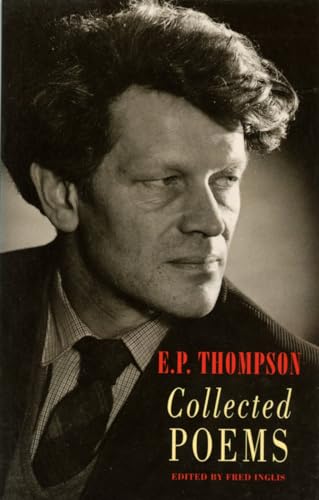
Synopsis
To many, E.P. Thompson is the writer of the Cold War, the outstanding voice of heart and reason, crying out against the obscenity and unreason of the war. One of Britain's leading Marxist historians, he re-wrote our concept of history in The Making of the English Working Class, and made major contributions to political protest in such works as The Poverty of Theory, Writing by Candlelight, and Protest and Survive. His poetry has been overshadowed by the political writings, yet they exhibit the same incisive and spellbinding qualities. In the poems, Thompson's vision encompasses tenderness and sardonic anger, rage and hatred, epic grandeur and grand wit. For Thompson, as for T.S Eliot, the language of history and the language of politics were one and the same. His poetry too, renews old speech to keep it speakable.
Reviews
Thompsons social consciousness is evident in his poetry as early as 1940 (when he was still at school) and remained the dominant feature in all his writing until his death in 1993. His major prose worksstudies of William Morris and William Blake, and a history of the English working classwere written out of a need to understand the big picture of political and literary history. Editor Inglis provides a select bibliography and helpful introductory essay, in which he characterizes Thompson as an old-fashioned, English radical of letters and calls him the writer of the Cold War. In his public work Thompson waved the banner for social justice, yet he understood poetry to be the ultimate technique for telling truths about the soul in all its nakedness. Although there is polemic in the poems, the naked soul is often visible, as in My Study: Even the little dogmas do not bark. / I leave my desk and peer into the world. / Outside the owls are hunting. Dark / Has harvested the moon. Imperial eyes / Quarter the ground for fellow creaturehood: / Small as the hour some hunted terror cries. / I go back to my desk. If it could fight / Or dream or mate, what other creature would / Sit making marks on paper through the night?Although Thompsons reputation may ultimately rest on his prose writings, his poetry is a pertinent reminder that poetry can address major social and political themes without forfeiting its ability to speak toand forthe eternal verities of the human heart. -- Copyright © 2000 Kirkus Associates, LP. All rights reserved.
Thompson (1924-1993) stands tall among social historians and in the pantheon of the British Left: The Making of the English Working Class (1963) made him a giant for the former, and his frequent political essays, books and pamphlets in the '70s and '80s gave him a commanding voice in the latter. Few of his fans will have known much of his poetry; this volume assiduously gathers it all, beginning with Thompson's schoolboy verse of the early '40s, then following up with his skillful, morally charged imitations of Auden, MacNeice and the Eliot of Four Quartets. From the early '50s to the '70s, Thompson wrote only six poems (the best responds with acid incredulity to the 1956 invasion of Hungary). High claims for his poetry will rest instead on two later sequences. "Powers and Names" (1986) turns the career and the archeological evidence of a malevolent Chinese Emperor into a general essay on politics, oppression and freedom; here his harsh language and storytelling cadences have a power like that of the late Ted Hughes. But Thompson's best work is "Infant and Emperor" (1983), which retells the story of the Annunciation, the Nativity and the Flight into Egypt. Thompson uses a panoply of verse forms--stanzaic ode, mock-choral song, Blakean mystical narrative, metrical psalm--to make the story of the infant Christ yield meditations on politics, violence, ethics, religious sensibility and humanist hope. Readers who get past some obvious echoes of Auden will find in this sequence verbal subtlety and moral power: readers of English history and politics will want to know about the whole volume, which reveals yet another talent of this authoritative figure. (Apr.)
Copyright 2000 Reed Business Information, Inc.
"About this title" may belong to another edition of this title.