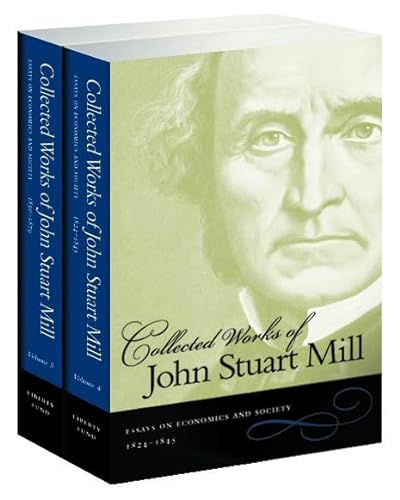
Liberty Fund is pleased to make available in paperback eight of the original thirty-three cloth volumes of the Collected Works of John Stuart Mill that were first published by the University of Toronto Press that remain most relevant to liberty and responsibility in the twenty-first century. Born in London in 1806 and educated at the knee of his father, the Scottish philosopher James Mill, John Stuart Mill became one of the nineteenth century’s most influential writers on economics and social philosophy.
Primarily of interest to economists is Mill’s Essays on Economics and Society, in which he writes on the most compelling economic problems and social concerns brought about by the rapidly industrialized nineteenth-century Britain.
John Stuart Mill (1806–1873) was an economist, philosopher, Member of Parliament, and one of the most significant English classical liberals of the nineteenth century. Mill spent most of his working life with the East India Company, which he joined at age sixteen and worked for for thirty-eight years. He is also the author of On Liberty (1859), Utilitarianism (1861), and The Subjection of Women (1869).
John Stuart Mill was an English philosopher, politician and economist most famous for his contributions to the theory of utilitarianism. The author of numerous influential political treatises, Mill s writings on liberty, freedom of speech, democracy and economics have helped to form the foundation of modern liberal thought. His 1859 work, On Liberty, is particularly noteworthy for helping to address the nature and limits of the power of the state over the individual. Mills has become one of the most influential figures in nineteenth-century philosophy, and his writings are still widely studied and analyzed by scholars. Mills died in 1873 at the age of 66.