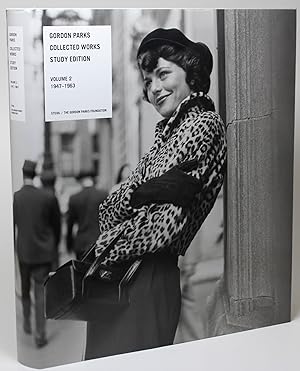
Synopsis
This five-volume collection surveys five decades of Gordon Parks' photography. It is the most extensive publication to document his legendary career. Widely recognized as the most important and influential African-American photographer of the twentieth century, Parks combined a unique documentary and artistic style with a profound commitment to social justice. Working first for the Farm Security Administration and later for Life magazine, he specialized in extended narrative picture stories on difficult subject matter. Covering crime, poverty, segregation, the politics of race and class and controversial personalities, Parks became legendary for his ability to meld penetrating insight with a lyrical aesthetic. He was thus able to introduce a broad and diverse public to people, issues and ideas they might otherwise have ignored. Parks was remarkably versatile, travelling the world to photograph news events and fashion, as well as the worlds of art, literature, music, theatre and film. Later in life, he reconceived his vision in fundamentally personal and poetic terms, producing color photographs that were allusive rather than descriptive, symbolic rather than literal.
About the Author
Gordon Parks, born into poverty and segregation on a farm in Kansas in 1912, was the youngest of 15 children. He worked at odd jobs before buying a camera at a pawnshop in 1938 and training himself to become a photographer. Parks was a photographer at the Farm Security Administration and later at the Office of War Information in Washington D.C. from 1941 to 1945. As a freelance photographer, his 1948 photo essay on the life of a Harlem gang leader won him widespread acclaim and a position from 1948 to 1972 as the first black staff photographer and writer for Life Magazine, the largest circulation picture publication of its day. He was also a noted composer and author, and in 1969, became the first African American to write and direct a Hollywood feature film, The Learning Tree, based on his bestselling novel of the same name. This was followed in 1971 by the hugely successful motion picture, Shaft. Parks was the recipient of numerous awards, including the National Medal of Arts in 1988 and over 50 honorary doctorates. Parks died in 2006 at the age of 93.
"About this title" may belong to another edition of this title.