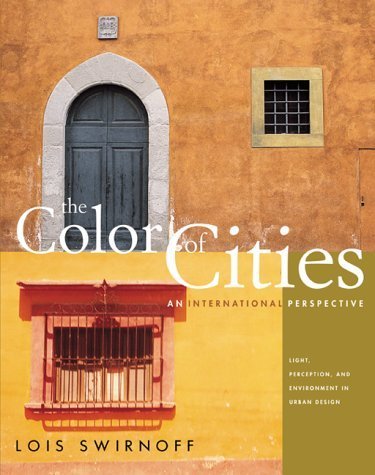
Swirnoff ( Dimensions of Color ) has specialized in the three-dimensional use of color in her career at several universities. Here she explores how colors work in cities around the world, with over 300 of her photographs illustrating the text. She sets out a design science of the urban environment, arguing that the perception of color in the three-dimensional environment depends on the angle of incidence of light, and so cities and towns close to the equator surface their buildings with bright or saturated colors, while those closer to the poles use warm, neutral colors. Annotation c. Book News, Inc., Portland, OR (booknews.com)
The First Major Study of Color in Urban Design. Architecture and urban design define a locale by giving it structure and form. But less obviously, and more fundamentally, color has a significant impact on the overall perception of an urban environment. The Color of Cities: An International Perspective is the first book to explore the complex interactions that inform and shape this perception. It documents the use of color in urban areas around the world, showing how color contributes to a city's unique character and appearance.
Over 300 full-color photographs support this ground-breaking work by noted color theorist Lois Swirnoff. Drawing on specific examples from cities in the United States, Europe, the Middle East, Latin America, and Asia, The Color of Cities demonstrates how local color selection is rooted in the geophysical, determined in large part by how colors originate in - and are altered by - the angle of the Sun's rays. And the book explains how the intensity of light differs globally, from the direct beam of the Equatorial regions to the angular glow of cities nearer the poles.
Using dimensional color as her premise, Swirnoff explores the links between a culture's distinctive character and its color choices, and describes how color plays a role in building the environment. You'll also see some unexpected similarities in different cities' use of color in standard urban features such as facades, streets and plazas, boundaries, and market-places. For easy reference, the book is organized according to these features, with abundant photographic appendix offers a summary overview of the color palettes of cities and locales. It all adds up to the most in-depth, most complete look at the pivotal role of color in urban design - and one you'll refer to again and again.