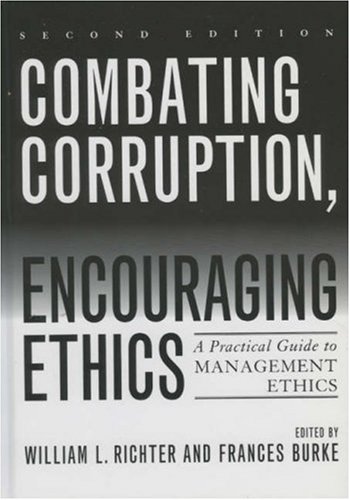
In their second edition of Combating Corruption, Encouraging Ethics, William L. Richter and Frances Burke update this essential staple to delve deeply into the unique ethical problems of twenty-first century public administration. Wide-ranging readings from Aristotle and Kant to John Kennedy and John T. Noonan provide initiation into the philosophical basis of ethics as virtue, consequence, principle, and responsibility, while new case studies drawn from today's headlines join old classics from the previous edition to help students apply ethical foundations to a modern administrative career. New chapters on privacy, secrecy, and confidentiality and the changing boundaries of public administration consider the consequences of computerization and globalization, two of this century's greatest challenges.
By seamlessly melding theory with practice, Richter and Burke have created a key resource in educating future public administrators on the ethical problems associated with corruption, deception, evasion of accountability, and the abuse of authority. Open-ended examples and discussion questions encourage students to understand the complexity of administrative ethics and the need for careful thought in their day-to-day decisions. Combating Corruption, Encouraging Ethics offers both the depth demanded by graduate courses in administrative ethics and the accessibility necessary for an undergraduate introduction to public administration.
Aristotle (384 BC – 322 BC) was a Greek philosopher, a student of Plato and teacher of Alexander the Great. He wrote on many different subjects, including physics, metaphysics, poetry, theater, music, logic, rhetoric, politics, government, ethics, biology and zoology.
KATHRYN G. DENHARDT is Visiting Assistant Professor of Public Administration at the University of Missouri at Columbia.
Amitai Etzioni is the founder and director of the Communitarian Network and University Professor at The George Washington University. He has served as a senior advisor to the White House and President of the American Sociological Association. He has taught sociology at Columbia University, the Harvard Business School, and the University of California at Berkeley. He is the author of 22 books, including The New Golden Rule, Political Unification Revisited and My Brother's Keeper: A Memoir and a Message. A recent study listed him as one of the leading hundred public intellectuals.
Stephen C. Schlesinger, JD, is fellow at the Century Foundation in New York; author of Act of Creation: The Founding of The United Nations, winner of the 2004 Harry S. Truman Book Award; former director of the World Policy Institute at the New School (1997–2006); and former publisher of the magazine The World Policy Journal.
Glenn L. Starks, PhD, holds a doctorate in public policy and administration from Virginia Commonwealth University's L. Douglas Wilder School of Government and Public Affairs. He has almost 30 years of experience working for the U.S. government and has written extensively on public administration and American politics.